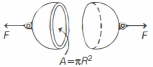
In Guericke's experiment to show the effect of atmospheric pressure, two copper hemispheres were tightly fitted to each other to form a hollow sphere and the air from the sphere was pumped out to create vacuum inside. If the radius of each hemisphere is $R$ and the atmospheric pressure is $p$, then the minimum force required (when the two hemispheres are pulled apart by the same force) to separate the hemispheres is
KVPY 2017, Advanced


Download our appand get started for free
Experience the future of education. Simply download our apps or reach out to us for more information. Let's shape the future of learning together!No signup needed.*
Similar Questions
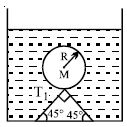
- 1A hollow sphere of mass $M$ and radius $r$ is immersed in a tank of water (density $\rho$$_w$ ). The sphere would float if it were set free. The sphere is tied to the bottom of the tank by two wires which makes angle $45^o$ with the horizontal as shown in the figure. The tension $T_1$ in the wire is :View Solution
- 2A table tennis ball has radius $(3 / 2) \times 10^{-2} m$ and mass $(22 / 7) \times 10^{-3} kg$. It is slowly pushed down into a swimming pool to a depth of $d=0.7 m$ below the water surface and then released from rest. It emerges from the water surface at speed $v$, without getting wet, and rises up to a height $H$. Which of the following option(s) is (are) correct?View Solution
[Given: $\pi=22 / 7, g=10 ms ^{-2}$, density of water $=1 \times 10^3 kg m ^{-3}$, viscosity of water $=1 \times 10^{-3} Pa$-s.]
$(A)$ The work done in pushing the ball to the depth $d$ is $0.077 J$.
$(B)$ If we neglect the viscous force in water, then the speed $v=7 m / s$.
$(C)$ If we neglect the viscous force in water, then the height $H=1.4 m$.
$(D)$ The ratio of the magnitudes of the net force excluding the viscous force to the maximum viscous force in water is $500 / 9$.
- 3View SolutionThe coefficient of viscosity for hot air is
- 4Eight equal drops of water are falling through air with a steady speed of $10\,cm / s$. If the drops coalesce, the new velocity is $.........\,cm/s$View Solution
- 5View SolutionIn old age arteries carrying blood in the human body become narrow resulting in an increase in the blood pressure. This follows from
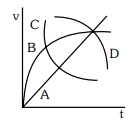
- 6A spherical ball is dropped in a long column of a highly viscous liquid. The curve in the graph shown, which represents the speed of the ball $(v)$ as a function of time $(t)$ isView Solution
- 7Water flows in a streamlined manner through a capillary of radius $'a'$, the pressure difference being $'p'$ and the rate of flow $Q$. If the radius is reduced to $'a/2'$ and the pressure increased to $'4p'$, the rate of flow becomes :-View Solution
- 8A cylindrical vessel of $90 cm$ height is kept filled upto the brim. It has four holes $ 1, 2, 3, 4$ which are respectively at heights of $20 cm, 30 cm, 45 cm $ and $50 cm$ from the horizontal floor $PQ.$ The water falling at the maximum horizontal distance from the vessel comes fromView Solution
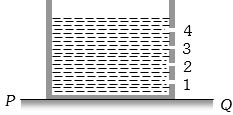
- 9A balloon of mass $m$ contains water of mass $M$ . If it is completely immersed in water, find the apparent mass of the balloon with water in itView Solution
- 10A heavy spherical ball is dropped near surface in a long column of viscous liquid. Which of the following graphs represent the variation ofView Solution
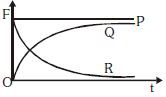
$(i)$ Gravitational force with time
$(ii)$ Viscous force with time
$(iii)$ Net force acting on the ball with time