Question
A flywheel rotates about an axis. Due to friction at the axis, it experiences an angular retardation proportional to its angular velocity. If its angular velocity falls to half while it makes $n$ rotations, how many more rotations will it make before coming to rest?

Answer

$\alpha \,is\,propotional\,to\,\omega $

$Let = \alpha  = k\omega $                       ($k$ is constant)

$\frac{{d\omega }}{{dt}} = k\omega \,\,\,\,\,\,\,\,\,\left[ {also\,\frac{{d\theta }}{{dt}} = \omega  \Rightarrow dt = \frac{{d\theta }}{\omega }} \right]$

$\therefore \frac{{\omega d\omega }}{{d\theta }} = k\omega  \Rightarrow d\omega  = kd\theta $

$Now\,\int\limits_\omega ^{\omega /2} {d\omega  = k\int {d\theta } } $

$\int\limits_{\omega /2}^0 {d\omega  = k\int\limits_0^\theta  {d\theta  \Rightarrow  - \frac{\omega }{2} = k\theta  \Rightarrow  - \frac{\omega }{2} = K{\theta _1}} } $

$\,\,\,\,\,\,\,\,\,\,\,\,\,\,\,\,\,\,\,\,\,\,\,\,\,\,\,\,\,\,\,\,\,\,\,\,\,\,\,\,\,\,\,\,\,\,\,\,\,\,\left( {{\theta _1} = 2\pi n} \right)$

$\therefore \theta  = {\theta _1}\,\,or\,\,2\pi {n_1} = 2\pi n$

${n_1} = n$
Need a full question paper?

Generate a complete, print-ready paper with questions like this in minutes — across 16+ boards, with answer keys.

Start Generating Free

Similar questions

In the given figure each plate of capacitance $C$ has partial value of charge
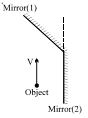
In the diagram shown, all the velocities are given with respect to earth. What is the relative velocity of the image in mirror $(1)$ with respect to the image in the mirror $(2)?$ The mirror $(1)$ forms an angle $\beta$ with the vertical.
A hot and a cold body are kept in vacuum separated from each other. Which of the following cause decrease in temperature of the hot body
The period of oscillation of a magnet in vibration magnetometer is $2 \,sec$. The period of oscillation of a magnet whose magnetic moment is four times that of the first magnet is...$sec$
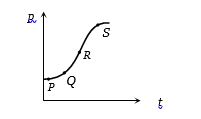
The variation of momentum with time of one of the body in a two body collision is shown in fig. The instantaneous force is maximum corresponding to point
Infinite charges of magnitude $q$ each are lying at $x =1,\, 2,\, 4,\, 8...$ meter on $X$-axis. The value of intensity of electric field at point $x = 0$ due to these charges will be
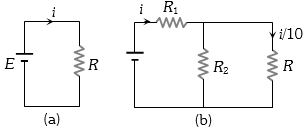
Consider the circuits shown in the figure. Both the circuits are taking same current from battery but current through $R$ in the second circuit is $\frac{1}{{10}}$$^{th}$ of current through $R$ in the first circuit. If $R$ is $11$ $\Omega$, the value of $ R_1$ ................  $\Omega$
In an electrical cable there is a single wire of radius $9\, mm$ of copper. Its resistance is $5\,\Omega $. The cable is replaced by $6$ different insulated copper wires, the radius of each wire is $3\,mm$. Now the total resistance of the cable will be ............... $\Omega$
$A$ particle of mass m is constrained to move on $x$ -axis. $A$ force $F$ acts on the particle. $F$ always points toward the position labeled $E$. For example, when the particle is to the left of $E, F$ points to the right. The magnitude of $F$ is a constant $F$ except at point $E$ where it is zero. The system is horizontal. $F$ is the net force acting on the particle. The particle is displaced a distance $A$ towards left from the equilibrium position $E$ and released from rest at $t = 0.$ Find minimum time it will take to reach from $x = - \frac{A}{2}$ to $0$.
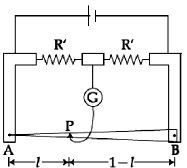
In a meter bridge, the wire of length $1\, m$ has a nonuniform cross-section such that, the variation $\frac{{dR}}{{d\ell }}$ of its resistance $R$ with length $\ell $ is $\frac{{dR}}{{d\ell }} \propto \frac{1}{{\sqrt \ell  }}$ Two equal resistances are connected as shown in the figure. The galvanometer has zero deflection when the jockey is at point $P$. What is the length $AP$ ? ................ $m$