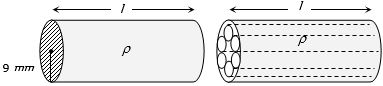
In an electrical cable there is a single wire of radius $9\, mm$ of copper. Its resistance is $5\,\Omega $. The cable is replaced by $6$ different insulated copper wires, the radius of each wire is $3\,mm$. Now the total resistance of the cable will be ............... $\Omega$
Diffcult
Download our app for free and get started
(a) Initially : Resistance of given cable
$R = \rho \frac{l}{{\pi \times {{(9 \times {{10}^{ - 3}})}^2}}}$ ... $(i)$
Finally : Resistance of each insulated copper wire is
$R\,' = \rho \frac{l}{{\pi \times {{(3 \times {{10}^{ - 3}})}^2}}}$. Hence equivalent resistance of cable ${R_{eq}} = \frac{{R\,'}}{6} = \frac{1}{6} \times \left( {\rho \frac{l}{{\pi \times {{(3 \times {{10}^{ - 3}})}^2}}}} \right)$….$(ii)$
On solving equation $(i)$ and $(ii)$ we get $R_{eq} = 7.5 \,\Omega$
$R = \rho \frac{l}{{\pi \times {{(9 \times {{10}^{ - 3}})}^2}}}$ ... $(i)$
Finally : Resistance of each insulated copper wire is
$R\,' = \rho \frac{l}{{\pi \times {{(3 \times {{10}^{ - 3}})}^2}}}$. Hence equivalent resistance of cable ${R_{eq}} = \frac{{R\,'}}{6} = \frac{1}{6} \times \left( {\rho \frac{l}{{\pi \times {{(3 \times {{10}^{ - 3}})}^2}}}} \right)$….$(ii)$
On solving equation $(i)$ and $(ii)$ we get $R_{eq} = 7.5 \,\Omega$

Download our appand get started for free
Experience the future of education. Simply download our apps or reach out to us for more information. Let's shape the future of learning together!No signup needed.*
Similar Questions
- 1The same mass of copper is drawn into two wires $1\, mm$ and $2\, mm$ thick. Two wires are connected in series and current is passed through them. Heat produced in the wire is in the ratioView Solution
- 2In an experiment to find $emf$ of a cell using potentiometer, the length of null point for a cell of emf $1.5\,V$ is found to be $60\,cm$. If this cell is replaced by another cell of $emf\; E$. the length-of null point increases by $40\,cm$. The value of $E$ is $\frac{x}{10} V$. The value of $x$ is $............$View Solution
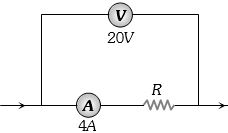
- 3In the diagram shown, the reading of voltmeter is $20\, V$ and that of ammeter is $4\, A$. The value of $R$ should be (Consider given ammeter and voltmeter are not ideal)View Solution
- 4Two wires of equal diameters, of resistivities ${\rho _1}$ and ${\rho _2}$ and lengths $l_1$ and $l_2$, respectively, are joined in series. The equivalent resistivity of the combination isView Solution
- 5The value of internal resistance of an ideal cell is $\Omega$View Solution
- 6Two identical cells send the same current in $2\,\Omega $ resistance, whether connected in series or in parallel. The internal resistance of the cell should be ............... $\Omega$View Solution
- 7The resistance of a conductor is $5\, ohm$ at $50\,^oC$ and $6\, ohm$ at $100\,^oC$. Its resistance at $0\,^oC$ is ................ $ohm$View Solution
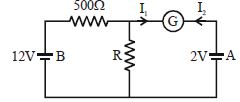
- 8In the adjoining circuit, the galvanometer $G$ shows zero deflection. If the batteries $A$ and $B$ have negligible internal resistance, the value of the resistor $R$ will be .............. $\Omega$View Solution
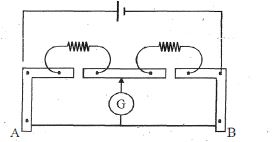
- 9A meter bridge set up as shown to determine end correction at $A$ and $B$ . When a resistance of $15\,\Omega $ is used in left gap and of $20\,\Omega $ in right gap, then null point comes at a distance $42\ cm$ from $A$ . When these resistances are interchanged null point comes at a distance $57\ cm$ from $A$ . Values of end corrections areView Solution
- 10For a wire $\frac{R}{l}=\frac{1}{2}$ and length of wire is $l=5\, cm .$ If potential difference $1\, V$ is applied across it, current through wire will be: $( R =$ Resistance $)$ (in $A$)View Solution