Question
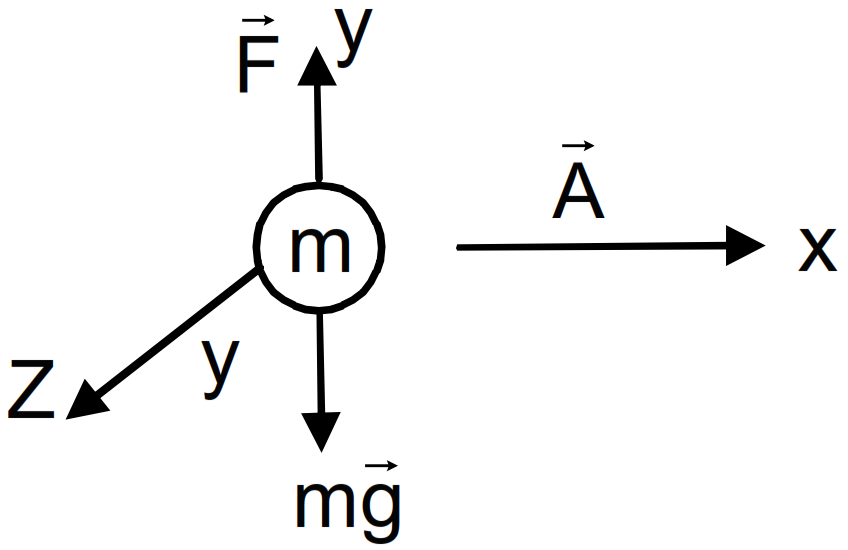
A force $\overrightarrow{\text{F}}=\overrightarrow{\text{v}}\times\overrightarrow{\text{A}}$ is exerted on a particle in addition to the force of gravity, where v is the velocity of the particle and $\overrightarrow{\text{A}}$ is a constant vector in the horizontal direction. With what minimum speed a particle of mass m be projected so that it continues to move undeflected with a constant velocity?
Answer

Given that, $\overrightarrow{\text{F}}=\overrightarrow{\text{u}}\times\overrightarrow{\text{A}}$ and $\overrightarrow{\text{mg}}$ act on the particle. For the particle to move undeflected with constant velocity, net force should be zero.$\therefore\big(\overrightarrow{\text{u}}\times\overrightarrow{\text{A}}\big)+\overrightarrow{\text{mg}}=0$
$\therefore\big(\overrightarrow{\text{u}}\times\overrightarrow{\text{A}}\big)-\overrightarrow{\text{mg}}=0$
Because, $\big(\overrightarrow{\text{u}}\times\overrightarrow{\text{A}}\big)$ is perpendicular to the plane containing $\overrightarrow{\text{u}}$ and $\overrightarrow{\text{A}},\overrightarrow{\text{u}}$ should be in the xz-plane. Again, $\text{u A}\sin\theta=\text{mg}$$\therefore\text{u}=\frac{\text{mg}}{\text{A}\sin\theta}$
u will be minimum, when $\sin\theta=1\Rightarrow\theta=90^{\circ}$$\therefore\text{u}_{\text{min}}=\frac{\text{mg}}{\text{A}}$ along Z-axis.

Need a full question paper?

Generate a complete, print-ready paper with questions like this in minutes — across 16+ boards, with answer keys.

Start Generating Free

Similar questions

Which waves are electromagnetic waves?Which factors are responsible for their production?
The band gap for silicon is 1.1eV.
  1. Find the ratio of the band gap to kT for silicon at room temperature 300K.
  2. At what temperature does this ratio become one tenth of the value at 300K?
(Silicon will not retain its structure at these high temperatures.)
Figure shows a potentiometer circuit for comparison of two resistances. The balance point with a standard resistor $\text{R}=10.0\ \Omega$ is found to be 58.3 cm, while that with the unknown resistance X is 68.5 cm. Determine the value of X. What might you do if you failed to find a balance point with the given cell of emf $\varepsilon?$
A particle goes in a circle of radius 2.0cm. A concave mirror of focal length 20cm is placed with its principal axis passing through the centre of the circle and perpendicular to its plane. The distance between the pole of the mirror and the centre of the circle is 30cm. Calculate the radius of the circle formed by the image.
One end of a steel rod $(\text{K}=46\text{Js}^{-1}\text{m}^{-1}{^{\circ}}\text{C}^{-1})$ of length 1.0m is kept in ice at 0°C and the other end is kept in boiling water at 100°bC. The area of cross section of the rod is $0.04cm^2$. Assuming no heat loss to the atmosphere, find the mass of the ice melting per second. Latent heat of fusion of ice $=3.36\times10^5\text{Jkg}^{-1}.$
Define relaxation time of the free electrons drifting in a conductor. How is it related to the drift velocity of free electrons? Use this relation to deduce the expression for the electrical resistivity of the material.
What is the de Broglie wavelength of:
  1. A bullet of mass 0.040 kg travelling at the speed of 1.0 km/s,
  2. A ball of mass 0.060 kg moving at a speed of 1.0 m/s, and
  3. A dust particle of mass $1.0 \times 10^{–9} kg$ drifting with a speed of 2.2 m/s?
What are isotopes? Explain with an example how the average mass can be obtained from the relative proportions of different isotopes of the same element.
In the given circuit, the value of resistance effect of the coil L is exactly equal to the resistance R. Bulbs $B_1$ and $B_2$ are exactly identical. Answer the following questions based on above information:
  1. Which one of the two bulbs lights up earlier, when key K is closed and why?
  2. What will be the comparative brightness of the two bulbs after sometime if the key K is kept closed and why?