The ratio of momenta of an electron and an $\alpha$-particle which are accelerated from rest by a potential difference of $100\, volts$ is
Easy
Download our app for free and get started
(d) Momentum $p = \sqrt {2mK} \,;$ where $K =$ kinetic energy = $Q.V$
$==>$ $p = \sqrt {2mQV} $ $==>$ $p \propto \sqrt {mQ} \, \Rightarrow \,\frac{{{p_e}}}{{{p_\alpha }}} = \sqrt {\frac{{{m_e}{Q_e}}}{{{m_\alpha }{Q_\alpha }}}} $$ = \sqrt {\frac{{{m_e}}}{{2{m_\alpha }}}} $
$==>$ $p = \sqrt {2mQV} $ $==>$ $p \propto \sqrt {mQ} \, \Rightarrow \,\frac{{{p_e}}}{{{p_\alpha }}} = \sqrt {\frac{{{m_e}{Q_e}}}{{{m_\alpha }{Q_\alpha }}}} $$ = \sqrt {\frac{{{m_e}}}{{2{m_\alpha }}}} $

Download our appand get started for free
Experience the future of education. Simply download our apps or reach out to us for more information. Let's shape the future of learning together!No signup needed.*
Similar Questions
- 1Separation between the plates of a parallel plate capacitor is $d$ and the area of each plate is $A$. When a slab of material of dielectric constant $k$ and thickness $t(t < d)$ is introduced between the plates, its capacitance becomesView Solution
- 2In a parallel plate condenser, the radius of each circular plate is $12\,cm$ and the distance between the plates is $5\,mm$. There is a glass slab of $3\,mm$ thick and of radius $12\,cm$ with dielectric constant $6$ between its plates. The capacity of the condenser will beView Solution
- 3Three capacitors of capacitances $3\,\mu F,\;9\,\mu F$ and $18\,\mu F$ are connected once in series and another time in parallel. The ratio of equivalent capacitance in the two cases $\left( {\frac{{{C_s}}}{{{C_p}}}} \right)$ will beView Solution
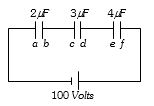
- 4Three capacitors are connected to $D.C.$ source of $100\;volts$ shown in the adjoining figure. If the charge accumulated on plates of ${C_1},\;{C_2}$ and ${C_3}$ are ${q_a},\;{q_b},\;{q_c},{q_d}.{q_e}$ and ${q_f}$ respectively, thenView Solution
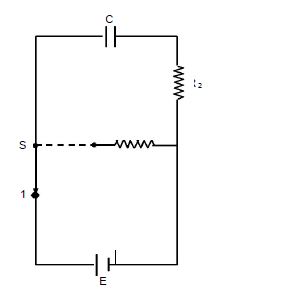
- 5Switch $S$ of circuit shown in figure is in position $1$ for a long time. At instant $t = 0$ , it is thrown from position $1$ to $2$ . The thermal power $P_1(t)$ generated in resistance $R_1$View Solution
- 6A parallel plate condenser with a dielectric of dielectric constant $K$ between the plates has a capacity $C$ and is charged to a potential $V\ volt$. The dielectric slab is slowly removed from between the plates and then reinserted. The net work done by the system in this process isView Solution
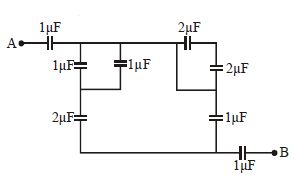
- 7Find the equivalent capacitance between $A$ and $B$View Solution
- 8An electric charge $10^{-6} \mu \mathrm{C}$ is placed at origin $(0,0)$ $\mathrm{m}$ of $\mathrm{X}-\mathrm{Y}$ co-ordinate system. Two points $\mathrm{P}$ and $\mathrm{Q}$ are situated at $(\sqrt{3}, \sqrt{3}) \mathrm{m}$ and $(\sqrt{6}, 0) \mathrm{m}$ respectively. The potential difference between the points $P$ and $Q$ will be :View Solution
- 9An electric field of $1000\,V/m$ is applied to an electric dipole at angle of $45^o$. The value of electric dipole moment is $10^{-29}\, C.m.$ What is the potential energy of the electric dipole?View Solution
- 10In free space, a particle $A$ of charge $1\,\mu C$ is held fixed at a point $P.$ Another particle $B$ of the same charge and mass $4\,\mu g$ is kept at a distance of $1\,mm$ from $P$. If $B$ is released, then its velocity at a distance of $9\,mm$ from $P$ is [ Take $\frac{1}{{4\pi {\varepsilon _0}}} = 9 \times {10^9}\,N{m^2}{C^{ - 2}}$ ]View Solution