A force $F$ is applied on the wire of radius $r$ and length $L$ and change in the length of wire is $l.$ If the same force $F$ is applied on the wire of the same material and radius $2r$ and length $2L,$ Then the change in length of the other wire is
Easy
Download our app for free and get started
(c) $l = \frac{{FL}}{{AY}} \Rightarrow l \propto \frac{L}{{{r^2}}}$ $(F$ and $Y$ are constant$)$
$\frac{{{l_2}}}{{{l_1}}} = \frac{{{L_2}}}{{{L_1}}} \times {\left( {\frac{{{r_1}}}{{{r_2}}}} \right)^2} = 2 \times {\left( {\frac{1}{2}} \right)^2} = \frac{1}{2}$
$\therefore {l_2} = \frac{{{l_1}}}{2}$
i.e. the change in the length of other wire is $\frac{l}{2}$

Download our appand get started for free
Experience the future of education. Simply download our apps or reach out to us for more information. Let's shape the future of learning together!No signup needed.*
Similar Questions
- 1The ratio of two specific heats of gas ${C_p}/{C_v}$ for argon is $1.6$ and for hydrogen is $1.4$. Adiabatic elasticity of argon at pressure $P$ is $E.$ Adiabatic elasticity of hydrogen will also be equal to $E$ at the pressureView Solution
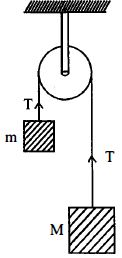
- 2Two blocks of masses $m$ and $M$ are connected by means of a metal wire of cross-sectional area $A$ passing over a frictionless fixed pulley as shown in the figure. The system is then released. If $M = 2\, m$, then the stress produced in the wire isView Solution
- 3One end of a horizontal thick copper wire of length $2 L$ and radius $2 R$ is welded to an end of another horizontal thin copper wire of length $L$ and radius $R$. When the arrangement is stretched by a applying forces at two ends, the ratio of the elongation in the thin wire to that in the thick wire is :View Solution
- 4View SolutionOn stretching a wire, the elastic energy stored per unit volume is
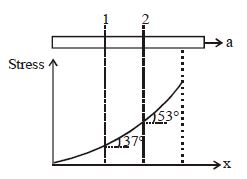
- 5Rod of constant cross-section moves towards right with constant acceleration. Graph of stress and distance from left end is given as in figure. If density of material of rod at cross section $1$ is $9$ $\frac{{gm}}{{c{m^3}}}$ . Find density at cross section $2$.View Solution
.......... $\mathrm{gm} / \mathrm{cm}^{3}$
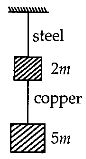
- 6If the ratio of diameters, lengths and Young's modulus of steel and copper wires shown in the figure are $p, q$ and $s$ respectively, then the corresponding ratio of increase in their lengths would beView Solution
- 7The elastic limit of brass is $379\,MPa.$ .......... $mm$ should be the minimum diameter of a brass rod if it is to support a $400\,N$ load without exceeding its elastic limit .View Solution
- 8To determine Young's modulus of a wire, the formula is $Y = \frac{F}{A}.\frac{L}{{\Delta L}}$ where $F/A$ is the stress and $L/\Delta L$ is the strain. The conversion factor to change $Y$ from $CGS$ to $MKS$ system isView Solution
- 9A body of mass $\mathrm{m}=10\; \mathrm{kg}$ is attached to one end of a wire of length $0.3\; \mathrm{m} .$ The maximum angular speed (in $rad \;s^{-1}$ ) with which it can be rotated about its other end in space station is (Breaking stress of wire $=4.8 \times 10^{7} \;\mathrm{Nm}^{-2}$ and area of cross-section of the wire $=10^{-2}\; \mathrm{cm}^{2}$ ) isView Solution
- 10An area of cross-section of rubber string is $2\,c{m^2}$. Its length is doubled when stretched with a linear force of $2 \times {10^5}$dynes. The Young's modulus of the rubber in $dyne/c{m^2}$ will beView Solution