MCQ
A force $\overrightarrow F = - K(y\hat i + x\hat j)$ (where $K$ is a positive constant) acts on a particle moving in the $x-y$ plane. Starting from the origin, the particle is taken along the positive $x-$ axis to the point $(a, 0)$ and then parallel to the $y-$axis to the point $(a, a)$. The total work done by the forces $\overrightarrow F $ on the particle is
  • A
    $ - 2\,K{a^2}$
  • B
    $2\,K{a^2}$
  • $ - K{a^2}$
  • D
    $K{a^2}$

Answer

Correct option: C.
$ - K{a^2}$
c
(c) For motion of the particle from $(0, 0)$ to $(a, 0)$

$\overrightarrow F = - K(0\,\hat i + a\,\hat j)$ $ \Rightarrow \,\,\overrightarrow F = - Ka\hat j$

Displacement $\overrightarrow {r\,} = (a\,\hat i + 0\,\hat j) - (0\,\hat i + 0\,\hat j) = a\hat i$

So work done from $(0, 0)$ to $(a, 0)$ is given by

$W = \overrightarrow F \,.\,\overrightarrow {r\,} $$ = - Ka\hat j\,.\,a\hat i = 0$

For motion $(a, 0)$ to $(a, a)$

$\overrightarrow F = - K(a\hat i + a\hat j)$ and displacement

$\overrightarrow {r\,} = (a\hat i + a\hat j) - (a\hat i + 0\hat j) = a\hat j$

So work done from $(a, 0)$ to $(a, a)$ $W = \overrightarrow F \,.\,\overrightarrow {r\,} $

$ = - K(a\hat i + a\hat j)\,.\,a\hat j = - K{a^2}$

So total work done$ = - K{a^2}$

Need a full question paper?

Generate a complete, print-ready paper with questions like this in minutes — across 16+ boards, with answer keys.

Start Generating Free

Similar questions

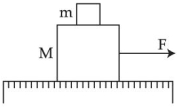
A system of two blocks of masses $m =2 \; kg$ and $M=8 \; kg$ is placed on a smooth table as shown in figure. The coefficient of static friction between two blocks is $0.5$. The maximum horizontal force $F$ that can be applied to the block of mass $M$ so that the blocks move together will be $\dots \; N$
A quarter horse power motor runs at a speed of $ 600 r.p.m.$  Assuming $40\%$  efficiency the work done by the motor in one rotation will be
Given below are two statements:

Statement $I:$ A truck and a car moving with same kinetic energy are brought to rest by applying brakes which provide equal retarding forces. Both come to rest in equal distance.

Statement $II:$ A car moving towards east takes a turn and moves towards north, the speed remains unchanged. The acceleration of the car is zero.

In the light of given statements, choose the most appropriate answer from the options given below.

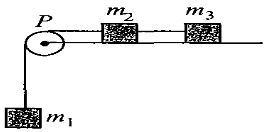
A system consists of three masses $m_1 , m_2$ and $m_3$ connected by a string passing over a pulley $P.$ The mass $m_1$ hangs freely and $m_2$ and $m_3$ are on a rough horizontal table (the coefficient of friction $= \mu ).$ The pulley is frictionless and of negligible mass. The downward acceleration of mass $m_1$ is $(Assume\, m = m_2 = m_3 = m)$ 
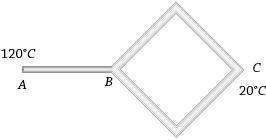
Five identical rods are joined as shown in figure. Point $A$ and $C$ are maintained at temperature $120^o C$ and $20^o C$ respectively. The temperature of junction $B$ will be....... $^oC$
A vibrating tuning fork is moving slowly and uniformly in a horizontal circular path of radius $8\,m$. The shortest distance of an observer in same plane from the tuning fork is $9 \,m$. The distance between the tuning fork and observer at the instant when apparent frequency becomes maximum is ......... $m$
Which of the following statements is/are not an assumption of the kinetic theory for an ideal gas?
Three very large plates of same area are kept parallel and close to each other. They are considered as ideal black surfaces and have very high thermal conductivity. The first and third plates are maintained at temperatures $2T$ and $3T$ respectively. The temperature of the middle (i.e. second) plate under steady state condition is
$Assertion :$ Adiabatic expansion is always accompanied by fall in temperature.
$Reason :$ In adiabatic process, volume is inversely proportional to temperature.
A rod of mass $M$ and length $L$ is lying on a horizontal frictionless surface. A particle of mass ' $m$ ' travelling along the surface hits at one end of the rod with velocity $'u'$ in a direction perpendicular to the rod. The collision is completely elastic. After collision, particle comes to rest. The ratio of masses $\left(\frac{m}{M}\right)$ is $\frac{1}{x}$. The value of ' $x$ ' will be ..... .