A force of $200\, N$ is applied at one end of a wire of length $2\, m$ and having area of cross-section ${10^{ - 2}}\,c{m^2}$. The other end of the wire is rigidly fixed. If coefficient of linear expansion of the wire $\alpha = 8 \times 10{^{-6}}°C^{-1}$ and Young's modulus $Y = 2.2 \times {10^{11}}\,N/{m^2}$ and its temperature is increased by $5°C$, then the increase in the tension of the wire will be ........ $N$
Medium
Download our app for free and get started
(d) Increase in tension of wire $ = YA\alpha \Delta \theta $
$ = 8 \times {10^{ - 6}} \times 2.2 \times {10^{11}} \times {10^{ - 2}} \times {10^{ - 4}} \times 5 = 8.8\;N$

Download our appand get started for free
Experience the future of education. Simply download our apps or reach out to us for more information. Let's shape the future of learning together!No signup needed.*
Similar Questions
- 1View SolutionThe following four wires are made of the same material. Which of these will have the largest extension when the same tension is applied?
- 2In an experiment, brass and steel wires of length $1\,m$ each with areas of cross section $1\,mm^2$ are used. The wires are connected in series and one end of the combined wire is connected to a rigid support and other end is subjected to elongation. The stress requires to produced a new elongation of $0.2\,mm$ is [Given, the Young’s Modulus for steel and brass are respectively $120\times 10^9\,N/m^2$ and $60\times 10^9\,N/m^2$ ]View Solution
- 3To break a wire of one meter length, minimum $40 \,kg \,wt$. is required. Then the wire of the same material of double radius and $6 \,m$ length will require breaking weight ....... $kg \,wt$View Solution
- 4Two wires of same length and radius are joined end to end and loaded. The Young's modulii of the materials of the two wires are $Y_{1}$ and $Y_{2}$. The combination behaves as a single wire then its Young's modulus is:View Solution
- 5Stress required in a wire to produce $0.1\%$ strain is $4 \times10^8\, N/m^2$. Its yound modulus is $Y_1$. If stress required in other wire to produce $0.3\%$ strain is $6 \times 10^8\, N/m^2$. Its young modulus is $Y_2$. Which relation is correctView Solution
- 6What must be the lengths of steel and copper rods at $0^o C$ for the difference in their lengths to be $10\,cm$ at any common temperature? $(\alpha_{steel}=1.2 \times {10^{-5}} \;^o C^{-1})$ and $(\alpha_{copper} = 1.8 \times 10^{-5} \;^o C^{-1})$View Solution
- 7View SolutionWhich one of the following substances possesses the highest elasticity
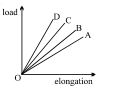
- 8View SolutionThe load versus strain graph for four wires of the same material is shown in the figure. The thickest wire is represented by the line
- 9A wire is loaded by $6\, kg$ at its one end, the increase in length is $12\, mm.$ If the radius of the wire is doubled and all other magnitudes are unchanged, then increase in length will be ......... $mm$View Solution
- 10Two wires of the same material have lengths in the ratio 1 : 2 and their radii are in the ratio $1:\sqrt 2 $. If they are stretched by applying equal forces, the increase in their lengths will be in the ratioView Solution