The following four wires are made of the same material. Which of these will have the largest extension when the same tension is applied?
AIPMT 2013, Medium


Download our appand get started for free
Experience the future of education. Simply download our apps or reach out to us for more information. Let's shape the future of learning together!No signup needed.*
Similar Questions
- 1A steel wire having a radius of $2.0\, mm$, carrying a load of $4\, kg$, is hanging from a ceiling. Given that $g = 3.1\pi \,m{s^{ - 2}}$ , what will be the tensile stress that would be developed in the wire?View Solution
- 2A material has Poisson's ratio $0.50.$ If a uniform rod of it suffers a longitudinal strain of $2 \times {10^{ - 3}}$, then the percentage change in volume isView Solution
- 3A wire of length $L$ and radius $r$ is clamped at one end. If its other end is pulled by a force $F$, its length increases by $l$. If the radius of the wire and the applied force both are reduced to half of their original values keeping original length constant, the increase in length will become.View Solution
- 4Young's modulus is determined by the equation given by $\mathrm{Y}=49000 \frac{\mathrm{m}}{\ell} \frac{\text { dyne }}{\mathrm{cm}^2}$ where $\mathrm{M}$ is the mass and $\ell$ is the extension of wre used in the experiment. Now error in Young modules $(\mathrm{Y})$ is estimated by taking data from $M-\ell$ plot in graph paper. The smallest scale divisions are $5 \mathrm{~g}$ and $0.02$ $\mathrm{cm}$ along load axis and extension axis respectively. If the value of $M$ and $\ell$ are $500 \mathrm{~g}$ and $2 \mathrm{~cm}$ respectively then percentage error of $\mathrm{Y}$ is :View Solution
- 5View SolutionIn suspended type moving coil galvanometer, quartz suspension is used because
- 6The bulk modulus of a spherical object is '$B$'. If it is subjected to uniform pressure '$P$', the fractional decrease in radius isView Solution
- 7A rectangular block of size $10\,cm \times 8\,cm \times 5\,cm$ is kept in three different positions $P, Q$ and $R$ in turn as shown in the figure. In each case, the shaded area is rigidly fixed and a definite force $F$ is applied tangentially to the opposite face to deform the block. The displacement of the upper face will beView Solution
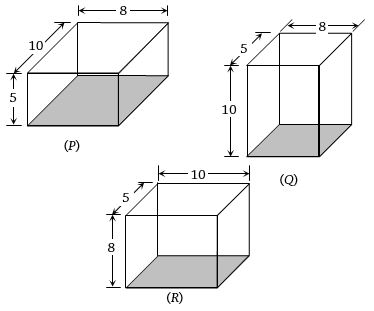
- 8A wire extends by $1 mm$ when a force is applied. Double the force is applied to another wire of same material and length but half the radius of cross-section. The elongation of the wire in mm will be ........View Solution
- 9A metal wire of length $0.5 m$ and cross-sectional area $10^{-4}\; m ^{2}$ has breaking stress $5 \times 10^{8}\; Nm ^{-2}$. A block of $10\; kg$ is attached at one end of the string and is rotating in a horizontal circle. The maximum linear velocity of block will be $ms ^{-1}$.View Solution
- 10View SolutionThe following four wires are made of the same material. Which of these will have the largest extension when the same tension is applied ?