A force of $200\, N$ is applied at one end of a wire of length $2\, m$ and having area of cross-section ${10^{ - 2}}\,c{m^2}$. The other end of the wire is rigidly fixed. If coefficient of linear expansion of the wire $\alpha = 8 \times 10{^{-6}}°C^{-1}$ and Young's modulus $Y = 2.2 \times {10^{11}}\,N/{m^2}$ and its temperature is increased by $5°C$, then the increase in the tension of the wire will be ........ $N$
Medium


Download our appand get started for free
Experience the future of education. Simply download our apps or reach out to us for more information. Let's shape the future of learning together!No signup needed.*
Similar Questions
- 1A pan with set of weights is attached with a light spring. When disturbed, the mass-spring system oscillates with a time period of $0.6$ $s.$ When some additional weights are added then time period is $0.7s.$ The extension caused by the additional weights is approximately given by ......... $cm$View Solution
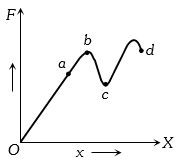
- 2The graph is drawn between the applied force $F$ and the strain $(x)$ for a thin uniform wire. The wire behaves as a liquid in the partView Solution
- 3If a spring is extended to length $l,$ then according to Hook's lawView Solution
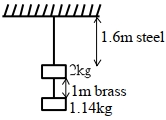
- 4Two wires each of radius $0.2\,cm$ and negligible mass, one made of steel and other made of brass are loaded as shown in the figure. The elongation of the steel wire is $.........\times 10^{-6}\,m$. [Young's modulus for steel $=2 \times 10^{11}\,Nm ^{-2}$ and $g =10\,ms ^{-2}$ ]View Solution
- 5Two wires of same diameter of the same material having the length $l$ and $2l.$ If the force $ F$ is applied on each, the ratio of the work done in the two wires will beView Solution
- 6Consider two wires of same material having their ratio of radii to be $2: 1$. If these two wires are stretched by equal force, then the ratio of stress produced in them isView Solution
- 7A vertical hanging bar of length $l$ and mass $m$ per unit length carries a load of mass $M$ at lower end, its upper end is clamped to a rigid support. The tensile stress a distance $x$ from support is $(A \rightarrow$ area of cross-section of bar)View Solution
- 8View SolutionThe value of Young's modulus for a perfectly rigid body is ...........
- 9A brass rod of length $2\,m$ and cross-sectional area $2.0\,cm^2$ is attached end to end to a steel rod of length $L$ and cross-sectional area $1.0\,cm^2$ . The compound rod is subjected to equal and opposite pulls of magnitude $5 \times 10^4\,N$ at its ends. If the elongations of the two rods are equal, then length of the steel rod $(L)$ is ........... $m$ $(Y_{Brass}=1.0\times 10^{11}\,N/m^2$ and $Y_{Steel} = 2.0 \times 10^{11}\,N/m^2)$View Solution
- 10View SolutionThe modulus of elasticity is dimensionally equivalent to