A force of $98\, N$ is required to just start moving a body of mass $100\, kg$ over ice. The coefficient of static friction is
Easy


Download our appand get started for free
Experience the future of education. Simply download our apps or reach out to us for more information. Let's shape the future of learning together!No signup needed.*
Similar Questions
- 1A body of mass $'m'$ is launched up on a rough inclined plane making an angle of $30^{\circ}$ with the horizontal. The coeffcient of friction between the body and plane is $\frac{\sqrt{x}}{5}$ if the time of ascent is half of the time of descent. The value of $x$ is ..... .View Solution
- 2A uniform rope of length l lies on a table. If the coefficient of friction is $\mu $, then the maximum length ${l_1}$ of the part of this rope which can overhang from the edge of the table without sliding down isView Solution
- 3View SolutionIf the overbridge is concave instead of being convex, the thrust on the road at the lowest position will be
- 4A block of mass $m$ is moving with a constant acceleration a on a rough plane. If the coefficient of friction between the block and ground is $\mu $, the power delivered by the external agent after a time $t$ from the beginning is equal toView Solution
- 5At time $t=0$, a disk of radius $1 m$ starts to roll without slipping on a horizontal plane with an angular acceleration of $\alpha=\frac{2}{3} rad s ^{-2}$. A small stone is stuck to the disk. At $t=0$, it is at the contact point of the disk and the plane. Later, at time $t=\sqrt{\pi} s$, the stone detaches itself and flies off tangentially from the disk. The maximum height (in $m$ ) reached by the stone measured from the plane is $\frac{1}{2}+\frac{x}{10}$. The value of $x$ is. . . . . . .[Take $g=10 m s ^{-2}$.]View Solution
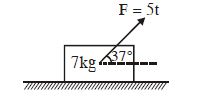
- 6A block of $7\,kg$ is placed on a rough horizontal surface and is pulled through a variable force $F$ (in $N$ ) $= 5\,t$ , where $'t'$ is time in second, at an angle of $37^o$ with the horizontal as shown in figure. The coefficient of static friction of the block with the surface is one. If the force starts acting at $t = 0\,s$ . Find the time at which the block starts to slide ......... $\sec$ (Take $g = 10\,m/s^2$ )View Solution
- 7A particle moves in a horizontal circle on the smooth inner surface of a hemispherical bowl of radius $R$. The plane of motion is at a depth $d$ below the centre of the hemisphere. The speed of the particle is :-View Solution
- 8A man is standing on a rough $(\mu = 0.5)$ horizontal disc rotating with constant angular velocity of $5$ $rad/sec.$ At what distance from centre should he stand so that he does not slip on the disc?View Solution
- 9A particle of mass $m$ is at rest at the origin at time $t = 0$. It is subjected to a force $F(t) = F_0e^{-bt}$ in the $x$ -direction. Its speed $v(t)$ is depicted by which of the following curves ?View Solution
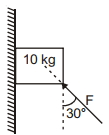
- 10A block of mass $10 \,kg$ is held at rest against a rough vertical wall $[\mu=0.5]$ under the action a force $F$ as shown in figure. The minimum value of $F$ required for it is ............ $N$ $\left(g=10 \,m / s ^2\right)$View Solution