At time $t=0$, a disk of radius $1 m$ starts to roll without slipping on a horizontal plane with an angular acceleration of $\alpha=\frac{2}{3} rad s ^{-2}$. A small stone is stuck to the disk. At $t=0$, it is at the contact point of the disk and the plane. Later, at time $t=\sqrt{\pi} s$, the stone detaches itself and flies off tangentially from the disk. The maximum height (in $m$ ) reached by the stone measured from the plane is $\frac{1}{2}+\frac{x}{10}$. The value of $x$ is. . . . . . .[Take $g=10 m s ^{-2}$.]
IIT 2022, Difficult
Download our app for free and get started
(image)
$\text { At } t =0, \omega=0$
$\text { at } t =\sqrt{\pi}, \omega=\alpha t =\frac{2}{3} \sqrt{\pi}, v =\omega r =\frac{2}{3} \sqrt{\pi}$
$\theta=\frac{1}{2} \alpha t ^2$
$\theta=\frac{1}{2} \times \frac{2}{3} \times \pi=\frac{\pi}{3}$
$\theta=60^{\circ}$
$v _y= v \sin 60=\frac{\sqrt{3}}{2} V$
$h =\frac{ u _Y^2}{2 g }=\frac{\frac{3}{4} v ^2}{2 g }$
$h =\frac{\frac{3}{4} \times \frac{4}{9} \pi}{2 g }$
$h =\frac{3 \pi}{9 \times 2 g }=\frac{\pi}{6 g }$
Maximum height from plane, $H=\frac{R}{2}+h$
$H =\frac{1}{2}+\frac{\pi}{6 \times 10}$
$x =\frac{\pi}{6} ; x =0.52$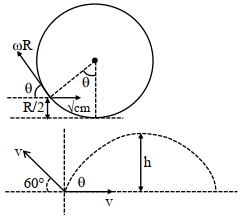

Download our appand get started for free
Experience the future of education. Simply download our apps or reach out to us for more information. Let's shape the future of learning together!No signup needed.*
Similar Questions
- 1A mass is supported on a frictionless horizontal surface. It is attached to a string and rotates about a fixed centre at an angular velocity ${\omega _0}$. If the length of the string and angular velocity are doubled, the tension in the string which was initially ${T_0}$ is nowView Solution
- 2A $2 \mathrm{~kg}$ brick begins to slide over a surface which is inclined at an angle of $45^{\circ}$ with respect to horizontal axis. The co-efficient of static friction between their surfaces is:View Solution
- 3A body takes $1\frac{1}{3}$ times as much time to slide down a rough identical but smooth inclined plane. If the angle of inclined plane is $45^o$, the coefficient of friction isView Solution
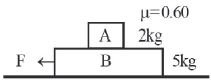
- 4Two block $(A)\,2\,kg$ and $(B)\,5\,kg$ rest one over the other on a smooth horizontal plane. The cofficient of static and dynamic friction between $(A)$ and $(B)$ is the same and equal to $0.60$. The maximum horizontal force that can be applied to $(B)$ in order that both $(A)$ and $(B)$ do not have any relative motion : $(g = 10\,m/s^2)$View Solution
- 5A disc with a flat small bottom beaker placed on it at a distance $R$ from its center is revolving about an axis passing through the center and perpendicular to its plane with an angular velocity $\omega$. The coefficient of static friction between the bottom of the beaker and the surface of the disc is $\mu$. The beaker will revolve with the disc ifView Solution
- 6A hemispherical bowl of radius $R$ is rotated about its axis of symmetry which is kept vertical with angular velocity $\omega $ . A small block is kept in the bowl. It remains stationary relative to the bowl surface at a position where the radius makes an angle $\theta $ with the vertical. The friction is absent. The value of $\theta $ isView Solution
- 7A girl holds a book of mass $m$ against a vertical wall with a horizontal force $F$ using her finger, so that the book does not move. The frictional force on the book by the wall isView Solution
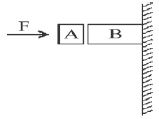
- 8Given in the figure are two blocks $A$ and $B$ of weight $20\ N$ and $100\ N,$ respectively. These are being pressed against a wall by a force $F$ as shown. If the coefficient of friction between the blocks is $0.1$ and between block $B$ and the wall is $0.15$, the frictional force applied by the wall on block $B$ is ........... $N$View Solution
- 9A boy on a cycle pedals around a circle of $20\, metres$ radius at a speed of $20\,metres/\sec .$ The combined mass of the boy and the cycle is $90\, kg$. The angle that the cycle makes with the vertical so that it may not fall is ......... $^o$ $(g = 9.8\,m/{\sec ^2})$View Solution
- 10A disc rotates about its axis of symmetry in a hoizontal plane at a steady rate of $3.5$ revolutions per second. A coin placed at a distance of $1.25\,cm$ from the axis of rotation remains at rest on the disc. The coefficient of friction between the coin and the disc is $(g\, = 10\,m/s^2)$View Solution