MCQ
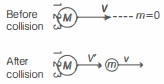
A mass $M$ moving with a certain speed $V$ collides elastically with another stationary mass $m$. After the collision, the masses $M$ and $m$ move with speeds $V^{\prime}$ and $v$, respectively. All motion is in one dimension. Then,
  • A
    $V=V^{\prime}+v$
  • B
    $V^{\prime}=V+v$
  • C
    $V^{\prime}=\frac{(V+v)}{2}$
  • $v=V+V^{\prime}$

Answer

Correct option: D.
$v=V+V^{\prime}$
d
(d)

Collision is elastic, so both linear momentum and kinetic energy are conserved.

We have following situation,

According to figure,

$M V=M V^{\prime}+m v \ldots$ $(i)$ (linear momentum conservation)

$\frac{1}{2} M V^2=\frac{1}{2} M V^{\prime 2}+\frac{1}{2} m v^2 \dots(ii)$

(kinetic energy conservation)

From Eqs. $(i)$ and $(ii)$, we get

$M\left(V-V^{\prime}\right)=m v \dots(iii)$

and $M\left(V^2-V^{\prime 2}\right)=m v^2 \dots(iv)$

Dividing Eq. $(iv)$ by Eq. $(iii)$, we have

$\frac{M(V^2-V^{\prime 2})}{M(V-V^{\prime})}=\frac{mv^2}{mv}$

$\text { or } V+V^{\prime}=v$

Need a full question paper?

Generate a complete, print-ready paper with questions like this in minutes — across 16+ boards, with answer keys.

Start Generating Free

Similar questions

A spherical drop of water has radius $1\, mm$ If surface tension of water is $70 \times {10^{ - 3}}\,N/m$ difference of pressures between inside and out side of the spherical drop is ........ $N/{m^{ - 2}}$
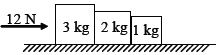
Three blocks of masses $3\, kg, 2\, kg$ and $1\, kg$ are placed side by side on a smooth  surface as shown in figure. A horizontal force of $12\,N$ is applied to $3\, kg$ block. The  net force on $2\, kg$ block is ............ $N$
The position vectors of points $A, B, C$ and $D$ are $A = 3\hat i + 4\hat j + 5\hat k,\,\,B = 4\hat i + 5\hat j + 6\hat k,\,\,C = 7\hat i + 9\hat j + 3\hat k$ and $D = 4\hat i + 6\hat j$ then the displacement vectors $AB$ and $CD $ are
The torque of a force $5 \hat{i}+3 \hat{j}-7 \hat{k}$ about the origin is $\tau$. If the force acts on a particle whose position vector is $2 \hat{i}+2 \hat{j}+\hat{k}$, then the value of $\tau$ will be.
For a certain organ pipe, the first three resonance frequencies are in the ratio of $1:3:5$ respectively. If the frequency of fifth harmonic is $405\,Hz$ and the speed of sound in air is $324 \,ms ^{-1}$ the length of the organ pipe is $..........m.$
Assume that a tunnel is dug along a chord of the earth, at a perpendicular distance $( R / 2)$ from the earth's centre, where $'R'$ is the radius of the Earth. The wall of the tunnel is frictionless. If a particle is released in this tunnel, it will execute a simple harmonic motion with a time period
The source producing sound and an observer both are moving along the direction of propagation of sound waves. If the respective velocities of sound, source and an observer are $v,  {v_s}$ and ${v_o}$, then the apparent frequency heard by the observer will be ($n =$ frequency of sound)
A body is projected vertically upward direction from the surface of earth. If upward direction is taken as positive, then acceleration of body during its upward and downyard jourhey are respectively
If the mass of the Sun were ten times smaller  and the universal gravitational constant were ten times larger in magnitude, which of the following is not correct? 
A body at rest may have