MCQ
A force $\vec F = (5\hat i + 3\hat j + 2\hat k)N$ is applied over a particle which displaces it from its origin to the point $\vec r = (2\hat i - \hat j)m$. The work done on the particle in joules is
  • A
    $-7$
  • $+7$
  • C
    $+10$
  • D
    $+13$

Answer

Correct option: B.
$+7$
b
(b)$W = \overrightarrow F .\overrightarrow r = (5\hat i + 3\hat j + 2\hat k).(2\hat i - \hat j) = 10 - 3 = 7\,J$

Need a full question paper?

Generate a complete, print-ready paper with questions like this in minutes — across 16+ boards, with answer keys.
Start Generating Free

Similar questions

A uniform wire of length $l$ and radius $r$ has a resistance of $100\, \Omega $. It is recast into a wire of radius $\frac{r}{2}$. The resistance of new wire will be ............... $\Omega$
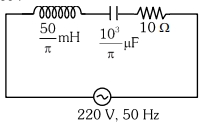
The net impedance of circuit (as shown in figure) will be $...........\,\Omega$
Reactance of a capacitor of capacitance $C\mu F$ for $ac$ frequency $\frac{{400}}{\pi }$ $Hz$ is $25\Omega $. The value $C$ is.....$\mu F$
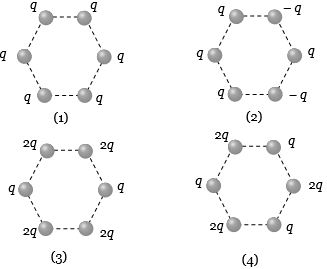
Figures below show regular hexagons, with charges at the vertices. In which of the following cases the electric field at the centre is not zero
A block starts moving up an inclined plane of inclination $30^{\circ}$ with an initial velocity of $v_{0}$. It comes back to its initial position with velocity $\frac{v_{0}}{2} .$ The value of the coefficient of kinetic friction between the block and the inclined plane is close to $\frac{ I }{1000},$ The nearest integer to $I$ is......
If the velocity of light $c$, universal gravitational constant $G$ and planck's constant $h$ are chosen as fundamental quantities. The dimensions of mass in the new system is
Select the correct statement about rainbow.
Two identical balls, $A$ and $B$ , of uniform composition and initially at the same temperature, each absorb exactly the same amount of heat. $A$ is hanging down from the ceiling while $B$ rests on the horizontal floor in the same room. Assuming no subsequent heat loss by the balls, which of the following statements is correct about their final temperatures, $T_A$ and $T_B$ , once the balls have reached their final state?
Point charge ${q_1} = 2\,\mu C$ and ${q_2} = - 1\,\mu C$ are kept at points $x = 0$ and $x = 6$ respectively. Electrical potential will be zero at points
$250\,gm$ of water and an equal volume of alcohol of mass $200\,gm$ are placed successively in the same calorimeter and cools from $60^{\circ}\,C$ to $55^{\circ}\,C$ in $130\,sec$ and $67 sec$ respectively. If the water equivalent of the calorimeter is $10\,gm$. , then the specific heat of alcohol in cal/gm $cal / gm ^{\circ}\,C$ is