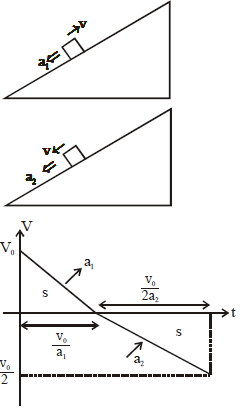
A block starts moving up an inclined plane of inclination $30^{\circ}$ with an initial velocity of $v_{0}$. It comes back to its initial position with velocity $\frac{v_{0}}{2} .$ The value of the coefficient of kinetic friction between the block and the inclined plane is close to $\frac{ I }{1000},$ The nearest integer to $I$ is......
JEE MAIN 2020, Diffcult


Download our appand get started for free
Experience the future of education. Simply download our apps or reach out to us for more information. Let's shape the future of learning together!No signup needed.*
Similar Questions
- 1A body of mass $100\, g$ is sliding from an inclined plane of inclination $30^°$. What is the frictional force experienced if $\mu = 1.7$View Solution
- 2A piece of ice slides down a rough inclined plane at $\theta=45^{\circ}$ inclination in twice the time that it takes to slide down an identical but frictionless inclined plane. What is the coefficient of friction between ice and incline ?View Solution
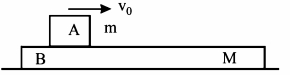
- 3The masses of blocks A and B are $m$ and $M$ respectively. Between $A$ and $B$, there is a constant frictional force $F$ and $B$ can slide on a smooth horizontal surface. A is set in motion with velocity while $B$ is at rest. What is the distance moved by A relative to $B$ before they move with the same velocity?View Solution
- 4Starting from rest a body slides down a $45^o$ inclined plane in twice the time it takes to slide down the same distance in the absence of friction. The co-efficient of friction between the body and the inclined plane isView Solution
- 5A cart moves with a constant speed along $a$ horizontal circular path. From the cart, $a$ particle is thrown up vertically with respect to the cartView Solution
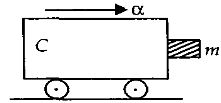
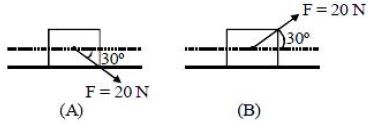
- 6A block of mass $5\, kg$ is $(i)$ pushed in case $(A)$ and $(ii)$ pulled in case $(B)$, by a force $F = 20\, N$, making an angle of $30^o$ with the horizontal, as shown in the figures. The coefficient of friction between the block and floor is $\mu = 0.2$. The difference between the accelerations of the block, in case $(B)$ and case $(A)$ will be $....... ms^{-2}$ .$(g = 10\, ms^{-2})$View Solution
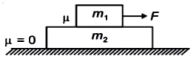
- 7In the given arrangement the maximum value of $F$ for which there is no relative motion between the blocksView Solution
- 8A body of weight $64\, N$ is pushed with just enough force to start it moving across a horizontal floor and the same force continues to act afterwards. If the coefficients of static and dynamic friction are $0.6$ and $0.4$ respectively, the acceleration of the body will be (Acceleration due to gravity $= g$)View Solution
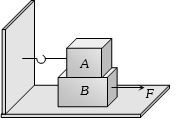
- 9A block A with mass $100\, kg $ is resting on another block $B$ of mass $200\, kg$. As shown in figure a horizontal rope tied to a wall holds it. The coefficient of friction between $A$ and $B$ is $ 0.2 $ while coefficient of friction between $B$ and the ground is $0.3$. The minimum required force $F$ to start moving $B$ will be ........ $N$View Solution
- 10A block of mass $m$ is in contact with the cart $C$ as shown in the figure. The coefficient of static friction between the block and the cart is $\mu .$ The acceleration $\alpha$ of the cart that will prevent the block from falling satisfiesView Solution