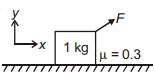
A force $\vec{F}=\hat{i}+4 \hat{j}$ acts on the block shown. The force of friction acting on the block is
Medium
Download our app for free and get started
(a)
Limiting friction $F_L=(0.3)(1)(g)$
$=3 \,N$
$x$-component or horizontal component of force is $=1 \,N$
hence this much of magnitude will act in backward direction due to friction.

Download our appand get started for free
Experience the future of education. Simply download our apps or reach out to us for more information. Let's shape the future of learning together!No signup needed.*
Similar Questions
- 1A car is moving on a circular path and takes a turn. If ${R_1}$ and ${R_2}$ be the reactions on the inner and outer wheels respectively, thenView Solution
- 2If ${\mu _s},\,{\mu _k}$ and ${\mu _r}$ are coefficients of static friction, sliding friction and rolling friction, thenView Solution
- 3A body is moving along a rough horizontal surface with an initial velocity $6\,\,m/s.$ If the body comes to rest after travelling $9\, m$, then the coefficient of sliding friction will beView Solution
- 4View SolutionThe limiting value of static friction between two contact surfaces is ...........
- 5A particle is moving along the circle $x^2 + y^2 = a^2$ in anti clock wise direction. The $x-y$ plane is a rough horizontal stationary surface. At the point $(a\, cos\theta , a\, sin\theta )$, the unit vector in the direction of friction on the particle is:View Solution
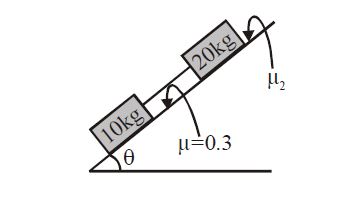
- 6Value of $\theta$ is increased gradually from $\theta = 0$ At $\theta=tan^{-1}(\frac{1}{2})$ both the block just start slipping. Then value of $\mu_2$ is : $(g = 10 m/s^2)$View Solution
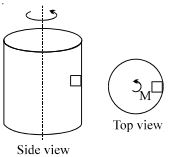
- 7A hollow vertical cylinder of radius $R$ is rotated with angular velocity $\omega$ about an axis through its center. What is the minimum coefficient of static friction necessary to keep the mass $M$ suspended on the inside of the cylinder as it rotates?View Solution
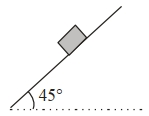
- 8Consider a block kept on an inclined plane (inclined at $45^{\circ}$ ) as shown in the figure. If the force required to just push it up the incline is $2$ times the force required to just prevent it from sliding down, the coefficient of friction between the block and inclined plane $(\mu)$ is equal toView Solution
- 9A block of mass $m$ slides down the plane inclined at angle $30^{\circ}$ with an acceleration $\frac{ g }{4}$. The value of coefficient of kinetic friction will be :View Solution
- 10A uniform rod of length $L$ and mass $M$ has been placed on a rough horizontal surface. The horizontal force $F$ applied on the rod is such that the rod is just in the state of rest. If the coefficient of friction varies according to the relation $\mu = Kx$ where $K$ is a $+$ ve constant. Then the tension at mid point of rod isView Solution