If ${\mu _s},\,{\mu _k}$ and ${\mu _r}$ are coefficients of static friction, sliding friction and rolling friction, then
Easy
Download our app for free and get started
(c) $\mu_{r}<\mu_{k}<\mu_{s}$
which implies that the rolling friction is least because of the wheel and rotating effect and the kinetic friction is in middle of the series because of its moving properties $\&$ static friction is highest because of the limiting moving properties.

Download our appand get started for free
Experience the future of education. Simply download our apps or reach out to us for more information. Let's shape the future of learning together!No signup needed.*
Similar Questions
- 1$A$ particle inside the rough surface of $a$ rotating cone about its axis is at rest relative to it at $a$ height of $1m$ above its vertex. Friction coefficient is $\mu = 0.5$, if half angle of cone is $45^o$, the maximum angular velocity of revolution of cone can be :View Solution
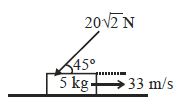
- 2A block of mass $5\, kg$ is kept on a rough horizontal floor. It is given a velocity $33\, m/s$ towards right. A force of $20\sqrt {2\,} \,N$ continuously acts on the block as shown in the figure. If the coefficient of friction between block and floor is $0.5$ the velocity of block after $3\, seconds$ is ........ $m/s$ ($g = 10\, m/s^2$)View Solution
- 3A lift is moving downwards with an acceleration equal to acceleration due to gravity. A body of mass $m$ kept on the floor of the lift is pulled horizontally. If the coefficient of friction is $\,\mu $, then the frictional resistance offered by the body isView Solution
- 4A coin is placed on a disc. The coefficient of friction between the coin and the disc is $\mu$. If the distance of the coin from the center of the disc is $r$, the maximum angular velocity which can be given to the disc, so that the coin does not slip away, is:View Solution
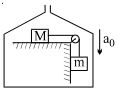
- 5In figure, two blocks $M$ and $m$ are tied together with an inextensible and light string. The mass $M$ is placed on a rough horizontal surface with coefficient of friction $\mu$ and the mass $m$ is hanging vertically against a smooth vertical wall. The pulley is frictionless. Imagine a situation in which the given arrangement is placed inside an elevator that can move only in the vertical direction and compare the situation with the case when it is placed on the ground. When the elevator accelerates downward with $a_0( < g)$, thenView Solution
- 6A vehicle is moving with speed $v$ on a curved road of radius $r$. The coefficient of friction between the vehicle and the road is $\mu$. The angle $\theta$ of banking needed is given byView Solution
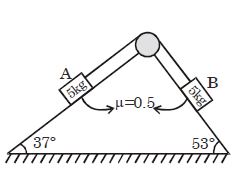
- 7In the shown arrangement if $f_A\,,\, f_B$ and $T$ be the frictional forces on $A$ Block, $B$ Block and tension in the string respectively, then their values areView Solution
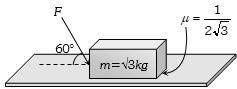
- 8What is the maximum value of the force $F$ such that the block shown in the arrangement, does not move ........ $N$View Solution
- 9A block of mass $10\, kg$ is placed on a rough horizontal surface having coefficient of friction $\,\mu = 0.5$. If a horizontal force of $100\, N$ is acting on it, then acceleration of the block will be ....... $m/s^2$View Solution
- 10A horizontal force of $129.4 \,N $ is applied on a $10\, kg$ block which rests on a horizontal surface. If the coefficient of friction is $0.3$, the acceleration should be ....... $m/s^2$View Solution