A block of mass $m$ slides down the plane inclined at angle $30^{\circ}$ with an acceleration $\frac{ g }{4}$. The value of coefficient of kinetic friction will be :
JEE MAIN 2023, Medium
Download our app for free and get started
$Mg \sin 30^{\circ}-\mu mg \cos 30^{\circ}= ma$
$\frac{g}{2}-\frac{\sqrt{3}}{2} \cdot \mu g=\frac{g}{4}$
$\frac{\sqrt{3}}{2} \mu=\frac{1}{4}$
$\mu=\frac{1}{2 \sqrt{3}}$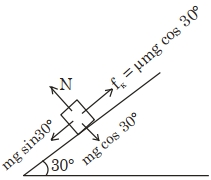

Download our appand get started for free
Experience the future of education. Simply download our apps or reach out to us for more information. Let's shape the future of learning together!No signup needed.*
Similar Questions
- 1A force of $19.6\, N$ when applied parallel to the surface just moves a body of mass $10 \,kg$ kept on a horizontal surface. If a $5\, kg$ mass is kept on the first mass, the force applied parallel to the surface to just move the combined body is........ $N.$View Solution
- 2$Assertion$ : Angle of repose is equal to the angle of limiting friction.View Solution
$Reason$ : When the body is just at the point of motion, the force of friction in this stage is called limiting friction. - 3View SolutionA cyclist taking turn bends inwards while a car passenger taking same turn is thrown outwards. The reason is
- 4A box when dropped from a certain height reaches the ground with a speed $v$. When it slides from rest from the same height down a rough inclined plane inclined at angle $45^{\circ}$ to the horizontal, it reaches the ground with a speed $v / 3$. The coefficient of sliding friction between the box and the plane is (Take, acceleration due to gravity is $10 \,ms ^{-2}$ )View Solution
- 5A body of mass $2 \,kg$ is kept by pressing to a vertical wall by a force of $100\, N$. The coefficient of friction between wall and body is $0.3.$ Then the frictional force is equal to ........ $N$View Solution
- 6$STATEMENT-1$ It is easier to pull a heavy object than to push it on a level ground. andView Solution
$STATEMENT-2$ The magnitude of frictional force depends on the nature of the two surfaces in contact.
- 7A $2 \,kg$ mass starts from rest on an inclined smooth surface with inclination $30^°$ and length $2\, m$. ...... $m$ will it travel before coming to rest on a frictional surface with frictional coefficient of $0.25$View Solution
- 8A force $F = Kt$ (where $t$ is the time in seconds and $K = 2\, N/s$) is applied on $2 \,kg$ block at $t = 0$ as shown in the figure. The displacement of $8\ kg$ block till the time when $2\, kg$ block start slipping on $8\,kg$ block will be (coefficient of friction between $2\,kg$ block and $8\, kg$ block is $0.2$ and between $8\, kg$ block and surface is zero,View Solution
$g = 10m/s^2)$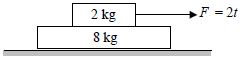
- 9Statement $I :$ A cyclist is moving on an unbanked road with a speed of $7\, kmh ^{-1}$ and takes a sharp circular turn along a path of radius of $2 \,m$ without reducing the speed. The static friction coefficient is $0.2$ . The cyclist will not slip and pass the curve $\left( g =9.8\, m / s ^{2}\right)$View Solution
Statement $II :$ If the road is banked at an angle of $45^{\circ}$, cyclist can cross the curve of $2\, m$ radius with the speed of $18.5\, kmh ^{-1}$ without slipping.
In the light of the above statements, choose the correct answer from the options given below.
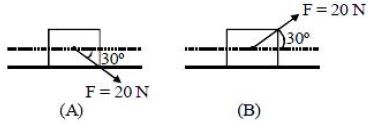
- 10A block of mass $5\, kg$ is $(i)$ pushed in case $(A)$ and $(ii)$ pulled in case $(B)$, by a force $F = 20\, N$, making an angle of $30^o$ with the horizontal, as shown in the figures. The coefficient of friction between the block and floor is $\mu = 0.2$. The difference between the accelerations of the block, in case $(B)$ and case $(A)$ will be $....... ms^{-2}$ .$(g = 10\, ms^{-2})$View Solution