MCQ
A frame of reference that is accelerated with respect to an inertial frame of reference is called a non-inertial frame of reference. A coordinate system fixed on a circular disc rotating about a fixed axis with a constant angular velocity $\omega$ is an example of a non-intertial fiame of reference. The relationship between the force $\vec{F}_{\text {rot }}$ experienced by a particle of nass in moving on the rotating disc and the force $\vec{F}_{\text {in }}$ experienced by the particle in an inertial frame of reference is

$\vec{F}_{\text {rot }}=\vec{F}_{\text {in }}+2 m\left(\vec{v}_{\text {rot }} \times \vec{\omega}\right)+m(\vec{\omega} \times \vec{r}) \times \vec{\omega},$

where $\vec{v}_{\text {rot }}$ is the velocity of the particle in the rotating frame of reference and $\bar{r}$ is the position vector of the particle with respect to the centre of the disc.

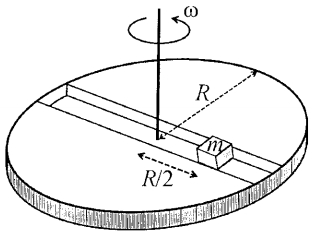
Now consider a smooth slot along a diameter of a disc of radius $R$ rotating counter-clockwise with a constant angular speed $\omega$ about its vertical axis through its center. We assign a coordinate system with the origin at the center of the disc, the $x$-axis along the slot, the $y$-axis perpendicular to the slot and the $z$-axis along the rotation axis $(\vec{\omega}=\omega \hat{k})$. A sm a $1$ block of mass $m$ is gently placed in the slot at $\vec{r}=(R / 2) \hat{i}$ at $t=0$ and is constrained to move only along the slot.

(Image)

($1$) The distance $r$ of the block at time $t$ is

($A$) $\frac{R}{4}\left(e^{\omega t}+e^{-\omega t}\right)$   ($B$) $\frac{R}{2} \cos \omega t$   ($C$) $\frac{R}{4}\left(e^{2 \omega t}+e^{-2 \omega t}\right)$

($D$) $\frac{F}{2} \cos 2 \omega t$

($2$) The net reaction of the disc on the block is

($A$) $\frac{1}{2} m \omega^2 R\left(e^{2 \omega t}-e^{-2 \omega t}\right) \hat{j}+m g \hat{k}$

($B$) $\frac{1}{2} m \omega^2 R\left(e^{\omega t}-e^{-a t t}\right) j+m g k$

($C$) $-m \omega^2 R \cos \omega t \hat{j}-m g \hat{k}$

($D$) $m \omega^2 R \sin \omega t \hat{j}-m g \hat{k}$

Give the answer quetioin ($1$) ($2$)
  • $A,B$
  • B
    $A,C$
  • C
    $A,D$
  • D
    $A,B,C$

Answer

Correct option: A.
$A,B$
a
$1.$ $\text { Force on the block along slat }=m r \omega^2=m v \frac{d v}{d r}$

$\therefore \int_o^v V d v=\int_{R / 2}^r \omega^2 r d r \Rightarrow V=\omega \sqrt{r^2-\frac{R^2}{4}}=\frac{d r}{d t}$

$\therefore \int_{R / 2}^r \frac{d r}{\sqrt{r^2-\frac{R^2}{4}}}=\int_o^t \omega d t$

On solving we get

$r+\sqrt{r^2-\frac{R^2}{4}}=\frac{R}{2} e^{w t}$

or $r^2-\frac{R^2}{4}=\frac{R^2}{4} e^{2 w t}+r^2-2 r \frac{R}{2} e^{w t}$

$\therefore r=\frac{R}{4}\left(e^{w t}+e^{-w t}\right)$

Need a full question paper?

Generate a complete, print-ready paper with questions like this in minutes — across 16+ boards, with answer keys.

Start Generating Free

Similar questions

A stone is projected from ground at $t = 0$. At the time of projection horizontal and vertical component of velocity are $10\, m/s$ and $20\, m/s$ respectively. Then time at which tangential and normal acceleration magnitude will be equal $(g = 10\, m/s^2)$ [neglect air friction]    ......... $\sec$
A black body at a temperature of $1640 K$  has the wavelength corresponding to maximum emission equal to $1.75$ $\mu $. Assuming the moon to be a perfectly black body, the temperature of the moon, if the wavelength corresponding to maximum emission is $ 14.35$ $\mu $ is ...... $K$
If $m$ mass of a substance undergoes a phase change, then amount of heat required will be:
The particle displacement of a travelling longitudional wave is represented by $\xi  = \xi (x,t)$. The midpoints of a compression zone and an adjacent rarefaction zone are represented by the letter ‘$C’$ and $‘R’$. Which of the following is true?
A body of mass $10\, kg$ is lying on a rough plane inclined at an angle of $30^o$ to the horizontal and the coefficient of friction is $0.5$. the minimum force required to pull the body up the plane is ........ $N$
Two rods of same length and cross section are joined along the length. Thermal conductivities of first and second rod are ${K_1}\,\,{\rm{and}}\,\,{K_2}$. The temperature of the free ends of the first and second rods are maintained at ${\theta _1}\,\,{\rm{and }}{\theta _2}$ respectively. The temperature of the common junction is
Three identical thin rods each of mass $m$ and length $l$ are placed along $x, y$ and $z$ -axis respectively they are placed such that, one end of each rod is at origin $O$ . Then moment of inertia of this system about $z -$ axis is
A solid sphere of mass $M$ and radius $R$ is divided into two unequal parts. The first part has a mass of $\frac {7M}{8}$ and is converted into a uniform disc of radius $2R.$ The second part is converted into a uniform solid sphere. Let $I_1$ be the moment of inertia of the disc about its axis and $I_2$ be the moment of inertia of the new sphere about its axis. The ratio of $I_1/I_2$ is given by
The graph predicts the condition of:
For a $\text{SHM},$ if the maximum potential energy become double, choose the correct option.