MCQ
The graph predicts the condition of:
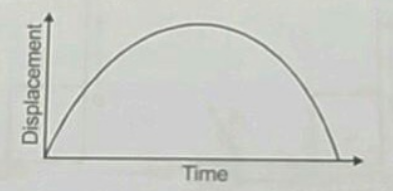
  • A
    Body is undergoing positive acceleration.
  • Body is undergoing negative acceleration.
  • C
    Uniform velocity.
  • D
    Uniform speed.

Answer

Correct option: B.
Body is undergoing negative acceleration.

Need a full question paper?

Generate a complete, print-ready paper with questions like this in minutes — across 16+ boards, with answer keys.

Start Generating Free

Similar questions

Three particles each of mass $M$ are placed at the three corners of an equilateral triangle of side $l$ . What is the force due to this system of particles on another particle of mass $m$ placed at the mid -point of any side?
In an elastic collision:
The speed of a homogeneous solid sphere after rolling down an inclined plane of vertical height $h$, from rest without sliding, is
Two bodies are thrown up at angles of $45^o $ and $60^o $, respectively, with the horizontal. If both bodies attain same vertical height, then the ratio of velocities with which these are thrown is
One kilowatt hour is equal to
The average kinetic energy of a gas molecule at $27^oC$ is $6.21 \times {10^{ - 21}}\,J$. Its average kinetic energy at $227°C$ will be
If the radius of curvature of the path of two particles of same masses are in the ratio $1 : 2$, then in order to have constant centripetal force, their velocity, should be in the ratio of
A student performed the experiment to measure the speed of sound in air using resonance air-column method. Two resonances in the air-column were obtained by lowering the water level. The resonance with the shorter air-column is the first resonance and that with the longer air-column is the second resonance. Then,

$(A)$ the intensity of the sound heard at the first resonance was more than that at the second resonance

$(B)$ the prongs of the tuning fork were kept in a horizontal plane above the resonance tube

$(C)$ the amplitude of vibration of the ends of the prongs is typically around $1 \mathrm{~cm}$

$(D)$ the length of the air-column at the first resonance was somewhat shorter than $1 / 4$ th of the wavelength of the sound in air

Which of the following statements are correct.
A particle starts moving rectilinearly at time $t = 0$ such that its velocity $'v'$ changes with time $'t'$ according to the equation $v = t^2 - t$ where $t$ is in seconds and $v$ is in $m/s.$ The time interval for which the particle retards is