Question
A frog can be deviated in a magnetic field produced by a current in a vertical solenoid placed below the frog. This is possible because the body of the frog behaves as(a) Paramagnetic(b) Diamagnetic(c) Ferromagnetic(d) Antiferromagnetic
       

Answer

(b) Diamagnetic

Need a full question paper?

Generate a complete, print-ready paper with questions like this in minutes — across 16+ boards, with answer keys.
Start Generating Free

Similar questions

The transconductance of a triode amplifier is 2.5 mili mho having plate resistance of 20 KW, amplification 10. Find the load resistance(a) 5 kW  (b) 25 kW(c) 20 kW(d) 50 kW
       
The surface with a constant value of potential at all points on the surface is called as:
A dielectric slab is inserted between the plates of an isolated charged capacitor. Which of the following quantities will remain the same?
 A rod of length l rotates with a small but uniform angular velocity $\omega$ about its perpendicular bisector. A uniform magnetic field B exists parallel to the axis of rotation. The potential difference between the centre of the rod and an end is:
  1. $\text{zero}$
  2. $\frac{1}{8}\omega\text{Bl}^2$
  3. $\frac{1}{2}\omega\text{Bl}^2$
  4. $\text{B}\omega\text{l}^2$ 
The photoelectric threshold wavelength for a metal surface is 6600 Å. The work function for this is(a) 1.87 V(b) 1.87 eV(c) 18.7 eV(d) 0.18 eV
       
The time taken by a photo$-$electron to come out after the photon strikes is approximately:
The current in a triode at anode potential $100 V$ and grid potential $– 1.2 V$ is $7.5\ mA$. If grid potential is changed to $– 2.2 V,$ the current becomes $5.5\ mA$. the value of trans conductance $(g_m)$ will be
What is the S.I. unit of electric potential? 
A wire can sustain the weight of 20kg before breaking. If the wire is cut into two equal parts, each part can sustain a weight of.
  1. 10kg
  2. 20kg
  3. 40kg
  4. 80kg.
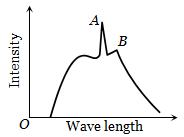
The figure represents the observed intensity of $X-$rays emitted by an $X-$ray tube as a function of wavelength. The sharp peaks $A$ and $B$ denote