Question
A function f(x) is said to be continuous in an open interval (a, b), if it is continuous at every point in this interval.
A function f(x) is said to be continuous in the closed interval [a, b), if f(x) is continuous in (a, b) and $\lim\limits_{\text{x}\rightarrow0}\text{f}(\text{a}+\text{h})=\text{f}(\text{a})$ and $\lim\limits_{\text{x}\rightarrow0}\text{f}(\text{b}-\text{h})=\text{f}(\text{b})$
If function $\text{f}(\text{x})=\begin{cases}\frac{\sin(\text{a}+1)\text{x}+\sin\text{x}}{\text{x}}&,\text{x}<0\\\text{c}&,\text{x}=0\\\frac{\sqrt{\text{x}+\text{bx}^2}-\sqrt{\text{x}}}{\text{bx}^{\frac{3}{2}}}&,\text{x}>0\end{cases}$ is continuous at x = 0, then answer the following questions.
  1. The value of a is:
  1. $-\frac{3}{2}$
  2. $0$
  3. $\frac{1}{2}$
  4. $-\frac{1}{2}$
  1. The value of b is:
  1. 1
  2. -1
  3. 0
  4. Any real number.
  1. The value of c is:
  1. $1$
  2. $\frac{1}{2}$
  3. $-1$
  4. $-\frac{1}{2}$
  1. The value of a + c is:
  1. 1
  2. 0
  3. -1
  4. -2
  1. The value of c - a is:
  1. 1
  2. 0
  3. -1
  4. 2

Answer

$\text{L.H.L.}(\text{at x})=\lim\limits_{\text{x}\rightarrow0}\frac{\sin(\text{a}+1)\text{x}+\sin\text{x}}{\text{x}}\Big(\frac{0}{0}\text{ form}\Big)$

Using L' Hospital rule, we get

$\text{L.H.L.} (\text{at x} = 0)$

$=\lim\limits_{\text{x}\rightarrow0}(\text{a}+1)\cos(\text{a}+1)\text{x}+\cos\text{x}=\text{a}+2$

$\text{R.H.L.} (\text{at x} = 0)=\lim\limits_{\text{x}\rightarrow0}\frac{\sqrt{\text{x}+\text{bx}^2}-\sqrt{\text{x}}}{\text{bx}^\frac{3}{2}}=\lim\limits_{\text{x}\rightarrow0}\frac{\sqrt{1+\text{bx}}-1}{\text{bx}}$

$=\lim\limits_{\text{x}\rightarrow0}\frac{1}{\sqrt{1+\text{bx}}+1}=\frac{1}{2}$

Since,f(x) is continuous at x = 0.

$\therefore$ From (i) and (ii), we get

$\text{a}+2=\text{c}=\frac{1}{2}\Rightarrow\text{a}=-\frac{3}{2},\text{c}=\frac{1}{2}$

Also, value of b does not affect the continuity of f(x), so b can be any real number.

  1. (a) $-\frac{3}{2}$

  1. (d) Any real number.
  1. (b) $\frac{1}{2}$

  1. (c) -1

Solution:

$\text{a}+\text{c}=-\frac{3}{2}+\frac{1}{2}=-1$

  1. (d) 2

Solution:

$\text{c}-\text{a}=\frac{1}{2}+\frac{3}{2}=2$

Need a full question paper?

Generate a complete, print-ready paper with questions like this in minutes — across 16+ boards, with answer keys.

Start Generating Free

Similar questions

A magazine company in a town has 5000 subscribers on its list and collects fix charges of ₹ 3000 per year from each subscriber. 'The company proposes to increase the annual charges, and it is believed that for every increase of ₹ 1 one subscriber will discontinue service.

Based on the above information, answer the following questions.

  1. If x denote the amount of increase in annual charges, then revenue R, as a function of x can be represented as.
  1. R(x) = 3000 × 5000 × x
  2. R(x) = (3000 - 2x)(5000 + 2x)
  3. R(x) = (5000 + x)(3000 - x)
  4. R(x) = (3000 + x)(5000 - x)
  1. If magazine company increases ₹ 500 as annual charges, then R is equal to.
  1. ₹ 15750000
  2. ₹ 16750000
  3. ₹ 17500000
  4. ₹ 15000000
  1. If revenue collected by the magazine company is ₹ 15640000, then value of amount increased as annual charges for each subscriber, is.
  1. 400
  2. 1600
  3. Both (a) and (b)
  4. None of these
  1. What amount of increase in annual charges will bring maximum revenue?
  1. ₹ 1000
  2. ₹ 2000
  3. ₹ 3000
  4. ₹ 4000
  1. Maximum revenue is equal to.
  1. ₹ 15000000
  2. ₹ 16000000
  3. ₹ 20500000
  4. ₹ 25000000
The Government declare that farmers can get ₹ 300 per quintal for their onions on 1st July and after that, the price will be dropped by ₹ 3 per quintal per extra day. Govind's father has 80 quintals of onions in the field on 1st July and he estimates that the crop is increasing at the rate of 1 quintal per day.

Image

(i) If $x$ is the number of days after $1^{\text {st }}$ July, then express price and quantity of onion and the revenue as a function of $x$.

(ii) Find the number of days after 1st July, when Govind's father attains maximum revenue.

(iii) On which day should Govind's father harvest the onions to maximize his revenue?

OR

Find the maximum revenue collected by Govind's father.

If y = f(u) is a differentiable function of u and u = g(x) is a differentiable function of x, then y = f(g(x)] is a differentiable function of x and $\frac{\text{dy}}{\text{dx}}=\frac{\text{dy}}{\text{du}}\times\frac{\text{du}}{\text{dx}}.$ This rule is also known as CHAIN RULE.
Based on the above information, find the derivative of functions w.r.t. x in the following questions.
  1. $\cos\sqrt{\text{x}}$
  1. $\frac{-\sin\sqrt{\text{x}}}{2\sqrt{\text{x}}}$
  2. $\frac{\sin\sqrt{\text{x}}}{2\sqrt{\text{x}}}$
  3. $\sin\sqrt{\text{x}}$
  4. $-\sin\sqrt{\text{x}}$
  1. $7^{\text{x}+\frac{1}{\text{x}}}$
  1. $\Big(\frac{\text{x}^2-1}{\text{x}^2}\Big)\cdot7^{\text{x}+\frac{1}{\text{x}}}\cdot\log7$
  2. $\Big(\frac{\text{x}^2+1}{\text{x}^2}\Big)\cdot7^{\text{x}+\frac{1}{\text{x}}}\cdot\log7$
  3. $\Big(\frac{\text{x}^2-1}{\text{x}^2}\Big)\cdot7^{\text{x}-\frac{1}{\text{x}}}\cdot\log7$
  4. $\Big(\frac{\text{x}^2+1}{\text{x}^2}\Big)\cdot7^{\text{x}-\frac{1}{\text{x}}}\cdot\log7$
  1. $\sqrt\frac{{1-\cos\text{x}}}{1+\cos\text{x}}$
  1. $\frac{1}{2}\sec^2\frac{\text{x}}{2}$
  2. $-\frac{1}{2}\sec^2\frac{\text{x}}{2}$
  3. $\sec^2\frac{\text{x}}{2}$
  4. $-\sec^2\frac{\text{x}}{2}$
  1. $\frac{1}{\text{b}}\tan^{-1}\Big(\frac{\text{x}}{\text{b}}\Big)+\frac{1}{\text{a}}\tan^{-1}\Big(\frac{\text{x}}{\text{a}}\Big)$
  1. $\frac{-1}{\text{x}^2+\text{b}^2}+\frac{1}{\text{x}^2+\text{a}^2}$
  2. $\frac{1}{\text{x}^2+\text{b}^2}+\frac{1}{\text{x}^2+\text{a}^2}$
  3. $\frac{1}{\text{x}^2+\text{b}^2}-\frac{1}{\text{x}^2+\text{a}^2}$
  4. None of these.
  1. $\sec^{-1}\text{x}+\text{cosec}^{-1}\frac{\text{x}}{\sqrt{\text{x}^2-1}}$
  1. $\frac{2}{\sqrt{\text{x}^2-1}}$
  2. $\frac{-2}{\sqrt{\text{x}^2-1}}$
  3. $\frac{1}{|\text{x}|\sqrt{\text{x}^2-1}}$
  4. $\frac{2}{|\text{x}|\sqrt{\text{x}^2-1}}$
Linear programming is a method for finding the optimal values (maximum or minimum) of quantities subject to the constraints when relationship is expressed as linear equations or inequations.

Based on the above information, answer the following questions.

  1. The optimal value of the objective function is attained at the points:
  1. On X-axis.
  2. On Y-axis.
  3. Which are comer points of the feasible region.
  4. None of these.
  1. The graph of the inequality 3x + 4y < 12 is:
  1. Half plane that contains the origin.
  2. Half plane that neither contains the origin nor the points of the line 3x + 4y = 12.
  3. Whole XOY-plane excluding the points on line 3x + 4y = 12.
  4. None of these.
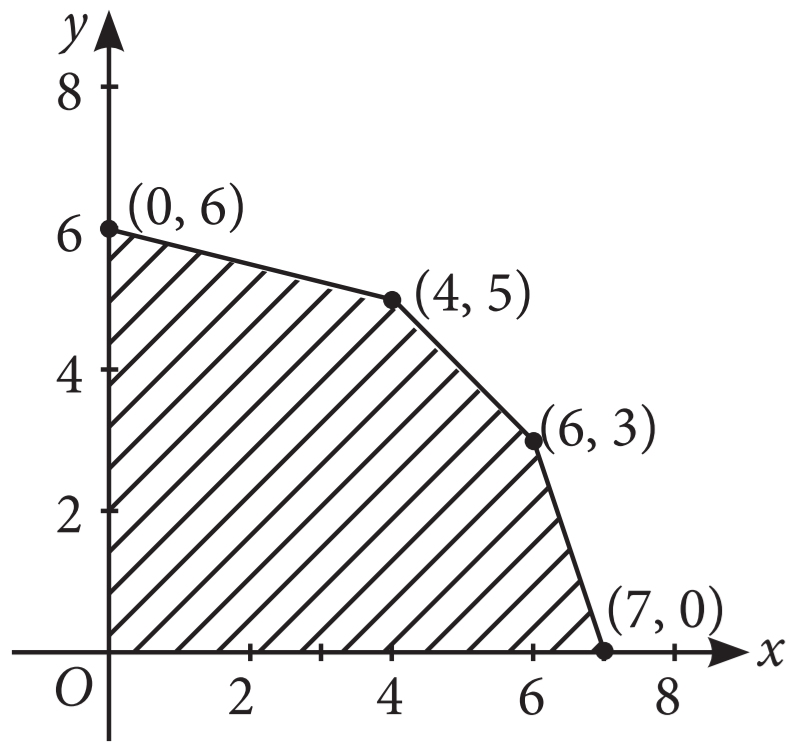
  1. The feasible region for an LPP is shown in the figure. Let Z = 2x + 5y be the objective function. Maximum of Z occurs at:

  1. (7, 0)
  2. (6, 3)
  3. (0, 6)
  4. (4, 5)
  1. The corner points of the feasible region determined by the system of linear constraints are (0, 10), (5, 5), (15, 15), (0, 20). Let Z = px + qy, where p, q > 0. Condition on p and q so that the maximum of Z occurs at both the points ( 15, 15) and (0, 20) is:
  1. p = q
  2. p = 2q
  3. q = 2p
  4. q = 3p
  1. The comer points of the feasible region determined by the system of linear constraints are (0, 0), (0, 40), (20, 40), (60, 20), (60, 0). The objective function is Z = 4x + 3y.

Compare the quantity in Column A and Column B

Column A
Column B
Maximum of Z
325
  1. The quantity in column A is greater.
  2. The quantity in column Bis greater.
  3. The two quantities are equal.
  4. The relationship cannot be determined on the basis of the information supplied.
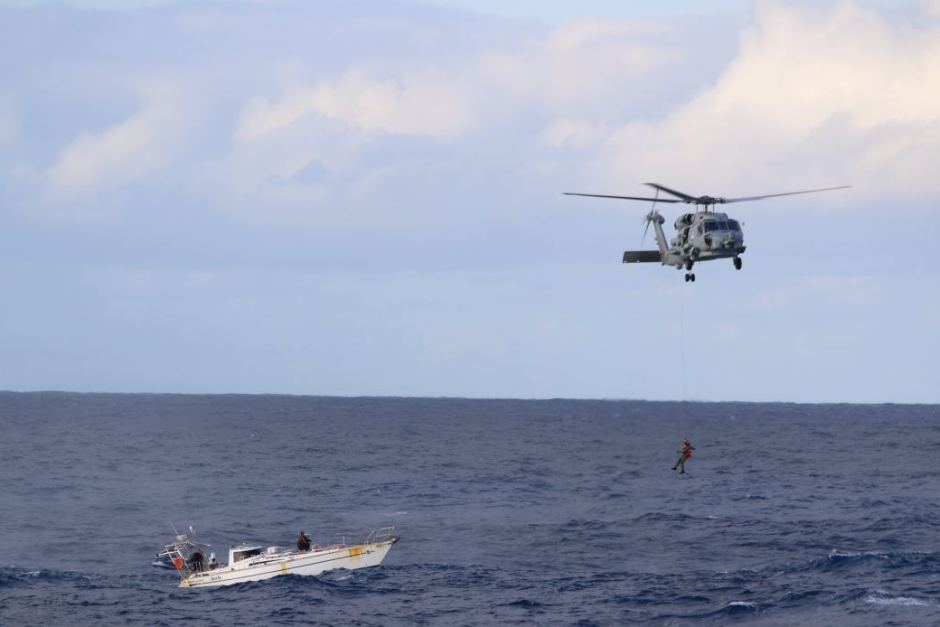
The Indian Coast Guard (ICG) while patrolling, saw a suspicious boat with four men. They were nowhere looking like fishermen. The soldiers were closely observing the movement of the boat for an opportunity to seize the boat. They observe that the boat is moving along a planar surface. At an instant of time, the coordinates of the position of coast guard helicopter and boat are (2, 3, 5) and (1, 4, 2) respectively.

Based on the above information, answer the following questions.
  1. If the line joining the positions of the helicopter and boat is perpendicular to the plane in which boat moves, then equation of plane is:
  1. x - y + 3z = 2
  2. x + y  + 3z = 2
  3. x - y + 3z = 3
  4. x + y + 3z = 3
  1. If the soldier decides to shoot the boat at given instant of time, where the distance measured in metres then what is the distance that bullet has to travel?
  1. $\sqrt{5}\text{m}$

  2. $\sqrt{8}\text{m}$

  3. $\sqrt{10}\text{m}$

  4. $\sqrt{11}\text{m}$

  1. If the speed of bullet is 30m/ sec, then how much time will the bullet take to hit the boat after the shot is fired?
  1. 30 seconds
  2. 1 second
  3. $\frac{1}{2}\text{second}$

  4. $\frac{\sqrt{11}}{30}\text{seconds}$

  1. At the given instant of time, the equation of line passing through the positions of helicopter and boat is:
  1. $\frac{\text{x}}{1}=\frac{\text{y}}{-1}=\frac{\text{z}}{3}$

  2. $\frac{\text{x}-1}{1}=\frac{\text{y}-4}{-1}=\frac{\text{z}-2}{3}$

  3. $\frac{\text{x}}{1}=\frac{\text{y}}{1}=\frac{\text{z}}{-3}$

  4. $\frac{\text{x}-1}{1}=\frac{\text{y}-4}{1}=\frac{\text{z}-2}{-3}$

  1. At a different instant of time, the boat moves to a different position along the planar surface. What should be the coordinates of the location of the boat for the bullet to hit the boat if soldier shoots the bullet along the line whose equation is $\frac{\text{x}-1}{1}=\frac{\text{y}-1}{-2}=\frac{\text{z}-2}{3}?$
  1. $\Big(\frac{1}{2},\frac{1}{2},\frac{1}{2}\Big)$

  2. $\Big(\frac{3}{4},\frac{3}{2},\frac{5}{4}\Big)$

  3. $\Big(\frac{1}{3},\frac{1}{4},\frac{1}{5}\Big)$

  4. None of these
Western music concert is organised every year in the stadium that can hold 36000 spectators. With ticket price of ₹ 10, the average attendance has been 24000. Some financial expert estimated that price of a ticket should be determined by the function.
$\text{p}(\text{x})=15-\frac{\text{x}}{3000}$ where x is the number of tickets sold.

Based on the above information, answer the following questions.
  1. The revenue, R as a function of x can be represented as.
  1. $15\text{x}-\frac{\text{x}^2}{3000}$
  2. $15-\frac{\text{x}^2}{3000}$
  3. $15\text{x}-\frac{1}{3000}$
  4. $15\text{x}-\frac{\text{x}}{3000}$
  1. The range of x is.
  1. [24000, 36000]
  2. [0, 24000]
  3. [0, 36000]
  4. None of these
  1. The value of x for which revenue is maximum, is.
  1. 20000
  2. 21000
  3. 22500
  4. 25000
  1. When the revenue is maximum, the price of the ticket is.
  1. ₹ 5
  2. ₹ 5.5
  3. ₹ 7
  4. ₹ 7.5
  1. How many spectators should be present to maximize the revenue?
  1. 21500
  2. 21000
  3. 22000
  4. 22500
Three slogans on chart papers are to be placed on a school bulletin board at the points A, Band C displaying A (Hub of Learning), B (Creating a better world for tomorrow) and C (Education comes first). The coordinates of these points are (1, 4, 2), (3, -3, -2) and (-2, 2, 6) respectively.

Based on the above information, answer the following questions.
  1. Let $\vec{\text{a}},\vec{\text{b}}$ and $\vec{\text{c}}$ be the position vectors of points A, B and C respectively, then $\vec{\text{a}}+\vec{\text{b}}+\vec{\text{c}}$ is equal to:
  1. $2\hat{\text{i}}+3\hat{\text{j}}+6\hat{\text{k}}$
  2. $2\hat{\text{i}}-3\hat{\text{j}}-6\hat{\text{k}}$
  3. $2\hat{\text{i}}+8\hat{\text{j}}+3\hat{\text{k}}$
  4. $2(7\hat{\text{i}}+8\hat{\text{j}}+3\hat{\text{k}})$
  1. Which of the following is not true?
  1. $\overline{\text{AB}}+\overline{\text{BC}}+\overline{\text{CA}}=\vec{0}$
  2. $\overline{\text{AB}}+\overline{\text{BC}}-\overline{\text{AC}}=\vec{0}$
  3. $\overline{\text{AB}}+\overline{\text{BC}}-\overline{\text{CA}}=\vec{0}$
  4. $\overline{\text{AB}}-\overline{\text{CB}}+\overline{\text{CA}}=\vec{0}$
  1. Area of $\triangle\text{ABC}$ is:
  1. 19 sq. units
  2. $\sqrt{1937}\text{sq}.\text{units}$
  3. $\frac{1}{2}\sqrt{1937}\text{sq}.\text{units}$
  4. $\sqrt{1837}\text{sq}.\text{units}$
  1. Suppose, if the given slogans are to be placed on a straight line, then the value of $|\vec{\text{a}}\times\vec{\text{b}}+\vec{\text{b}}\times\vec{\text{c}}+\vec{\text{c}}\times\vec{\text{a}}|$ will be equal to:
  1. -1
  2. -2
  3. 2
  4. 0
  1. If $\vec{\text{a}}=2\hat{\text{i}}+3\hat{\text{j}}+6\hat{\text{k}},$ then unit vector in the direction of vector $\vec{\text{a}}$ is:
  1. $\frac{2}{7}\hat{\text{i}}-\frac{3}{7}\hat{\text{j}}-\frac{6}{7}\hat{\text{k}}$
  2. $\frac{2}{7}\hat{\text{i}}+\frac{3}{7}\hat{\text{j}}+\frac{6}{7}\hat{\text{k}}$
  3. $\frac{3}{7}\hat{\text{i}}+\frac{2}{7}\hat{\text{j}}+\frac{6}{7}\hat{\text{k}}$
  4. None of these
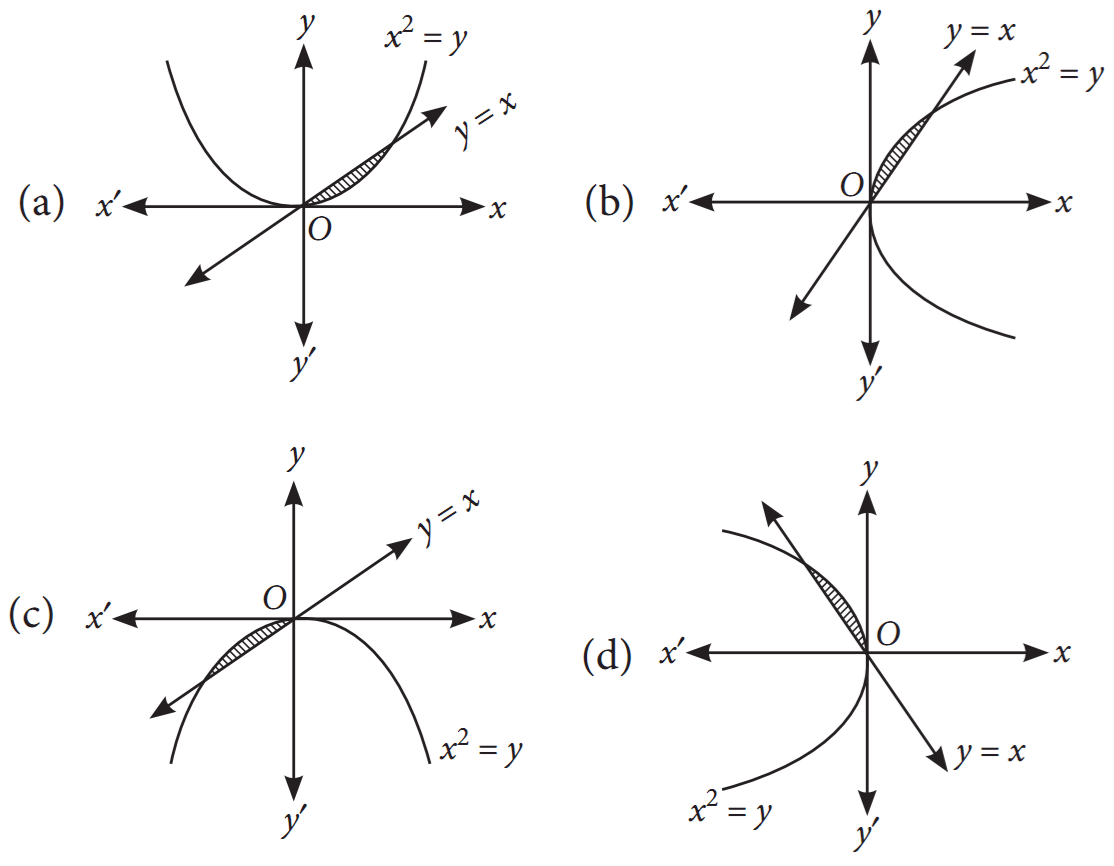
Consider the following equations of curves x2 = y and y = x.

On the basis of above information, answer the following questions.

  1. The point(s) of intersection of both the curves is (are).
  1. (0, 0)(2, 2)
  2. (0, 0)(1, 1)
  3. (0, 0)(-1, -1)
  4. (0, 0)(-2, -2)
  1. Area bounded by the curves is represented by which of the following graph?

  1. The value of the integral $\int\limits_{1}^{0}\text{x}\ \text{dx}$ is.
  1. $\frac{1}{4}$

  2. $\frac{1}{3}$

  3. $\frac{1}{2}$

  4. $1$

  1. The value of the integral $\int\limits_{0}^{1}\text{x}^2\ \text{dx}$ is.
  1. $\frac{1}{4}$

  2. $\frac{1}{3}$

  3. $\frac{1}{2}$

  4. $1$

  1. The value of area bounded by the curves x2 = y and x = y is.
  1. $\frac{1}{6}\text{ sq}.\text{unit}$

  2. $\frac{1}{3}\text{ sq}.\text{unit}$

  3. $\frac{1}{2}\text{ sq}.\text{unit}$

  4. ${1}\text{ sq}.\text{unit}$

A differential equation is said to be in the variable separable form if it is expressible in the form f(x) dx = g(y) dy.
The solution of this equation is given by
$\int\text{f(x)dx}=\int\text{g(y)dy}+\text{c},$ where c is the constant of integration.
Based on the above information, answer the following questions.
  1. If the solution of the differential equation $\frac{\text{dy}}{\text{dx}}=\frac{\text{ax+3}}{\text{2y+f}}$ represents a circle, then the value of 'a' is:
  1. 2
  2. -2
  3. 3
  4. -4
  1. The differential equation $\frac{\text{dy}}{\text{dx}}=\frac{\sqrt{1-\text{y}^2}}{\text{y}}$ determines a family of circle with.
  1. Variable radii and fixed centre (0, 1)
  2. Variable radii and fixed centre (0, -1)
  3. Fixed radius 1 and variable centre on x-axis
  4. Fixed radius 1 and variable centre on y-axis
  1. If = y'+ 1, y(0) = 1, then y (In 2) =
  1. 1
  2. 2
  3. 3
  4. 4
  1. The solution of the differential equation $\frac{\text{dy}}{\text{dx}}=\text{e}^\text{x-y}+\text{x}^2\text{e}^\text{-y}$ is:
  1. $\text{e}^\text{x}=\frac{\text{y}^3}{3}+\text{e}^\text{y}+\text{c}$
  2. $\text{e}^\text{y}=\frac{\text{x}^2}{3}+\text{e}^\text{x}+\text{c}$
  3. $\text{e}^\text{y}=\frac{\text{x}^3}{3}+\text{e}^\text{x}+\text{c}$
  4. None of these
  1. If $\frac{\text{dy}}{\text{dx}}=\text{y}\sin2\text{x},\ \text{y}(0)=1,$ then its solution is:
  1. $\text{y}=\text{e}^{\sin^2}\text{x}$
  2. $\text{y}={\sin^2}\text{x}$
  3. $\text{y}={\cos^2}\text{x}$
  4. $\text{y}=\text{e}^{\cos^2}\text{x}$
A phannaceutical company wants to advertise a new product on T.V., where the product is specially designed for women. For that an advertising executive is hired to study television-viewing habits of married couples during prime time hours. Based on past viewing records he has determined that during prime time husbands are watching television 70% of the time. It has also been determined that when the husband is watching television, 30% of the time the wife is also watching. When the husband is not watching television, 40% of the time the wife is watching television.

Based on the above information, answer the following questions.

  1. The probability that the husband is not watching television during prime time, is:
  1. 0.6

  2. 0.3

  3. 0.4

  4. 0.5

  1. If the wife is watching television, the probability that husband is also watching television, is:
  1. $\frac{2}{11}$

  2. $\frac{7}{11}$

  3. $\frac{5}{11}$

  4. $\frac{8}{11}$

  1. The probability that both husband and wife are watching television during prime time, is:
  1. 0.21

  2. 0.5

  3. 0.3

  4. 0.4

  1. The probability that the wife is watching television during prime time, is:
  1. 024

  2. 0.33

  3. 0.3

  4. 0.4

  1. If the wife is watching television, then the probability that husband is not watching television, is:
  1. $\frac{2}{11}$

  2. $\frac{4}{11}$

  3. $\frac{1}{11}$

  4. $\frac{5}{11}$