Question
A function f(x) is said to be continuous in an open interval (a, b), if it is continuous at every point in this interval.
A function f(x) is said to be continuous in the closed interval [a, b), if f(x) is continuous in (a, b) and $\lim\limits_{\text{x}\rightarrow0}\text{f}(\text{a}+\text{h})=\text{f}(\text{a})$ and $\lim\limits_{\text{x}\rightarrow0}\text{f}(\text{b}-\text{h})=\text{f}(\text{b})$
If function $\text{f}(\text{x})=\begin{cases}\frac{\sin(\text{a}+1)\text{x}+\sin\text{x}}{\text{x}}&,\text{x}<0\\\text{c}&,\text{x}=0\\\frac{\sqrt{\text{x}+\text{bx}^2}-\sqrt{\text{x}}}{\text{bx}^{\frac{3}{2}}}&,\text{x}>0\end{cases}$ is continuous at x = 0, then answer the following questions.
  1. The value of a is:
  1. $-\frac{3}{2}$
  2. $0$
  3. $\frac{1}{2}$
  4. $-\frac{1}{2}$
  1. The value of b is:
  1. 1
  2. -1
  3. 0
  4. Any real number.
  1. The value of c is:
  1. $1$
  2. $\frac{1}{2}$
  3. $-1$
  4. $-\frac{1}{2}$
  1. The value of a + c is:
  1. 1
  2. 0
  3. -1
  4. -2
  1. The value of c - a is:
  1. 1
  2. 0
  3. -1
  4. 2

Answer

$\text{L.H.L.}(\text{at x})=\lim\limits_{\text{x}\rightarrow0}\frac{\sin(\text{a}+1)\text{x}+\sin\text{x}}{\text{x}}\Big(\frac{0}{0}\text{ form}\Big)$
Using L' Hospital rule, we get
$\text{L.H.L.} (\text{at x} = 0)$
$=\lim\limits_{\text{x}\rightarrow0}(\text{a}+1)\cos(\text{a}+1)\text{x}+\cos\text{x}=\text{a}+2$
$\text{R.H.L.} (\text{at x} = 0)=\lim\limits_{\text{x}\rightarrow0}\frac{\sqrt{\text{x}+\text{bx}^2}-\sqrt{\text{x}}}{\text{bx}^\frac{3}{2}}=\lim\limits_{\text{x}\rightarrow0}\frac{\sqrt{1+\text{bx}}-1}{\text{bx}}$
$=\lim\limits_{\text{x}\rightarrow0}\frac{1}{\sqrt{1+\text{bx}}+1}=\frac{1}{2}$
Since,f(x) is continuous at x = 0.
$\therefore$ From (i) and (ii), we get
$\text{a}+2=\text{c}=\frac{1}{2}\Rightarrow\text{a}=-\frac{3}{2},\text{c}=\frac{1}{2}$
Also, value of b does not affect the continuity of f(x), so b can be any real number.
  1. (a) $-\frac{3}{2}$
  1. (d) Any real number.
  1. (b) $\frac{1}{2}$
  1. (c) -1
Solution:

$\text{a}+\text{c}=-\frac{3}{2}+\frac{1}{2}=-1$
  1. (d) 2
Solution:

$\text{c}-\text{a}=\frac{1}{2}+\frac{3}{2}=2$

Need a full question paper?

Generate a complete, print-ready paper with questions like this in minutes — across 16+ boards, with answer keys.

Start Generating Free

Similar questions

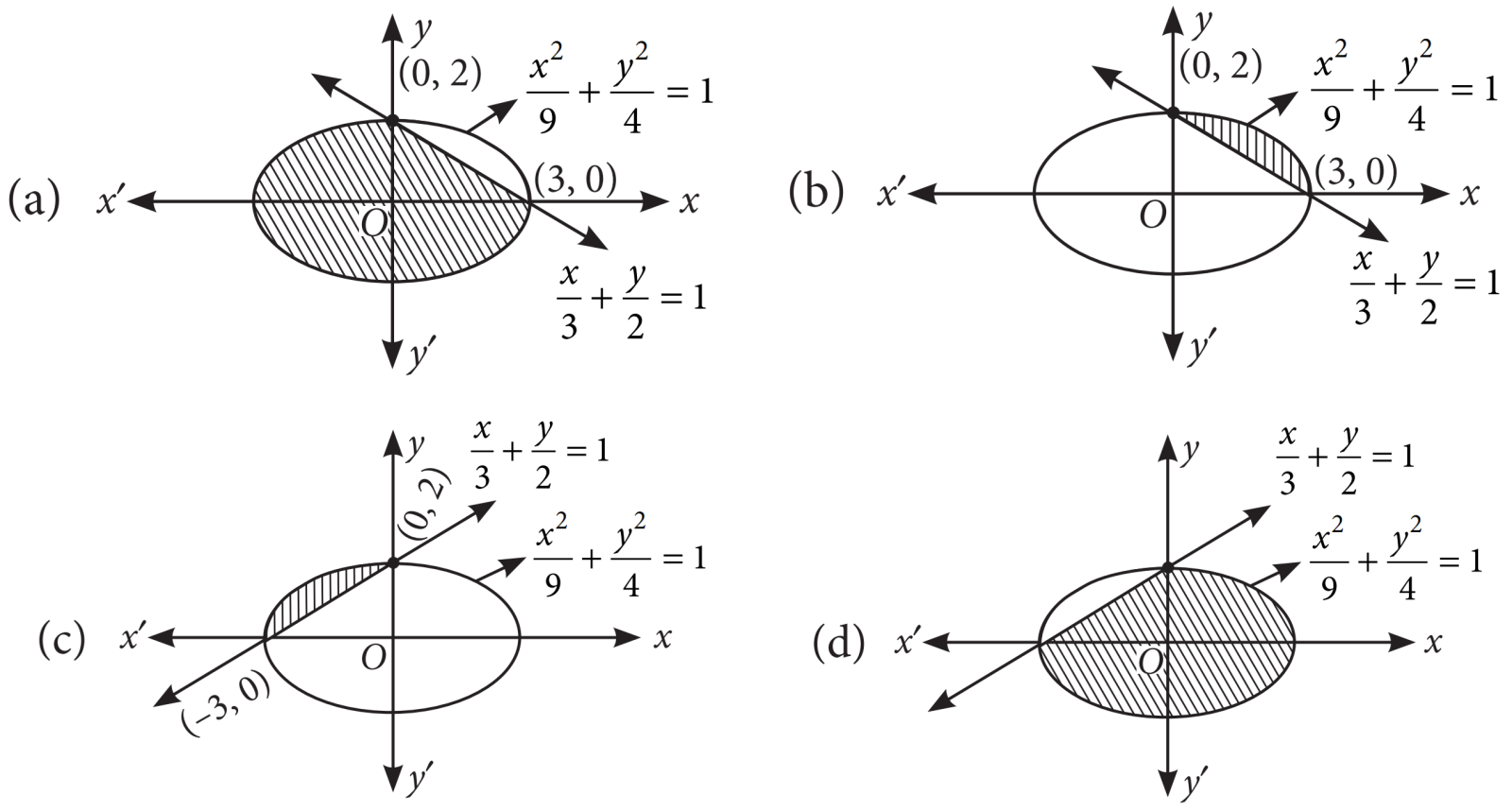
A mirror in the shape of an ellipse represented by $\frac{\text{x}^2}{9}+-\frac{\text{y}^2}{4}=1$ was hanging on the wall. Arun and his sister were playing with ball inside the house, even their mother refused to do so. All of sudden, ball hit the mirror and got a scratch in the shape of line represented by $\frac{\text{x}}{3}+\frac{\text{y}}{2}=1$

Based on the above information, answer the following questions.
  1. Point(s) of intersection of ellipse and scratch (straight line) is (are).
  1. (0, 2), (3, 0)
  2. (2, 0), (3, 0)
  3. (2, 3), (0, 0)
  4. (0, 3), (3, 0)
  1. Area of smaller region bounded by the ellipse and line is represented by.
  1. The value of $\frac{2}{3}\int\limits_{0}^{3}\sqrt{9-\text{x}^2}\text{dx}$ is.
    1. $\frac{\pi}{2}$
    2. $\pi$
    3. $\frac{3\pi}{2}$
    4. $\frac{\pi}{4}$
  1. The value of $2\int\limits_{0}^{3}\bigg(1-\frac{\text{x}}{3}\bigg)\text{dx}$ is.
    1. 0
    2. 1
    3. 2
    4. 3
  1. Area of the smaller region bounded by the mirror and scratch is.
  1. $3\Big(\frac{\pi}{2}+1\Big)\text{ sq.units}$
  2. $\Big(\frac{\pi}{2}+1\Big)\text{ sq.units}$
  3. $\Big(\frac{\pi}{2}-1\Big)\text{ sq.units}$
  4. $3\Big(\frac{\pi}{2}-1\Big)\text{ sq.units}$
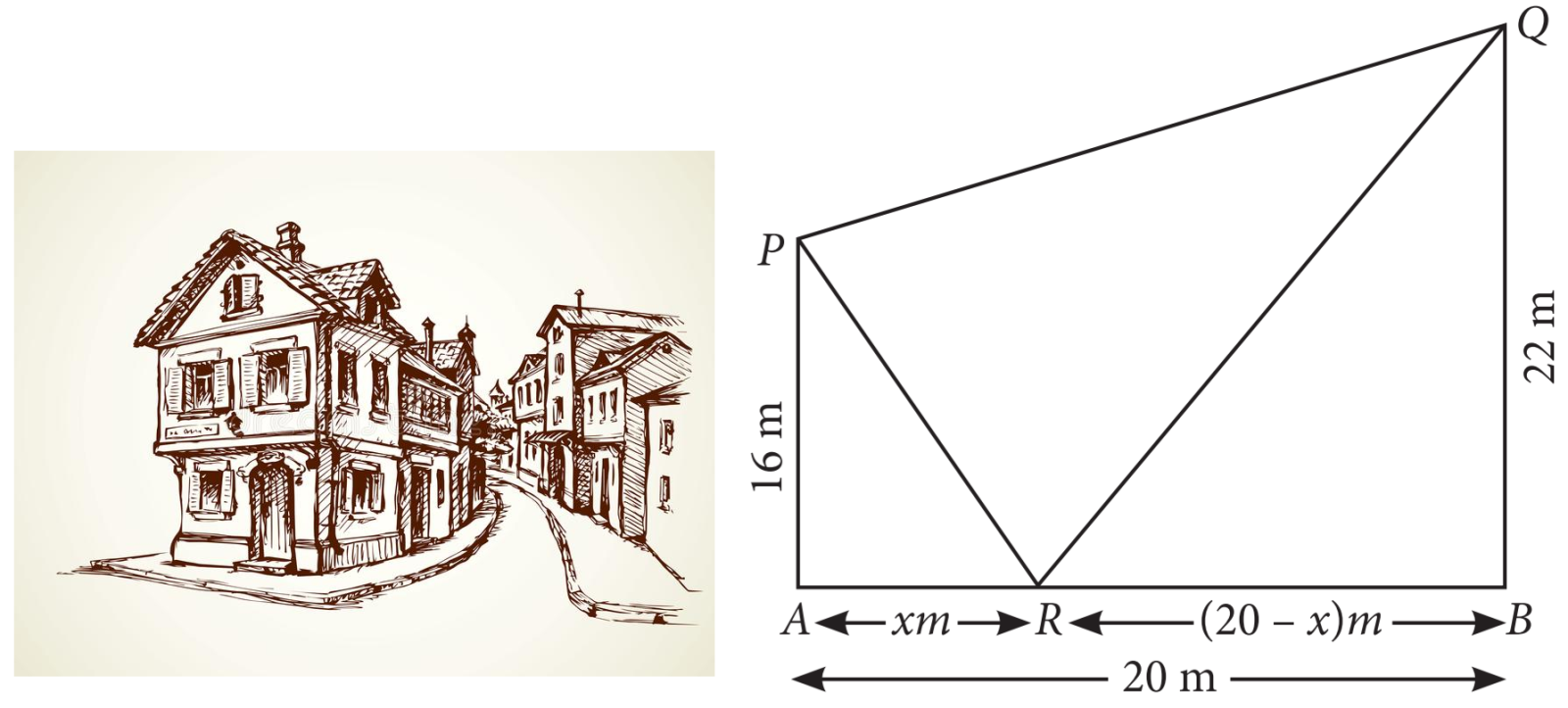
Two multi-storey buildings $($represented by $AP$ and $BQ)$ are on opposite side of a 20m wide road at point $A$ and $B$ respectively. There is a point $R$ on road as shown in figure.

Based on the above information, answer the following questions.
  1. Area of trapezium $ABQP$ is.
  1. $380$ sq. m
  2. $280$ sq. m
  3. $320$ sq. m
  4. $430$ sq. m
  1. The length PQ is.
  1. $20.5$m
  2. $19.80$ m
  3. $20.88$m
  4. $21$m
  1. Let there be a quantity $S$ such that $S = RP^2 + RQ^2$, then $S$ is given by.
  1. $2x^2 - 40x - 1140$
  2. $2x^2 + 40x + 1140$
  3. $2x^2 - 40x + 1140$
  4. $2x^2 + 40x - 1140$
  1. Find the value of $x$ for which value of $S$ is minimum.
  1. $10$
  2. $0$
  3. $4$
  4. $-10$
  1. For minimum value of $S,$ find the value of $PR$ and $RQ.$
  1. $18.50$m, $19.36$m
  2. $18.86$m, $24.17$m
  3. $17.56$m, $23.29$m
  4. None of these
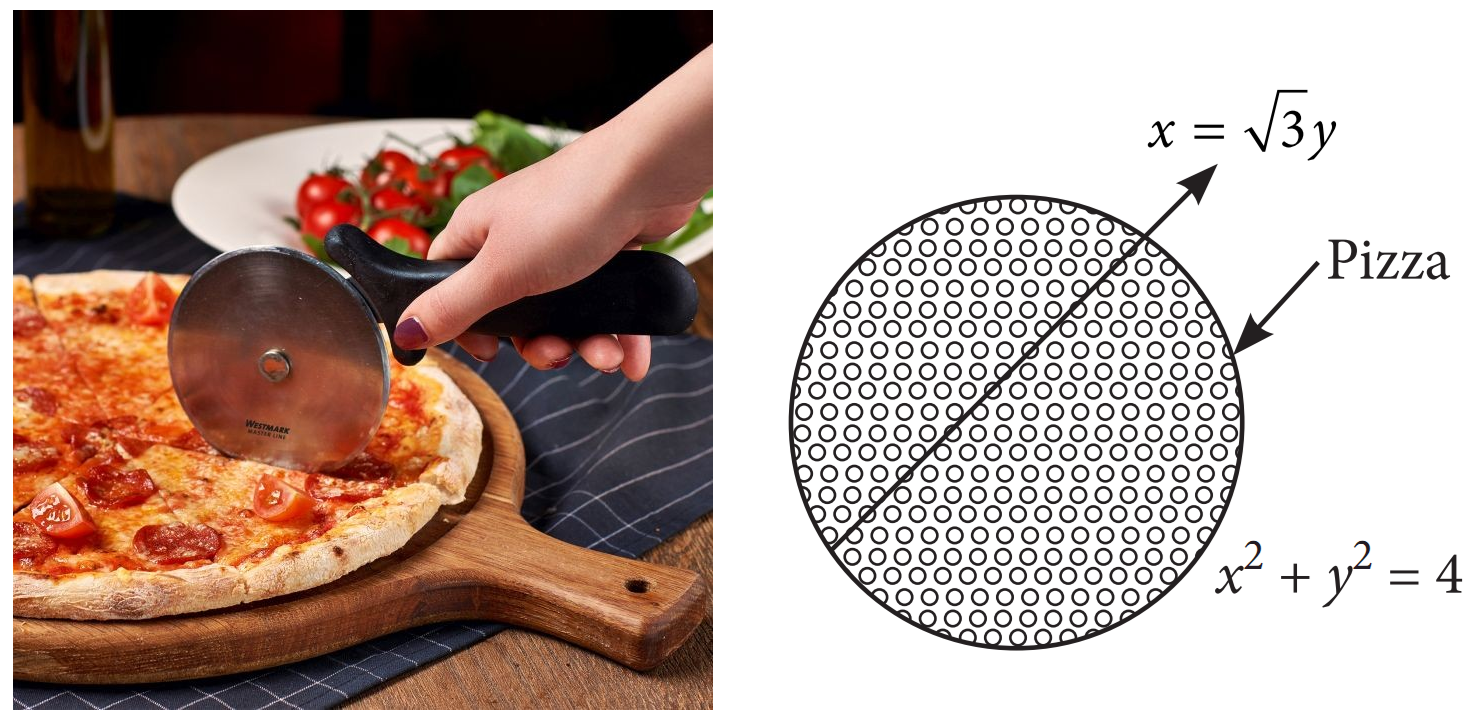
A child cut a pizza with a knife. Pizza is circular in shape which is represented by $x^2+y^2=4$ and sharp edge of knife represents a straight line given by $\text{x}=\sqrt{3\text{y}}$ Based on the above information, answer the following questions.
  1. The point(s) of intersection of the edge of knife (line) and pizza shown in the figure is (are).
  1. $(1, \sqrt{3}),(-1,-\sqrt{3})$
  2. $(\sqrt{3},1),(-\sqrt{3,}-1)$
  3. $(\sqrt{2,}0),(0,\sqrt{3})$
  4. $(-\sqrt{3,}),(1,-\sqrt{3})$
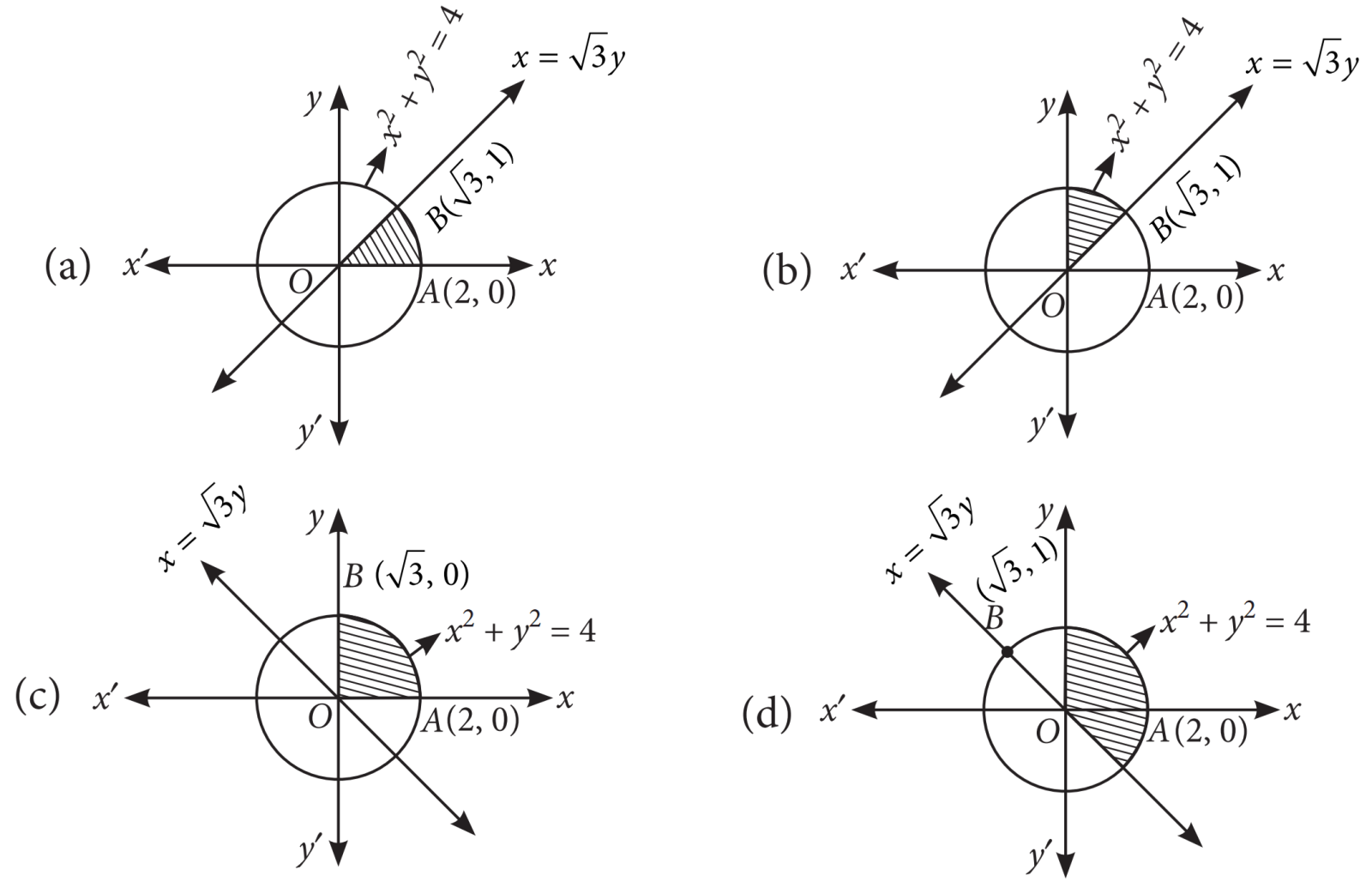
  1. Which of the following shaded portion represent the smaller area bounded by pizza and edge of knife in first quadrant?
  1. Value of area of the region bounded by circular pizza and edge of knife in first quadrant is.
  1. $\frac{\pi}{2}\text{ sq.units}$
  2. $\frac{\pi}{3}\text{ sq.units}$
  3. $\frac{\pi}{5}\text{ sq.units}$
  4. $\pi\text{ sq.units}$
  1. Area of each slice of pizza when child cut the pizza into 4 equal pieces is.
  1. $\pi\text{ sq.units}$
  2. $\frac{\pi}{2}\text{ sq.units}$
  3. $3\pi\text{ sq.units}$
  4. $2\pi\text{ sq.units}$
  1. Area of whole pizza is.
  1. $3\pi\text{ sq.units}$
  2. $2\pi\text{ sq.units}$
  3. $5\pi\text{ sq.units}$
  4. $4\pi\text{ sq.units}$
Logarithmic differentiation is a powerful technique to differentiate functions of the form $\text{f}(\text{x})=[\text{u}(\text{x})]^{\text{v}(\text{x})},$ where both u(x) and v(x) are differentiable functions and f and u need to be positive functions. Let function $\text{y}=\text{f}(\text{x})=(\text{u}(\text{x}))^{\text{v}(\text{x})},$ then $\text{y}'=\text{y}\Big[\frac{\text{v}(\text{x})}{\text{u}(\text{x})}\text{u}'(\text{x})+\text{v}'(\text{x})\cdot\log[\text{u}(\text{x})]\Big]$ On the basis of above information, answer the following questions.
  1. Differentiate $x^x$ w.r.t. $x.$
  1. $\text{x}^\text{x}(1+\log\text{x})$
  2. $\text{x}^\text{x}(1-\log\text{x})$
  3. $-\text{x}^\text{x}(1+\log\text{x})$
  4. $\text{x}^\text{x}\log\text{x}$
  1. Differentiate $x^x + a^x+ x^a + a^a$ w.r.t. $x.$
  1. $(1+\log\text{x})+(\text{a}^\text{x}\log\text{a}+\text{ax}^{\text{a}-1})$
  2. $\text{x}^\text{x}(1+\log\text{x})+\log\text{a}+\text{ax}^{\text{a}-1}$
  3. $\text{x}^\text{x}(1+\log\text{x})+\text{x}^\text{a}\log\text{x}+\text{ax}^{\text{a}-1}$
  4. $\text{x}^\text{x}(1+\log\text{x})+\text{a}^\text{x}\log\text{a}+\text{ax}^{\text{a}-1}$
  1. If $\text{x}=\text{e}^\frac{\text{x}}{\text{y}},$ then find $\frac{\text{dy}}{\text{dx}}.$
  1. $-\frac{(\text{x}+\text{y})}{\text{x}\log\text{x}}$
  2. $-\frac{(\text{x}-\text{y})}{\text{x}\log\text{x}}$
  3. $\frac{(\text{x}+\text{y})}{\text{x}\log\text{x}}$
  4. $\frac{\text{x}-\text{y}}{\text{x}\log\text{x}}$
  1. If $y = (2 - x)^3(3 + 2x)^5,$ then find $\frac{\text{dy}}{\text{dx}}.$
  1. $(2-\text{x})^3(3+2\text{x})^5\Big[\frac{15}{3+2\text{x}}-\frac{8}{2-\text{x}}\Big]$
  2. $(2-\text{x})^3(3+2\text{x})^5\Big[\frac{15}{3+2\text{x}}+\frac{3}{2-\text{x}}\Big]$
  3. $(2-\text{x})^3(3+2\text{x})^5\Big[\frac{10}{3+2\text{x}}-\frac{3}{2-\text{x}}\Big]$
  4. $(2-\text{x})^3(3+2\text{x})^5\cdot\Big[\frac{10}{3+2\text{x}}+\frac{3}{2-\text{x}}\Big]$
  1. If $\text{y}=\text{x}^\text{x}\cdot\text{e}^{(2\text{x}+5)},$ then find $\frac{\text{dy}}{\text{dx}}.$
  1. $\text{x}^\text{x}\text{e}^{2\text{x}+5}$
  2. $\text{x}^\text{x}\text{e}^{2\text{x}+5}(3-\log\text{x})$
  3. $\text{x}^\text{x}\text{e}^{2\text{x}+5}(1-\log\text{x})$
  4. $\text{x}^\text{x}\text{e}^{2\text{x}+5}\cdot(3+\log\text{x})$
Let R be the feasible region (convex polygon) for a linear programming problem and let Z = ax + by be the objective function. When Z has an optimal value (maximum or minimum), where the variables x and y are subject to constraints described by linear inequalities, this optimal value must occur at a corner point (vertex) of the feasible region. Based on the above information, answer the following questions.
  1. Objective function of a L.P.P. is:
  1. A constant.
  2. A function to be optimised.
  3. A relation between the variables.
  4. None of these.
  1. Which of the following statement is correct?
  1. Every LPP has at least one optimal solution.
  2. Every LPP has a unique optimal solution.
  3. If an LPP has two optimal solutions, then it has infinitely many solutions.
  4. None of these.
  1. In solving the LPP: "minimize f = 6x + 10y subject to constraints $\text{x}\geq6,\text{ y}\geq2,\text{ 2x}+\text{y}\geq10,\text{ x}\geq0,\text{ y}\geq0"$ redundant constraints are:
  1. $\text{x}\geq6,\text{ y}\geq2$
  2. $\text{2x}+\text{y}\geq10,\text{ x}\geq0,\text{ y}\geq0$
  3. $\text{x}\geq6$
  4. None of these
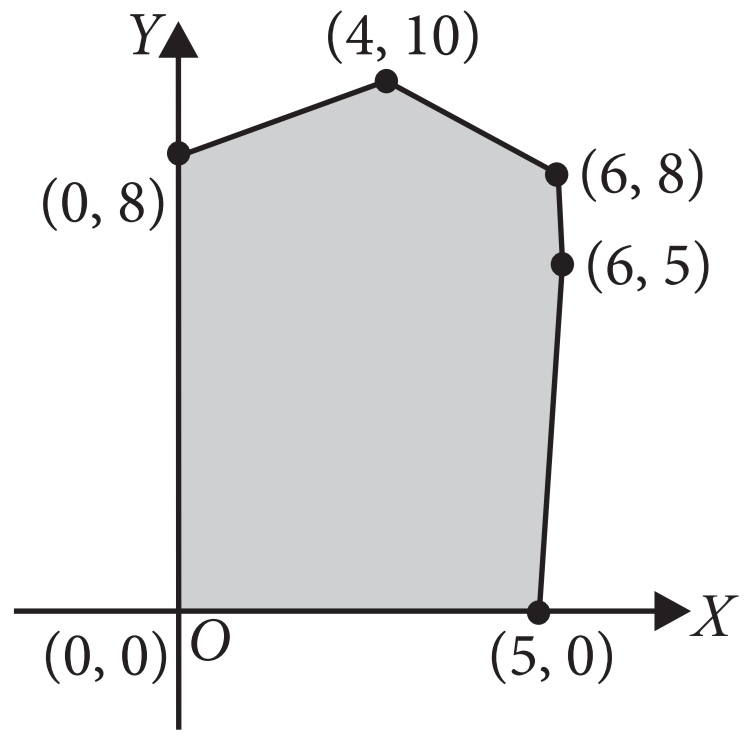
  1. The feasible region for a LPP is shown shaded in the figure. Let Z = 3x - 4y be the objective function. Minimum of Z occurs at:
  1. (0, 0)
  2. (0, 8)
  3. (5, 0)
  4. (4, 10)
  1. The feasible region for a LPP is shown shaded in the figure. Let F = 3x - 4y be the objective function. Maximum value of F is:
  1. 0
  2. 8
  3. 12
  4. -18
Suppose a dealer in rural area wishes to purpose a number of sewing machines. He has only ₹ 5760 to invest and has space for at most 20 items for storage. An electronic sewing machine costs him ₹ 360 and a manually operated sewing machine ₹ 240. He can sell an electronic sewing machine at a profit of ₹ 22 and a manually operated sewing machine at a profit of ₹ 18.

Based on the above information, answer the following questions.
  1. Let x and y denotes the number of electronic sewing machines and manually operated sewing machines purchased by the dealer. If it is assume that the dealer purchased atleast one of the the given machines, then:
  1. $\text{x}+\text{y}\geq0$
  2. $\text{x}+\text{y}<0$
  3. $\text{x}+\text{y}>0$
  4. $\text{x}+\text{y}\leq0$
  1. Let the constraints in the given problem is represented by the following inequalities.
$\text{x}+\text{y}\leq20$

$360\text{x}+240\text{y}\leq5760$

$\text{x},\text{y}\geq0$

Then which of the following point lie in its feasible region.
  1. (0, 24)
  2. (8, 12)
  3. (20, 2)
  4. None of these
  1. If the objective function of the given problem is maximise z = 22x + 18y, then its optimal value occur at:
  1. (0, 0)
  2. (16, 0)
  3. (8, 12)
  4. (0, 20)
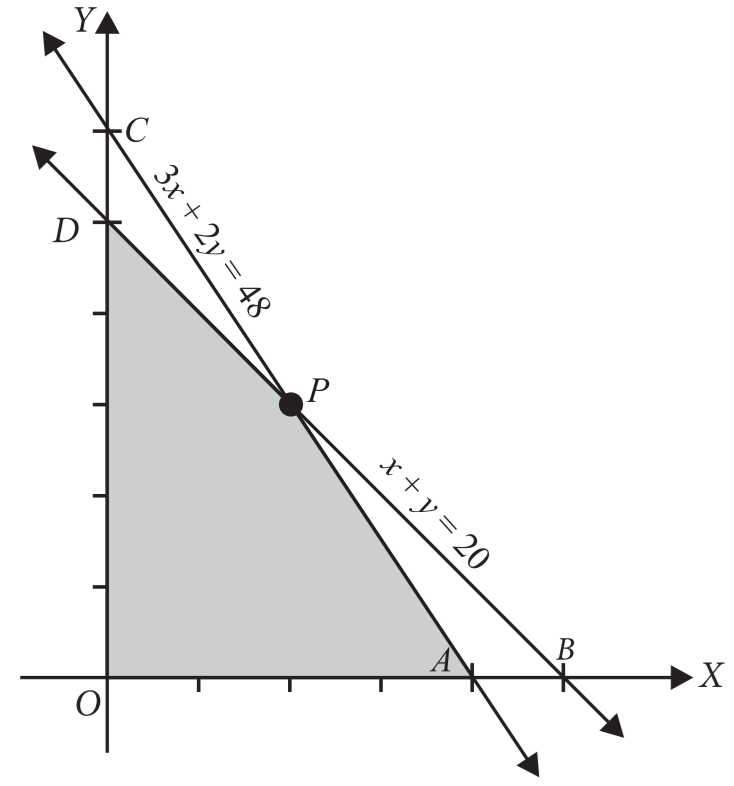
  1. Suppose the following shaded region APDO, represent the feasible region corresponding to mathematical formulation of given problem.
Then which of the following represent the coordinates of one of its corner points

  1. (0, 24)
  2. (12, 8)
  3. (8, 12)
  4. (6, 14)
  1. If an LPP admits optimal solution at two consecutive vertices of a feasible region, then:
  1. The required optimal solution is at the midpoint of the tine joining two points.
  2. The optimal solution occurs at every point on the tine joining these two points.
  3. The LPP under consideration is not solvable.
  4. The LPP under consideration must be reconstructed.
$x$ and $y$ are the sides of two squares such that $y = x - x^2.$ Find the rate of change of the area of second square with respect to the area of first square.
An architecture design a auditorium for a school for its cultural activities. The floor of the auditorium is rectangular in shape and has a fixed perimeter $P.$

Based on the above information, answer the following questions.
  1. If $x$ and $y$ represents the length and breadth of the rectangular region, then relation between the variable is.
  1. $x + y = P$
  2. $x^2 + y^2 = P^2$
  3. $2(x + y) = P$
  4. $x + 2y = P$
  1. The area (A) of the rectangular region, as a function of $x,$ can be expressed as.
  1. $\text{A}=\text{px}+\frac{\text{x}}{2}$
  2. $\text{A}=\frac{\text{px}+\text{x}^2}{2}$
  3. $\text{A}=\frac{\text{px}-\text{2x}^2}{2}$
  4. $\text{A}=\frac{\text{x}^2}{2}+\text{px}^2$
  1. School's manager is interested in maximising the area of floor $'A'$ for this to be happen, the value of $x$ should be.
  1. $\text{P}$
  2. $\frac{\text{P}}{2}$
  3. $\frac{\text{P}}{3}$
  4. $\frac{\text{P}}{4}$
  1. The value of $y,$ for which the area of floor is maximum, is.
  1. $\frac{\text{P}}{2}$
  2. $\frac{\text{P}}{3}$
  3. $\frac{\text{P}}{4}$
  4. $\frac{\text{P}}{16}$
  1. Maximum area of floor is.
  1. $\frac{\text{P}^2}{16}$
  2. $\frac{\text{P}^2}{64}$
  3. $\frac{\text{P}^2}{4}$
  4. $\frac{\text{P}^2}{28}$
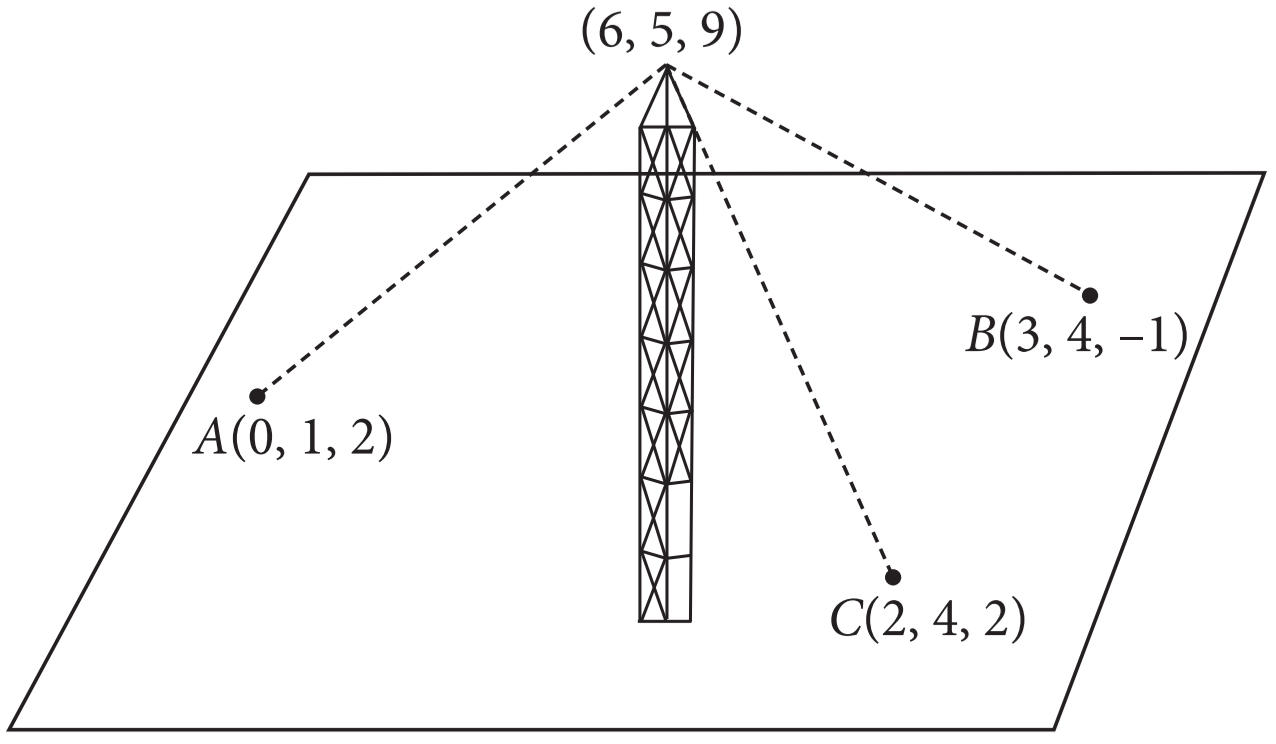
A mobile tower stands at the top of a hill. Consider the surface on which tower stand as a plane having points A(0, 1, 2), B(3, 4, -1), and C(2, 4, 2) on it. The mobile tower is tied with 3 cables from the point A, Band C such that it stand vertically on the ground. The peak of the tower is at the point ( 6, 5, 9), as shown in the figure. Based on the above information, answer the following questions.
  1. The equation of plane passing through the points A, Band C is:
  1. 3x - 4y + z = 0
  2. 3x - 2y + z = 0
  3. 3x - 2y + z = 0
  4. 4x - 3y + 3z = 0
  1. The height of the tower from the ground is:
  1. 6 units
  2. 5 units
  3. $\frac{17}{\sqrt{14}}\text{units}$
  4. $\frac{5}{\sqrt{14}}\text{units}$
  1. The equation of line of perpendicular drawn from the peak of tower to the ground is:
  1. $\frac{\text{x}-6}{3}=\frac{\text{y}-4}{-2}=\frac{\text{z}-9}{1}$
  2. $\frac{\text{x}-6}{3}=\frac{\text{y}-5}{-2}=\frac{\text{z}-9}{1}$
  3. $\frac{\text{x}-6}{3}=\frac{\text{y}-4}{2}=\frac{\text{z}-9}{1}$
  4. $\frac{\text{x}-6}{3}=\frac{\text{y}-5}{2}=\frac{\text{z}-9}{1}$
  1. The coordinates of foot of perpendicular drawn from the peak of tower to the ground are:
  1. $\Big(\frac{33}{14},\frac{104}{14},\frac{109}{14}\Big)$
  2. $\Big(\frac{33}{14},\frac{109}{14},\frac{104}{14}\Big)$
  3. $\Big(\frac{33}{14},\frac{105}{14},\frac{109}{14}\Big)$
  4. None of these
  1. The area of $\triangle\text{ABC}$ is:
  1. $\frac{1}{2}\sqrt{14}\text{sq}.\text{units}$
  2. $\frac{3}{2}\sqrt{14}\text{sq}.\text{units}$
  3. $\sqrt{14}\text{sq}.\text{units}$
  4. $2\sqrt{14}\text{sq}.\text{units}$