Question
Logarithmic differentiation is a powerful technique to differentiate functions of the form $\text{f}(\text{x})=[\text{u}(\text{x})]^{\text{v}(\text{x})},$ where both u(x) and v(x) are differentiable functions and f and u need to be positive functions. Let function $\text{y}=\text{f}(\text{x})=(\text{u}(\text{x}))^{\text{v}(\text{x})},$ then $\text{y}'=\text{y}\Big[\frac{\text{v}(\text{x})}{\text{u}(\text{x})}\text{u}'(\text{x})+\text{v}'(\text{x})\cdot\log[\text{u}(\text{x})]\Big]$ On the basis of above information, answer the following questions.
  1. Differentiate $x^x$ w.r.t. $x.$
  1. $\text{x}^\text{x}(1+\log\text{x})$
  2. $\text{x}^\text{x}(1-\log\text{x})$
  3. $-\text{x}^\text{x}(1+\log\text{x})$
  4. $\text{x}^\text{x}\log\text{x}$
  1. Differentiate $x^x + a^x+ x^a + a^a$ w.r.t. $x.$
  1. $(1+\log\text{x})+(\text{a}^\text{x}\log\text{a}+\text{ax}^{\text{a}-1})$
  2. $\text{x}^\text{x}(1+\log\text{x})+\log\text{a}+\text{ax}^{\text{a}-1}$
  3. $\text{x}^\text{x}(1+\log\text{x})+\text{x}^\text{a}\log\text{x}+\text{ax}^{\text{a}-1}$
  4. $\text{x}^\text{x}(1+\log\text{x})+\text{a}^\text{x}\log\text{a}+\text{ax}^{\text{a}-1}$
  1. If $\text{x}=\text{e}^\frac{\text{x}}{\text{y}},$ then find $\frac{\text{dy}}{\text{dx}}.$
  1. $-\frac{(\text{x}+\text{y})}{\text{x}\log\text{x}}$
  2. $-\frac{(\text{x}-\text{y})}{\text{x}\log\text{x}}$
  3. $\frac{(\text{x}+\text{y})}{\text{x}\log\text{x}}$
  4. $\frac{\text{x}-\text{y}}{\text{x}\log\text{x}}$
  1. If $y = (2 - x)^3(3 + 2x)^5,$ then find $\frac{\text{dy}}{\text{dx}}.$
  1. $(2-\text{x})^3(3+2\text{x})^5\Big[\frac{15}{3+2\text{x}}-\frac{8}{2-\text{x}}\Big]$
  2. $(2-\text{x})^3(3+2\text{x})^5\Big[\frac{15}{3+2\text{x}}+\frac{3}{2-\text{x}}\Big]$
  3. $(2-\text{x})^3(3+2\text{x})^5\Big[\frac{10}{3+2\text{x}}-\frac{3}{2-\text{x}}\Big]$
  4. $(2-\text{x})^3(3+2\text{x})^5\cdot\Big[\frac{10}{3+2\text{x}}+\frac{3}{2-\text{x}}\Big]$
  1. If $\text{y}=\text{x}^\text{x}\cdot\text{e}^{(2\text{x}+5)},$ then find $\frac{\text{dy}}{\text{dx}}.$
  1. $\text{x}^\text{x}\text{e}^{2\text{x}+5}$
  2. $\text{x}^\text{x}\text{e}^{2\text{x}+5}(3-\log\text{x})$
  3. $\text{x}^\text{x}\text{e}^{2\text{x}+5}(1-\log\text{x})$
  4. $\text{x}^\text{x}\text{e}^{2\text{x}+5}\cdot(3+\log\text{x})$
Answer

  1. (a) $\text{x}^\text{x}(1+\log\text{x})$
Solution:
Let $\text{y}=\text{x}^\text{x}\Rightarrow\log\text{y}=\text{x}\log\text{x}$
$\Rightarrow\frac{1}{\text{y}}\frac{\text{dy}}{\text{dx}}=\frac{\text{d}}{\text{dx}}(\text{x}\log\text{x})$
$\Rightarrow\frac{\text{dy}}{\text{dx}}=\text{x}^\text{x}[1\times\log\text{x}+\text{x}\times\frac{1}{\text{x}}]$
$=\text{x}^\text{x}[1+\log\text{x}]$
  1. (d) $\text{x}^\text{x}(1+\log\text{x})+\text{a}^\text{x}\log\text{a}+\text{ax}^{\text{a}-1}$
  1. (d) $\frac{\text{x}-\text{y}}{\text{x}\log\text{x}}$
Solution:
Given $\text{x}=\text{e}^\frac{\text{x}}{\text{y}}\Rightarrow\log\text{x}=\frac{\text{x}}{\text{y}}\log\text{e}\Rightarrow\text{y}\log\text{x}=\text{x}$
$\Rightarrow\text{y}\frac{1}{\text{x}}+(\log\text{x})\frac{\text{dy}}{\text{dx}}=1$
$\Rightarrow\frac{\text{dy}}{\text{dx}}=\Big(1-\frac{\text{y}}{\text{x}}\Big)\frac{1}{\log\text{x}}\Rightarrow\frac{1}{\text{x}\log\text{x}}(\text{x}-\text{y})$
  1. (c) $(2-\text{x})^3(3+2\text{x})^5\Big[\frac{10}{3+2\text{x}}-\frac{3}{2-\text{x}}\Big]$
Solution:
$\text{y}=(2-\text{x})^3(3+2\text{x})^5$
$\Rightarrow\log\text{y}=\log(2-\text{x})^3+\log(3+2\text{x})^5$
$=3\log(2-\text{x})+5\log(3+2\text{x})$
$\Rightarrow\frac{1}{\text{y}}\frac{\text{dy}}{\text{dx}}=\frac{3\times(-1)}{2-\text{x}}+\frac{5}{3+2\text{x}}\times(2)$
$\Rightarrow\frac{\text{dy}}{\text{dx}}=(2-\text{x})^3(3+2\text{x})^5\Big[\frac{10}{3+2\text{x}}-\frac{3}{2-\text{x}}\Big]$
  1. (d) $\text{x}^\text{x}\text{e}^{2\text{x}+5}\cdot(3+\log\text{x})$
Solution:
$\text{y}=\text{x}^\text{x}\cdot\text{e}^{(2\text{x}+5)}$
$\Rightarrow\log\text{y}=\text{x}\log\text{x}+(2\text{x}+5)$
$\Rightarrow\frac{1}{\text{y}}\cdot\frac{\text{dy}}{\text{dx}}=\Big(\text{x}\cdot\frac{1}{\text{x}}+\log\text{x}\Big)+2$
$\Rightarrow\frac{\text{dy}}{\text{dx}}=\text{x}^\text{x}\cdot\text{e}^{2\text{x}+5}\cdot(3+\log\text{x})$
Need a full question paper?

Generate a complete, print-ready paper with questions like this in minutes — across 16+ boards, with answer keys.

Start Generating Free

Similar questions

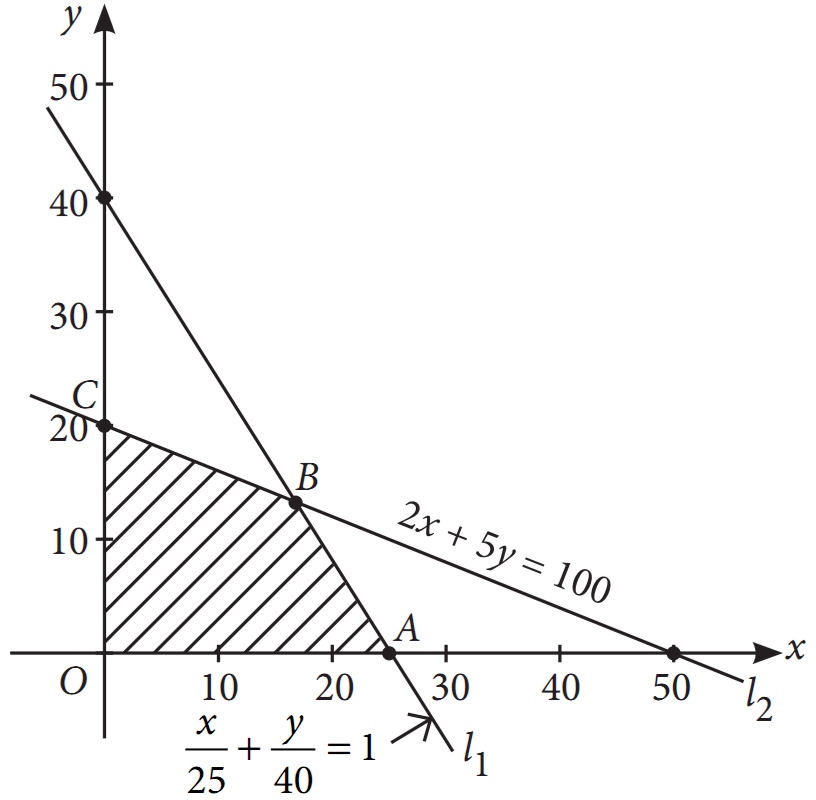
Deepa rides her car at $25 \mathrm{~km} / \mathrm{hr}$. She has to spend ₹ $2$ per km on diesel and if she rides it at a faster speed of $40 \mathrm{~km} /$ hr, the diesel cost increases to ₹ $5$ per km. She has ₹ $100$ to spend on diesel. Let she travels $x$ kms with speed $25 \mathrm{~km} /$ hr and y kms with speed $40 \mathrm{~km} / \mathrm{hr}$. The feasible region for the LPP is shown below:

Based on the above information, answer the following questions.
  1. What is the point of intersection of line $l_1$ and $l_2​​​​​​​$?
  1. $\Big(\frac{40}{3},\frac{50}{3}\Big)$
  2. $\Big(\frac{50}{3},\frac{40}{3}\Big)$
  3. $\Big(\frac{-50}{3},\frac{40}{3}\Big)$
  4. $\Big(\frac{-50}{3},\frac{-40}{3}\Big)$
  1. The comer points of the feasible region shown in above graph are:
  1. $(0,25),(20,0),\Big(\frac{40}{3},\frac{50}{3}\Big)$
  2. $(0, 0), (25, 0), (0, 20) $
  3. $(0,0),\Big(\frac{40}{3},\frac{50}{3}\Big),(0,20)$
  4. $(0,0),(25,0),\Big(\frac{50}{3},\frac{40}{3}\Big),(0,20)$
  1. If Z = x + y be the objective function and max Z = 30. The maximum value occurs at point:
  1. $\Big(\frac{50}{3},\frac{40}{3}\Big)$
  2. (0, 0)
  3. (25, 0)
  4. (0, 20)
  1. If Z = 6x - 9y be the objective function, then maximum value of Z is:
  1. -20
  2. 150
  3. 180
  4. 20
  1. If Z = 6x + 3y be the objective function, then what is the minimum value of Z?
  1. 120
  2. 130
  3. 0
  4. 150
Read the following text carefully and answer the questions that follow:
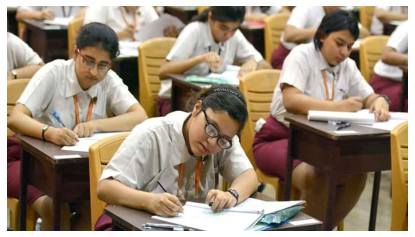
Shama is studying in class $XII$. She wants do graduate in chemical engineering. Her main subjects are mathematics, physics, and chemistry. In the examination, her probabilities of getting grade $A$ in these subjects are $0.2, 0.3,$ and $0.5$ respectively.
Image
$1$. Find the probability that she gets grade $A$ in all subjects.$ (1)$
$2.$ Find the probability that she gets grade $A$ in no subjects. $(1)$
$3$. Find the probability that she gets grade $A$ in two subjects. $(2)$
OR
Find the probability that she gets grade $A$ in at least one subject. $(2)$
Read the following text carefully and answer the questions that follow:
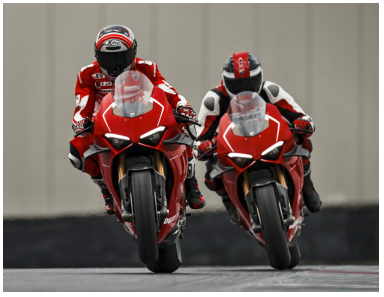
Two motorcycles $A$ and $B$ are running at the speed more than allowed speed on the road along the lines
$\vec{r}=\lambda(\hat{i}+2 \hat{j}-\hat{k})$ and $\vec{r}=3 \hat{i}+3 \hat{j}+\mu(2 \hat{i}+\hat{j}+\hat{k})$, respectively.
Image
$i$. Find the cartesian equation of the line along which motorcycle $A$ is running. $(1)$
$ii$. Find the direction cosines of line along which motorcycle $A$ is running. $(1)$
$iii$. Find the direction ratios of line along which motorcycle $B$ is running. $(2)$
OR
Find the shortest distance between the given lines. $(2)$
Ajay enrolled himself in an online practice test portal provided by his school for better practice. Out of 5 questions in a set-I, he was able to solve 4 of them and got stuck in the one which is as shown below.
If A and Bare independent events, P(A) = 0.6 and P(B) = 0.8, then answer the following questions.
  1. $\text{P}(\text{A}\cap\text{B})=$
  1. 0.2
  2. 0.9
  3. 0.48
  4. 0.6
  1. $\text{P}(\text{A}\cup\text{B})=$
  1. 0.92
  2. 0.08
  3. 0.48
  4. 0.64
  1. $\text{P}(\text{B}|\text{A})=$
  1. 0.14
  2. 0.2
  3. 0.6
  4. 0.8
  1. $\text{P}(\text{A}|\text{B})=$
  1. 0.6
  2. 0.9
  3. 0.19
  4. 0.11
  1. P (not A and not B)
  1. 0.01
  2. 0.48
  3. 0.08
  4. 0.91
In a family there are four children. All of them have to work in their family business to earn their livelihood at the age of 18. Based on the above information, answer the following questions.

  1. Probability that all children are girls, if it is given that elder child is a boy, is:
  1. $\frac{3}{8}$
  2. $\frac{1}{8}$
  3. $\frac{5}{8}$
  4. None of these.
  1. Probability that all children are boys, if two elder children are boys, is:
  1. $\frac{1}{4}$
  2. $\frac{3}{4}$
  3. $\frac{1}{2}$
  4. None of these.
  1. Find the probability that two middle children are boys, if it is given that eldest child is a girl.
  1. $0$
  2. $\frac{3}{4}$
  3. $\frac{1}{4}$
  4. None of these.
  1. Find the probability that all children are boys, if it is given that at most one of the children is a girl.
  1. $0$
  2. $\frac{1}{5}$
  3. $\frac{2}{5}$
  4. $\frac{4}{5}$
  1. Find the probability that all children are boys, if it is given that at least three of the children are boys.
  1. $\frac{1}{5}$
  2. $\frac{2}{5}$
  3. $\frac{3}{5}$
  4. $\frac{4}{5}$
If y = f(u) is a differentiable function of u and u = g(x) is a differentiable function of x, then y = f(g(x)] is a differentiable function of x and $\frac{\text{dy}}{\text{dx}}=\frac{\text{dy}}{\text{du}}\times\frac{\text{du}}{\text{dx}}.$ This rule is also known as CHAIN RULE.
Based on the above information, find the derivative of functions w.r.t. x in the following questions.
  1. $\cos\sqrt{\text{x}}$
  1. $\frac{-\sin\sqrt{\text{x}}}{2\sqrt{\text{x}}}$
  2. $\frac{\sin\sqrt{\text{x}}}{2\sqrt{\text{x}}}$
  3. $\sin\sqrt{\text{x}}$
  4. $-\sin\sqrt{\text{x}}$
  1. $7^{\text{x}+\frac{1}{\text{x}}}$
  1. $\Big(\frac{\text{x}^2-1}{\text{x}^2}\Big)\cdot7^{\text{x}+\frac{1}{\text{x}}}\cdot\log7$
  2. $\Big(\frac{\text{x}^2+1}{\text{x}^2}\Big)\cdot7^{\text{x}+\frac{1}{\text{x}}}\cdot\log7$
  3. $\Big(\frac{\text{x}^2-1}{\text{x}^2}\Big)\cdot7^{\text{x}-\frac{1}{\text{x}}}\cdot\log7$
  4. $\Big(\frac{\text{x}^2+1}{\text{x}^2}\Big)\cdot7^{\text{x}-\frac{1}{\text{x}}}\cdot\log7$
  1. $\sqrt\frac{{1-\cos\text{x}}}{1+\cos\text{x}}$
  1. $\frac{1}{2}\sec^2\frac{\text{x}}{2}$
  2. $-\frac{1}{2}\sec^2\frac{\text{x}}{2}$
  3. $\sec^2\frac{\text{x}}{2}$
  4. $-\sec^2\frac{\text{x}}{2}$
  1. $\frac{1}{\text{b}}\tan^{-1}\Big(\frac{\text{x}}{\text{b}}\Big)+\frac{1}{\text{a}}\tan^{-1}\Big(\frac{\text{x}}{\text{a}}\Big)$
  1. $\frac{-1}{\text{x}^2+\text{b}^2}+\frac{1}{\text{x}^2+\text{a}^2}$
  2. $\frac{1}{\text{x}^2+\text{b}^2}+\frac{1}{\text{x}^2+\text{a}^2}$
  3. $\frac{1}{\text{x}^2+\text{b}^2}-\frac{1}{\text{x}^2+\text{a}^2}$
  4. None of these.
  1. $\sec^{-1}\text{x}+\text{cosec}^{-1}\frac{\text{x}}{\sqrt{\text{x}^2-1}}$
  1. $\frac{2}{\sqrt{\text{x}^2-1}}$
  2. $\frac{-2}{\sqrt{\text{x}^2-1}}$
  3. $\frac{1}{|\text{x}|\sqrt{\text{x}^2-1}}$
  4. $\frac{2}{|\text{x}|\sqrt{\text{x}^2-1}}$
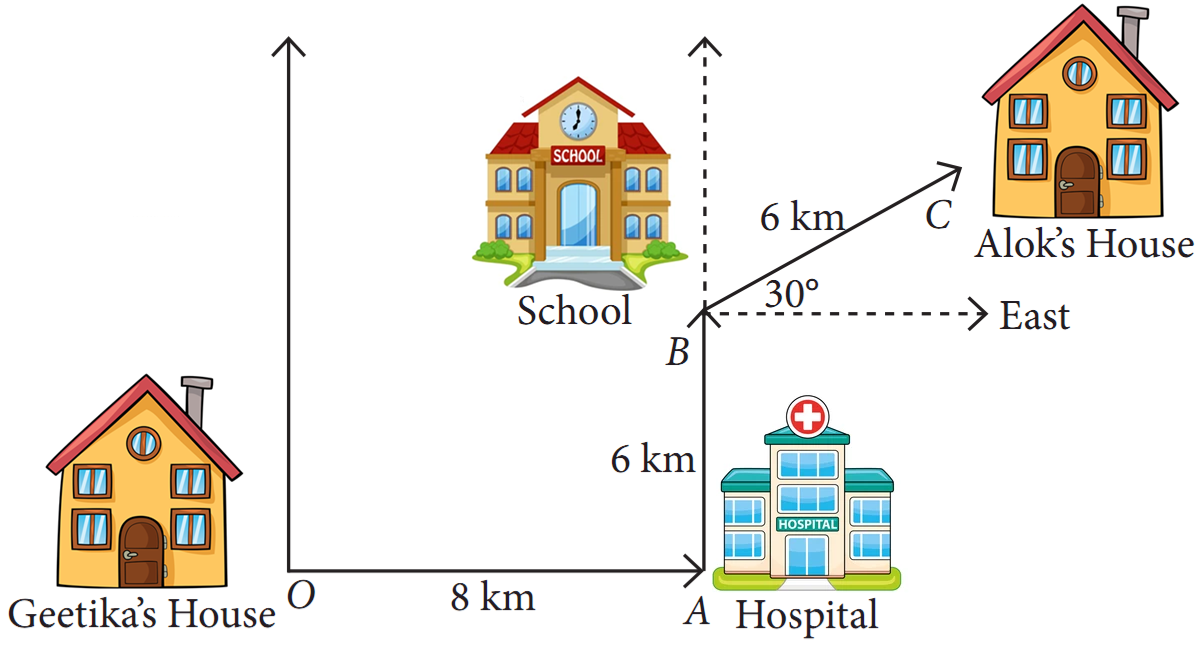
Geetika's house is situated at Shalimar Bagh at point O, for going to Alok's house she first travels 8km by bus in the East. Here at point A, a hospital is situated. From Hospital, Geetika takes an auto and goes 6km in the North, here at point B school is situated. From school, she travels by bus to reach Alok's house which is at 30º East, 6km from point B.

Based on the above information, answer the following questions.
  1. What is the vector distance between Geetika's house and school?
  1. $8\hat{\text{i}}-6\hat{\text{j}}$
  2. $8\hat{\text{i}}+6\hat{\text{j}}$
  3. $8\hat{\text{i}}$
  4. $6\hat{\text{j}}$
  1. How much distance Geetika travels to reach school?
  1. 14km
  2. 15km
  3. 16km
  4. 17km
  1. What is the vector distance from school to Alok's house?
  1. $\sqrt{3}\hat{\text{i}}+\hat{\text{j}}$
  2. $3\sqrt{3}\hat{\text{i}}+3\hat{\text{j}}$
  3. $6\hat{\text{i}}$
  4. $6\hat{\text{j}}$
  1. What is the vector distance from Geetika's house to Alok's house?
  1. $(8+3\sqrt{3})\hat{\text{i}}+9\hat{\text{j}}$
  2. $4\hat{\text{i}}+6\hat{\text{j}}$
  3. $15\hat{\text{i}}$
  4. $16\hat{\text{j}}$
  1. What is the total distance travelled by Geetika from her house to Alok's house?
  1. 19km
  2. 20km
  3. 21km
  4. 22km
A student is preparing for the competitive examinations LIC AAO, SSC CGL and Bank P.O. The probabilities that the student is selected independently in competitive examination of LIC AAO, SSC CGL and Bank P.O. are a, band c respectively. Of these examinations, students has 50% chance of selection in at least one, 40% chance of selection in at least two and 30% chance of selection in exactly two examinations.

Based on the above information, answer the following questions.
  1. The value of a+ b + e - ab - be - ca + abe is:
  1. 0.3
  2. 0.5
  3. 0.7
  4. 0.6
  1. The value of ab + be + ae - 2abe is:
  1. 0.5
  2. 0.3
  3. 0.4
  4. 0.6
  1. The value of abe is:
  1. 0.1
  2. 0.5
  3. 0.7
  4. 0.3
  1. The value of ab + be + ae is:
  1. 0.1
  2. 0.6
  3. 0.5
  4. 0.3
  1. The value of a + b + e is:
  1. 1
  2. 1.5
  3. 1.6
  4. 1.4
If the equation is of the form $\frac{\text{dy}}{\text{dx}}=\text{py}=\text{Q},$ where P, Q are functions of x, then the solution of the differential equation is given by $\text{ye}^{\int\text{pdx}}=\int\text{Q e}^{\int\text{pdx}}\text{dx}+\text{c},$ where $\text{e}^{\int\text{pdx}}$ is called the integrating factor (I.F.).
Based on the above information, answer the following questions.
  1. The integrating factor of the differential equation $\sin\text{x}\frac{\text{dy}}{\text{dx}}+2\text{y}\cos\text{x}=1$ is $(\sin\text{x})^\lambda,$ where $\lambda=$
  1. 0
  2. 1
  3. 2
  4. 3
  1. Integrating factor of the differential equation $(1-\text{x}^2)\frac{\text{dy}}{\text{dx}}-\text{xy}=1$ is:
  1. $-\text{x}$
  2. $\frac{\text{x}}{1+\text{x}^2}$
  3. $\sqrt{1-\text{x}^2}$
  4. $\frac{1}{2}\log(1-\text{x}^2)$
  1. The solution of $\frac{\text{dy}}{\text{dx}}+\text{y}=\text{e}^{-\text{x}},\text{ y}(0)=0,$ is:
  1. $\text{y}=\text{e}^\text{x}(\text{x}-1)$
  2. $\text{y}=\text{xe}^{-\text{x}}$
  3. $\text{y}=\text{xe}^{-\text{x}}+1$
  4. $\text{y}=(\text{x}+1)\text{e}^{-\text{x}}$
  1. General solution of $\frac{\text{dy}}{\text{dx}}+\text{y}\tan\text{x}=\sec\text{x}$ is:
  1. $\text{y}\sec\text{y}=\tan\text{x}+\text{c}$
  2. $\text{y}\tan\text{x}=\sec\text{x}+\text{c}$
  3. $\tan\text{x}=\text{y}\tan\text{x}+\text{c}$
  4. $\text{x}\sec\text{x}=\tan\text{y}+\text{c}$
  1. The integrating factor of differential equation $\frac{\text{dy}}{\text{dx}}-3\text{y}=\sin2\text{x}$ is:
  1. $\text{e}^{3\text{x}}$
  2. $\text{e}^{-2\text{x}}$
  3. $\text{e}^{-3\text{x}}$
  4. $\text{xe}^{-3\text{x}}$
Let f(x) be a real valued function, then its
  • Left Hand Derivative (L.H.D.) : $\text{Lf}'(\text{a})=\lim_\limits{\text{h}\rightarrow0}\frac{\text{f}(\text{a}-\text{h})-\text{f}(\text{a})}{-\text{h}}$
  • Right Hand Derivative (R.H.D.) : $\text{Rf}'(\text{a})=\lim_\limits{\text{h}\rightarrow0}\frac{\text{f}(\text{a}+\text{h})-\text{f}(\text{a})}{\text{h}}$
Also, a function f(x) is said to be differentiable at x = a if its L.H.D. and R.H.D. at x = a exist and are equal.
For the function $\text{f}(\text{x})=\begin{cases}|\text{x}-3|,\text{x}\geq1\\\\\frac{\text{x}^2}{4}-\frac{3\text{x}}{2}+\frac{13}{4},\text{x}<1\end{cases},$ answer the following questions.
  1. R.H.D. of f(x) at x = 1 is:
  1. 1
  2. -1
  3. 0
  4. 2
  1. L.H.D. of f(x) at x = 1 is:
  1. 1
  2. -1
  3. 0
  4. 2
  1. f(x) is non-differentiable at:
  1. x = 1
  2. x = 2
  3. x = 3
  4. x = 4
  1. Find the value of f'(2).
  1. 1
  2. 2
  3. 3
  4. -1
  1. The value of f'(-1) is:
  1. 2
  2. 1
  3. -2
  4. -1