MCQ
A galvanometer can be converted into an ammeter by connecting
  • A
    Low resistance in series
  • B
    High resistance in parallel
  • Low resistance in parallel
  • D
    High resistance in series

Answer

Correct option: C.
Low resistance in parallel
(c)To convert a galvanometer into an ammeter a low value resistance is to be connected in parallel to it called shunt.

Need a full question paper?

Generate a complete, print-ready paper with questions like this in minutes — across 16+ boards, with answer keys.
Start Generating Free

Similar questions

The acceleration due to gravity near the surface of a planet of radius $R$ and density $\mathrm{d}$ is proportional to
A body of mass $M$ is kept on a rough horizontal surface (friction coefficient $\mu$ ). A person is trying to pull the body by applying a horizontal force but the body is not moving. The force by the surface on the body is $F$, where
When hydrogen atom is in its first excited level, its radius is .... its ground state radius
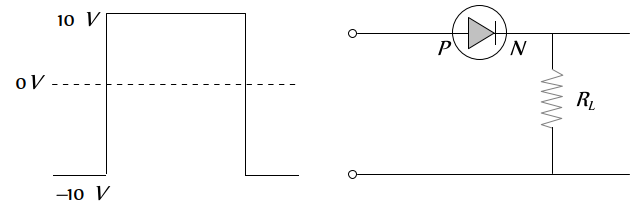
If the following input signal is sent through a $P N$-junction diode, then the output signal across $R$ will beImage
One mole of $\mathrm{O}_2$ gas having a volume equal to $22.4$ litres at $0^{\circ} \mathrm{C}$ and $1$ atmospheric pressure in compressed isothermally so that its volume reduces to $11.2$ litres. The work done in this process is
$100 \mathrm{gm}$ of ice at $0^{\circ} \mathrm{C}$ is mixed with $100 \mathrm{~g}$ of water at $100^{\circ} \mathrm{C}$. What will be the final temperature of the mixture
The phenomenon of interference is shown by
A point object $O$ is placed on the principal axis of a convex lens of focal length $20 \mathrm{~cm}$ at a distance of $40 \mathrm{~cm}$ to the left of it. The diameter of the lens is $10 \mathrm{~cm}$. If the eye is placed $60 \mathrm{~cm}$ to the right of the lens at a distance $h$ below the principal axis, then the maximum value of $h$ to see the image will be
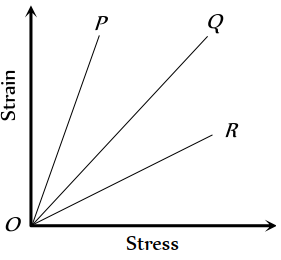
The strain-stress curves of three wires of different materials are shown in the figure. $P, Q$ and $R$ are the elastic limits of the wires. The figure shows that

Image

A particle is kept at rest at the top of a sphere of diameter $42 m$. When disturbed slightly, it slides down. At what height ' $h$ ' from the bottom, the particle will leave the sphere