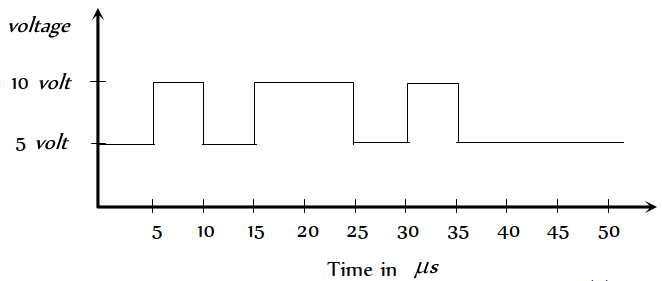
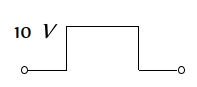
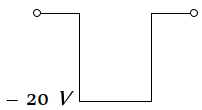
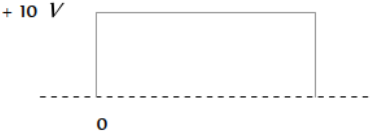
If the following input signal is sent through a $P N$-junction diode, then the output signal across $R$ will be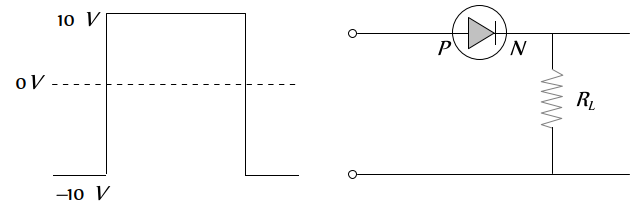
- A
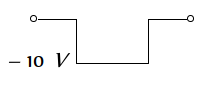
- B
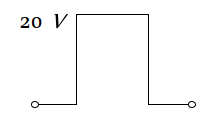
- C
- D


Download our appand get started for free
Experience the future of education. Simply download our apps or reach out to us for more information. Let's shape the future of learning together!No signup needed.*
Similar Questions
- 1In a semiconductor, the concentration of electrons is $8 \times 10^{14} / cm ^3$ and that of the holes is $5 \times 10^{12} cm ^3$. The semiconductor isView Solution
- 2A $G e$ specimen is doped with $A l$. The concentration of acceptor atoms is $\sim 10^{-}$atoms $/ m$. Given that the intrinsic concentration of electron hole pairs is $\sim 10^{19} / m ^3$, the concentration of electrons in the specimen isView Solution
- 3A semiconductor is cooled from $T_1 K$ to $T_2 K$. Its resistanceView Solution
- 4View SolutionWhich of the energy band diagrams shown in the figure corresponds to that of a semiconductor
- 5Thermionic emission from a heated filament varies with its temperature $T$ asView Solution
- 6The amplification factor of a triode valve is $15.$ If the grid voltage is changed by $0.3$ volt the change in plate voltage in order to keep the plate current constant (in volt) isView Solution
- 7The depletion layer in silicon diode is $1 \mu m$ wide and the knee potential is $0.6 V$, then the electric field in the depletion layer will beView Solution
- 8On adjusting the $P-N$ junction diode in forward biasedView Solution
- 9In diode, when there is saturation current, the plate resistance $\left(r_p\right)$ isView Solution
- 10View SolutionIn a negative logic the following wave form corresponds to the