Question
A galvanometer can be converted into voltmeter of given range by connecting a suitable resistance $R,$ in series with the galvanometer, whose value is given by, $\text{R}_\text{s}=\frac{\text{V}}{\text{I}_\text{g}}-\text{G}$
where vis the voltage to be measured, $lg$ is the current for full scale deflection of galvanometer and $G$ is the resistance of galvanometer.
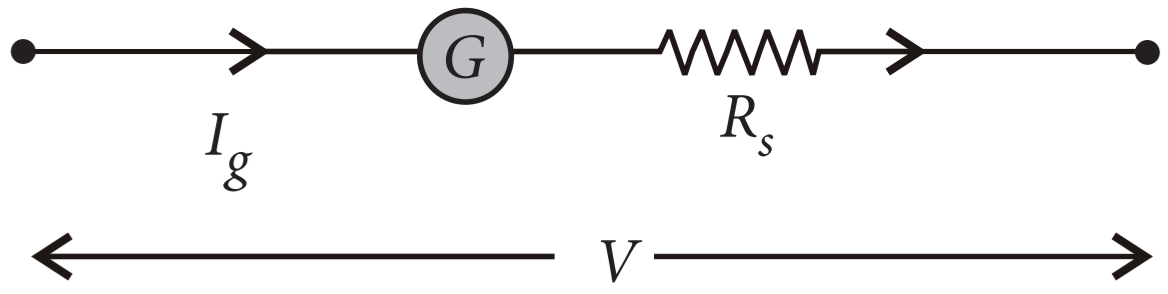
Series resistor$(R,)$ increases range of voltmeter and the effective resistance of galvanometer. It also protects the galvanometer from damage due to large current. Voltmeter is a high resistance instrument and it is always connected in parallel with the circuit element across which potential difference is to be measured. An ideal voltmeter has infinite resistance. In order to increase the range of voltmeter $n$ times the value of resistance to be connected in series with galvanometer is $R_s = (n - 1)G.$
  1. $10\ mA$ current can pass through a galvanometer of resistance $25\Omega$ What resistance in series should be connected through it, so that it is converted into a voltmeter of $100V$?
  1. $0.975\Omega$
  2. $99.75\Omega$
  3. $975\Omega$
  4. $9975\Omega$
  1. There are $3$ voltmeter $A, B, C$ having the same range but their resistance are $15000\Omega,10000\Omega,$ and $5000\Omega$ respectively. 'Tile best voltmeter amongst them is the one whose resistance is
  1. $5000\Omega$
  2. $10000\Omega$
  3. $15000\Omega$
  4. all are equally good.
  1. A milliammeter of range 0 to $25\ mA$ and resistance of $10\Omega$ is to be converted into a voltmeter with a range of 0 to $25V.$ 'Tile resistance that should be connected in series will be:
  1. $930\Omega$
  2. $960\Omega$
  3. $990\Omega$
  4. $1010\Omega$
  1. To convert a moving coil galvanometer $\ce{(MCG)}$ into a voltmeter:
  1. $A$ high resistance $R$ is connected in parallel with $\ce{MCG}.$
  2. $A$ low resistance $R$ is connected in parallel with $\ce{MCG}.$
  3. $A$ low resistance $R$ is connected in series with $\ce{MCG}.$
  4. $A $ high resistance $R$ is connected in series with $\ce{MCG}.$
  1. To increase the current sensitivity of a moving coil galvanometer, we should decrease:
  1. Zero.
  2. Low.
  3. High.
  4. Infinity.

Answer

  1. $(d) 9975\Omega$
A galvanometer can be converted into a voltmeter of given range by connecting a suitable high resistance $R$ in series of galvanometer, which is given by,
$\text{R}=\frac{\text{V}}{\text{I}_\text{g}}-\text{G}=\frac{100}{10\times10^{-3}}-25=10000-25=9975\Omega$
  1. $(c) 15000\Omega$
An ideal voltmeter should have a very high resistance.
  1. $(c) 990\Omega$
Resistance of voltmeter $=\frac{25}{25\times10^{-3}}=1000\Omega$
$\therefore\text{X}=1000-10=990\Omega$
  1. $(d)$ A high resistance $R$ is connected in series with $\ce{MCG}.$
To convert a moving coil galvanometer into a voltmeter, it is connected with a high resistance in series. The voltmeter is connected in parallel to measure the potential difference. As the resistance is high, the voltmeter itself does not consume current.
  1. $(d)$ Infinity.
The resistance of an ideal voltmeter is infinity.

Need a full question paper?

Generate a complete, print-ready paper with questions like this in minutes — across 16+ boards, with answer keys.

Start Generating Free

Similar questions

An object of size 3.0 cm is placed 14 cm in front of a concave lens of focal length 21 cm. Describe the image produced by the lens. What happens if the object is moved further away from the lens?
Using only NAND gate make combination diagrams to obtained NOT, AND and OR gates.
(a) Define mutual inductance and write its S.I. unit.
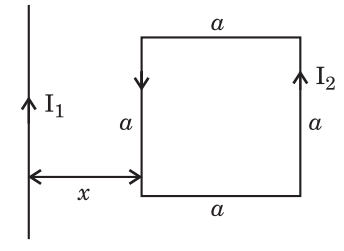
(b) A square loop of side 'a' carrying a current $I_{2}$ is kept at distance x from an infinitely long straight wire carrying a current $I_{1}$ as shown in the figure. Obtain the expression for the resultant force acting on the loop.
Image
The density of nuclear matter is the ratio of the mass of a nucleus to its volume. As the volume of a nucleus is directly proportional to its mass number $A,$ so the density of nuclear matter is independent of the size of the nucleus. Thus, the nuclear matter behaves like a liquid of constant density. Different nuclei are like drops of this liquid, of different sizes but of same density. Let $A$ be the mass number and $R$ be the radius of a nucleus. If $m$ is the average mass of a nucleon, then. Mass of nucleus $= mA$
Volume of nucleus $=\frac{4}{3}\pi\text{R}^3=\frac{4}{3}\pi\big(\text{R}_0\text{A}\frac{1}{3}\big)=\frac{4}{3}\pi\text{R}^3_0\text{A}$
$\therefore$ Nuclear density $,\rho\text{nu}=\frac{\text{Mass of nucleus}}{\text{Volume of nucleus}}$ or $\ \rho\text{nu}$
$=\frac{\text{MA}}{\frac{4}{3}\pi\text{R}_0^3\text{A}}=\frac{3\text{m}}{4\pi\text{R}_0^3}$
Clearly, nuclear density is independent of mass number $A$ or the size of the nucleus. The nuclear mass density is of the order $10^{17}kg m^{-3}$ This density is very large as compared to the density of ordinary matter, say water, for which $\rho = 1.0 \times 10^3\ kg m^{-3}$
  1. The nuclear radius of $_8^{16}\text{O} is 3 \times 10^{-15}m$. The density of nuclear matter is.
  1. $2.9 \times 10^{34}kg m^{-3}$
  2. $1.2 \times 10^{17}kg m^{-3}$
  3. $16 \times 10^{27}kg m^{-3}$
  4. $2.4 \times 10^{17}kg m^{-3}$
  1. What is the density of hydrogen nucleus in $SI$ units? Given $R_o= 1.1$ fermi and $m_P = 1.007825$ amu.
  1. $1.2 \times 10^{17}kg m^{-3}$
  2. $3.0 \times 10^{34}kg m^{-3}$
  3. $1.99 \times 10^{11}kg m^{-3}$
  4. $7.85 \times 10^{17}kg m^{-3}$
  1. Density of a nucleus is.
  1. More for lighter elements and less for heavier elements.
  2. More for heavier elements and less for lighter elements.
  3. Very less compared to ordinary matter.
  4. A constant.
  1. The nuclear mass of $_{23}^{56}\text{Fe}$ is $55.85$ amu. The its nuclear density is.
  1. $5.0 \times 10^{19}kg m^{-3}$
  2. $1.5 \times 10^{19}kg m^{-3}$
  3. $2.9 \times 10^{17}kg m^{-3}$
  4. $9.2 \times 10^{26}kg m^{-3}$
  1. If the nucleus of $_{13}^{27}\text{Al}$ has s a nuclear radius of about $3.6 fm,$ then $_{52}^{125}\text{Te}$ would have its radius approximately as.
  1. $9.6fm$
  2. $12fm$
  3. $4.8fm$
  4. $6fm$
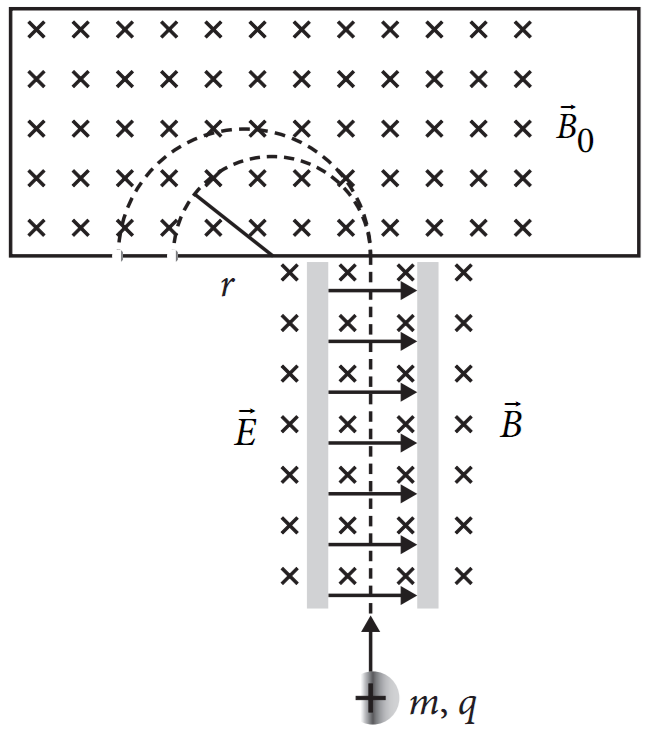
Various methods can be used to measure the mass of an atom. One possibility is through the use of a mass spectrometer. The basic feature of a Banbridge mass spectrometer is illustrated in figure. A particle carrying a charge $+q$ is first sent through a velocity selector and comes out with velocity $\text{v}=\frac{\text{E}}{\text{B}}.$
The applied electric and magnetic fields satisfy the relation $E = vB$ so that the trajectory of the particle is a straight line. Upon entering a region where a second magnetic field $\vec{\text{B}}_0$ pointing into the page has been applied, the particle will move in a circular path with radius rand eventually strike the photographic plate.
  1. In mass spectrometer, the ions are sorted out in which of the following ways?
  1. By accelerating them through electric field.
  2. By accelerating them through magnetic field.
  3. By accelerating them through electric and magnetic field.
  4. By applying a high voltage.
  1. Radius of particle in second magnetic field $B_0$ is :
  1. $\frac{2\text{mv}}{\text{qE}_0}$
  2. $\frac{\text{mv}}{\text{qE}_0}$
  3. $\frac{\text{mv}}{\text{qB}_0}$
  4. $\frac{2\text{mE}_0\text{v}}{\text{qB}_0}$
  1. Which of the following will trace a circular trajectory with largest radius?
  1. Proton
  2. $ct-$particle
  3. Electron
  4. A particle with charge twice and mass thrice that of electron.
  1.  Mass of the particle in terms $q, B_0, B,$ rand $E$ is :
  1. $\frac{\text{qbr}}{\text{E}}$
  2. $\frac{\text{qbr}}{\text{E}}$
  3. $\frac{\text{qbr}}{\text{E}}$
  4. $\frac{\text{qbr}}{\text{E}}$ 
  1. The particle comes out of velocity selector along a straight line, because :
  1. Electric force is less than magnetic force.
  2. Electric force is greater than magnetic force.
  3. Electric and magnetic force balance each other.
  4. Can't say.
The electron mobility characterises how quickly an electron can move through a metal of semiconductor when pulled by an electric field. There is an analogous quality for holes, called hole mobility. A block of pure silicon at $300K$ has a length of $10\ cm$ and an area of $1.0\ cm^2$. A battery of emf $2V$ is connected across it. The mobility of electron is $0.14m^2 V^{-1}s^{-1}$ and their number density is $1.5 \times 10^{16}m^{-3}$. The mobility of holes is $0.05m^2 V^{-1}s^{-1}.$
  1. The electron current is:
  1. $6.72 \times 10^{-4}A$
  2. $6.72 \times 10^{-5}A$
  3. $6.72 \times 10^{-6}A$
  4. $6.72 \times 10^{-7}A$
  1. The hole current is:
  1. $2.0 \times 10^{-7}A$
  2. $2.2 \times 10^{-7}A$
  3. $2.4 \times 10^{-7}A$
  4. $2.6 \times 10^{-7}A$
  1. The number density of donor atoms which are to be added up to pure silicon semiconductor to produce an $n-$ type semiconductor of conductivity $6.4\Omega^{-1}\text{cm}^{-1}$ is approximately $($neglect the contribution of holes to conductivity$)$.
  1. $3 \times 10^{22}m^{-3}$
  2. $3 \times 10^{23}m^{-3}$
  3. $3 \times 10^{24}m^{-3}$
  4. $3 \times 10^{21}m^{-3}$
  1. When the given silicon semiconductor is doped with indium, the hole concentration increases to $4.5 \times 10^{23}m^{-3}$. The electron concentration in doped silicon is:
  1. $3 \times 10^9m^{-3}$
  2. $4 \times 10^9m^{-3}$
  3. $5 \times 10^9m^{-3}$
  4. $6 \times 10^9m^{-3}$
  1. Pick out the statement which is not correct.
  1. At a low temperature, the resistance of a semiconductor is very high.
  2. Movement of holes is restricted to the valence band only.
  3. Width of the depletion region increases as the forward bias voltage increases in case of a $p-n$ junction diode.
  4. ln a forward bias condition, the diode heavily conducts.
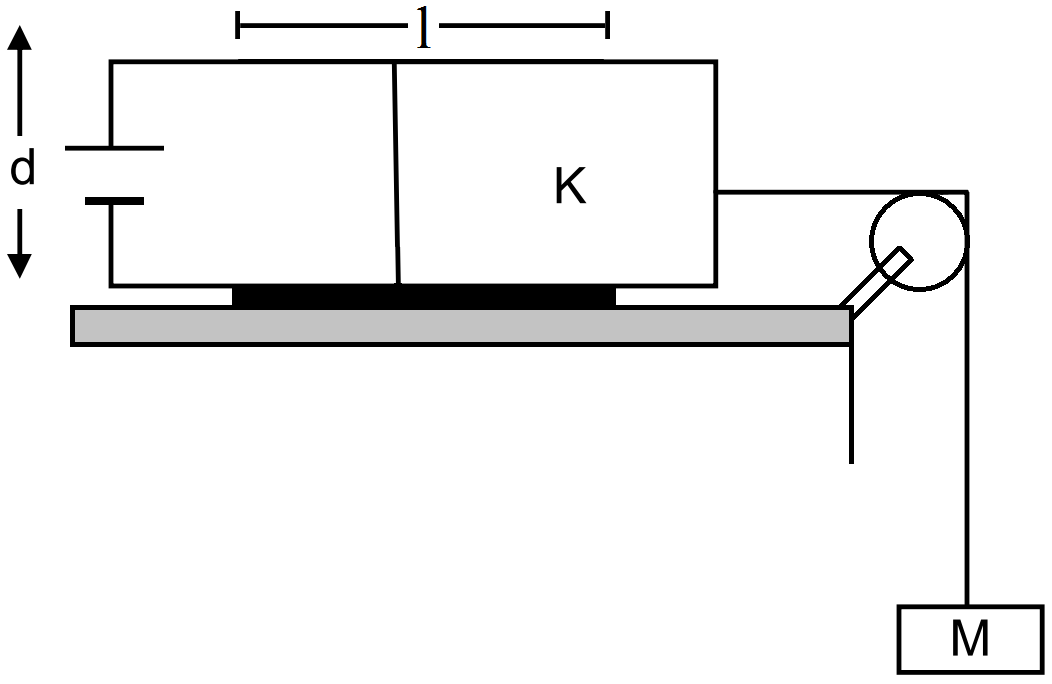
Consider the situation shown in figure. The width of each plate is b. The capacitor plates are rigidly clamped in the laboratory and connected to a battery of emf $\epsilon.$ All surfaces are frictionless. Calculate the value of M for which the dielectric slab will stay in equilibrium.

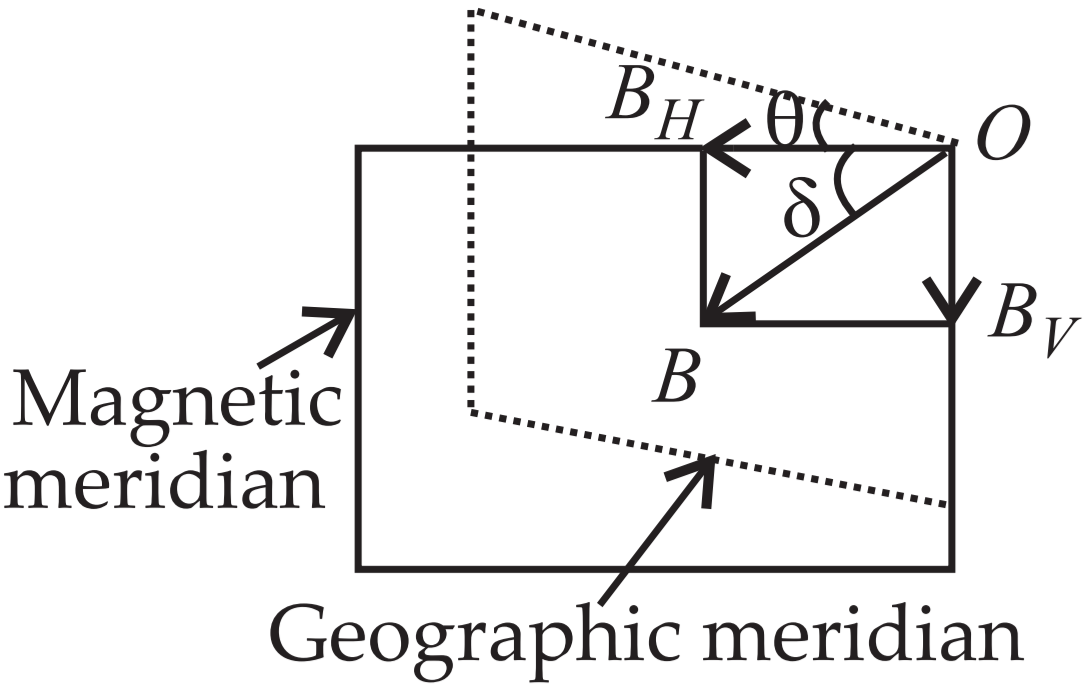
'Tile earth's magnetic field at a point on its surface is usually characterised by three quantities: (a) declination (bl inclination or dip and (cl horizontal component of the field. These are known as the elements of the earth's magnetic field. At a place, angle between geographic meridian and magnetic meridian is defined as magnetic declination, whereas angle made by the earth's magnetic field with the horizontal in magnetic meridian is known as magnetic dip.
  1. In a certain place, the horizontal component of magnetic field is $\frac{1}{\sqrt{3}}$ times the vertical component. 'Tile angle of dip at this place is:
  1. $\text{Zero}$
  2. $\frac{\pi}{3}$
  3. $\frac{\pi}{2}$
  4. $\frac{\pi}{6}$
  1. The angle between the true geographic north and the north shown by a compass needle is called as:
  1. Inclination.
  2. Magnetic declination.
  3. Angle of meridian.
  4. Magnetic pole.
  1. Tile angles of dip at the poles and the equator respectively are
  1. 30º, 30º
  2. 0º, 90º
  3. 45º, 90º
  4. 90º, 0º 
  1. A compass needle which is allowed to move in a horizontal plane is taken to a geomagnetic pole. It
  1. Will become rigid showing no movement.
  2. Will stay in any position.
  3. Will stay in north-south direction only.
  4. Will stay in east-west direction only. 
  1. Select the correct statement from the following.
  1. The magnetic dip is zero at the centre of the earth.
  2. Magnetic dip decreases as we move away from the equator towards the magnetic pole.
  3. Magnetic dip increases as we move away from the equator towards the magnetic pole.
  4. Magnetic dip does not vary from place to place. 
A metal rod is placed along the axis of a solenoid carrying a high-freqμency alternating current. It is found that the rod gets heated. Explain why the rod gets heated.