Question
A galvanometer cannot be used directly to measure current - why ? Explain the solution of this problem.
###
State the difficulties occured and their solution when galvanometer is directly used as ammeter.
Answer

There are two reasons why a galvanometer cannot be used directly as an ammeter

Image
(i) Galvanometer is a very sensitive device. It also shows the full scale deflection for a current of the order of $\mu A$.
(ii) To measure current, a galvanometer has to be connected in series but its resistance is high, so that it changes the value of the current flowing in the circuit.
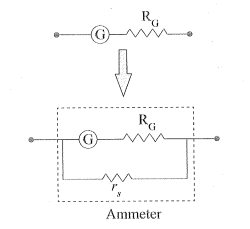
To overcome these difficulties, a small resistance called a shunt is connected to the galvanometer.
The shunt is connected in parallel with the galvanometer. Due to this, most of the current passes through the shunt.
The resistance of this arrangement is $=\frac{R_{ G } r_{ S }}{ R _{ G }+r_{ S }}$ But $R _{ G } \gg r_{ S }$
So, we can neglect $r_{ S }$ as compared to $R _{ G }$
So, $\frac{ R _{ G } r_{ S }}{ R _{ G }} \approx r_{ S }$
Since, the value of $r_{ S }$ very small, the original current does not change and the true value of current can be measured.

Need a full question paper?

Generate a complete, print-ready paper with questions like this in minutes — across 16+ boards, with answer keys.

Start Generating Free

Similar questions

The given graph shows the variation of charge $q$ versus potential difference $V$ for two capacitors $C_1$ and $C_2.$ The two capacitors have same plate separation but the plate area of $C_2$ is double than that of $C_1.$ Which of the two graphs $P$ and $Q$ correspond to capacitors $C_1$ and $C_2$ and why?
Why is the luminous efficiency small for a filament bulb as compared to a mercury vapour lamp?
The radius of the innermost electron orbit of a hydrogen atom is 5.3 ×10⁻¹¹ m. What are the radii of the n = 2 and n = 3 orbits? 
A long narrow horizontal slit is placed $1\ mm$ above a horizontal plane mirror. The interference between the light coming directly from the slit and that after reflection is seen on a screen $1.0m$ away from the slit. Find the fringe$-$width if the light used has a wavelength of $700\ nm.$
Briefly explain Geiger-Marsden experiment. Show the variation of the number of particles scattered (N) with scattering angle $(\theta)$ in this experiment. What is the main conclusion that can be inferred from this plot?
Find the flux of the electric field through a spherical surface of radius $R$ due to a charge of $10^{-7}C$ at the centre and another equal charge at a point $2R$ away from the centre.
What is light-emitting diode (LED)? Write down its one application.
Draw a circuit diagram using a metre bridge and write the necessary mathematical relation used to determine the value of an unknown resistance. Why cannot such an arrangement be used for measuring very low resistances?
Plot a graph showing variation of de Broglie wavelength $(\lambda)$ associated with a charged particle of mass m, versus $\frac{1}{\sqrt{\text{V}}},$ where V is the potential difference through which the particle is accelerated. How does this graph give us the information regarding the magnitude of the charge of the particle?
Derive an expression for the work done in rotating a dipole from the angle $\theta_{0}$ to $\theta_{1}$ in a uniform electric field E.