A galvanometer gives full scale reading of $50\ mA$ , when a $p.d.$ , across its terminals is $0.15\ V$ . It can be used as an ammeter of range $0 - 100\ A$ by connecting a shunt resistance of
Medium


Download our appand get started for free
Experience the future of education. Simply download our apps or reach out to us for more information. Let's shape the future of learning together!No signup needed.*
Similar Questions
- 1An electron accelerated through a potential difference $V$ enters a uniform transverse magnetic field and experiences a force $F$. If the accelerating potential is increased to $2V$, the electron in the same magnetic field will experience a forceView Solution
- 2The coil in a moving coil galvanometer experiences torque proportional to current passes through it. If a steady current $i$ is passed through it the steady deflection of the coil is found to be $90^o$ . Now the steady current is switched off and a charge $q$ is suddenly passed through coil. If the coil has $N$ turns of area $A$ and its moment of inertia is $I$ about the axis it is going to rotate then the maximum angle through which it deflects upon passing charge $q$ isView Solution
- 3If $\alpha $ and $\beta - $ particles are moving with equal velocity perpendicular to the flux density $B$, then the radii of their paths will beView Solution
- 4View SolutionElectrons moving with different speeds enter a uniform magnetic field in a direction perpendicular to the field. They will move along circular paths.
- 5The resistance of a galvanometer is $50\,\Omega $ and it requires $2\,\mu A$ per two division deflection. The value of the shunt required in order to convert this galvanometer into ammeter of range $5\,A$ is (The number of divisions on the galvanometer scale on one side is $30$)View Solution
- 6A square loop of area $25\,cm ^2$ has a resistance of $10\,\Omega$. The loop is placed in uniform magnetic field of magnitude $40.0 T$. The plane of loop is perpendicular to the magnetic field. The work done in pulling the loop out of the magnetic field slowly and uniformly in $1.0 sec$, will be $..........\times 10^{-3}$View Solution
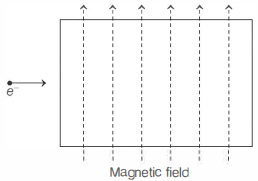
- 7View SolutionAn electron enters a chamber in which a uniform magnetic field is present as shown below. An electric field of appropriate magnitude is also applied, so that the electron travels undeviated without any change in its speed through the chamber. We are ignoring gravity. Then, the direction of the electric field is
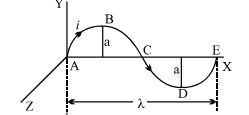
- 8A conductor $ABCDE$, shaped as shown, carries a current i. It is placed in the $xy$ plane with the ends $A$ and $E$ on the $x$-axis. $A$ uniform magnetic field of magnitude $B$ exists in the region. The force acting on it will beView Solution
- 9View SolutionThe resistance of an ideal ammeter is
- 10A charged particle enters a uniform magnetic field with velocity vector making an angle of $30^o$ with the magnetic field. The particle describes a helical trajectory of pitch $x$ . The radius of the helix isView Solution