If $\alpha $ and $\beta - $ particles are moving with equal velocity perpendicular to the flux density $B$, then the radii of their paths will be
Easy


Download our appand get started for free
Experience the future of education. Simply download our apps or reach out to us for more information. Let's shape the future of learning together!No signup needed.*
Similar Questions
- 1View SolutionMark the correct statement
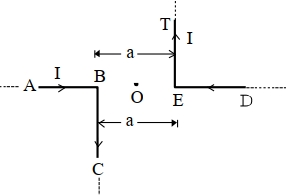
- 2The magnitude of magnetic induction at mid-point $O$ due to current arrangement as shown in Fig will beView Solution
- 3A current of $1\,A$ is flowing on the sides of an equilateral triangle of side $4.5\times10^{-2}\,m$ . The magnetic field at the centre of the triangle will beView Solution
- 4A long straight wire carries a current of $\pi \,amp.$ The magnetic field due to it will be $5 \times {10^{ - 5}}{\rm{ }}\,weber/{m^{\rm{2}}}$ at what distance from the wire $[{\mu _o} = $ permeability of air]View Solution
- 5A current $I$ flows along the length of an infinitely long, straight, thin walled pipe. ThenView Solution
- 6A milliammeter of range $10\, mA$ has a coil of resistance $1 \,\Omega$. To use it as voltmeter of range $10\, volt$, the resistance that must be connected in series with it, will be ............. $\Omega $View Solution
- 7A beam of well collimated cathode rays travelling with a speed of $5 \times {10^6}\,m{s^{ - 1}}$ enter a region of mutually perpendicular electric and magnetic fields and emerge undeviated from this region. If $| B |=0.02\; T$, the magnitude of the electric field isView Solution
- 8In an experiment, electrons are accelerated, from rest, by applying, a voltage of $500 \,V.$ Calculate the radius of the path if a magnetic field $100\,mT$ is then applied. [Charge of the electron $= 1.6 \times 10^{-19}\,C$ Mass of the electron $= 9.1 \times 10^{-31}\,kg$ ]View Solution
- 9If wire of length $L$ form a loop of radius $R$ and have $n$ turn. Find magnetic field at centre of loop if current flowing in loop is $I$View Solution
- 10A $50\,\Omega $ resistance is connected to a battery of $5\,V$. A galvanometer of resistance $100\, \Omega $ is to be used as an ammeter to measure current through the resistance, for this a resistance $r_s$ is connected to the galvanometer. Which of the following connections should be employed if the measured current is within $1\% $ of the current without the ammeter in the circuit ?View Solution