A galvanometer has a resistance of $25\, ohm$ and a maximum of $0.01\, A$ current can be passed through it. In order to change it into an ammeter of range $10\, A$, the shunt resistance required is
Medium


Download our appand get started for free
Experience the future of education. Simply download our apps or reach out to us for more information. Let's shape the future of learning together!No signup needed.*
Similar Questions
- 1A particle of mass $m$ and charge $q$ is in an electric and magnetic field given byView Solution
$\vec E = 2\hat i + 3\hat j ;\, B = 4\hat j + 6\hat k$
The charged particle is shifted from the origin to the point $P(x = 1 ;\, y = 1)$ along a straight path. The magnitude of the total work done is
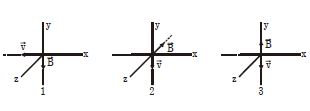
- 2The figure shows three situations when an electron with velocity $\vec v$ travels through a nuniform magnetic field $\vec B$ . In each case, what is the direction of magnetic force on the electron?View Solution
- 3The strength of the magnetic field at a point $r$ near a long straight current carrying wire is $B$. The field at a distance $\frac{r}{2}$ will beView Solution
- 4A current $I$ flows along the length of an infinitely long, straight, thin walled pipe. ThenView Solution
- 5Two particles $x$ and $y$ have equal charges and possessing equal kinetic energy enter in a uniform magnetic field and describe circular path of radius of curvature $r_1$ and $r_2$ respectively. The ratio of their masses isView Solution
- 6A galvanometer of resistance $100\,\Omega $ has $50\, divisions$ on its scale and has sensitivity of $20\,\mu A / division$. It is to be converted to a voltmeter with three ranges, of $0-2\, V$, $0-10\, V$ and $0-20\, V$. The appropriate circuit to do so isView Solution
- 7The electric current in a circular coil of four turns produces a magnetic induction $32\,T$ at its centre. The coil is unwound and is rewound into a circular coil of single turn, the magnetic induction at the centre of the coil by the same current will be $..........\,T$View Solution
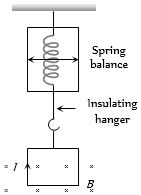
- 8A square loop of side $a$ hangs from an insulating hanger of spring balance. The magnetic field of strength $B$ occurs only at the lower edge. It carries a current $I$. Find the change in the reading of the spring balance if the direction of current is reversedView Solution
- 9The magnitude of the magnetic field at the centre of an equilateral triangular loop of side $1\,m$ which is carrying a current of $10\,A$ is:......$\mu T$ [Take $\mu _0 = 4\pi \times 10^{-7}\,NA^{-2}$]View Solution
- 10A charge particle projected with velocity $\vec v$ in uniform magnetic field ' $\vec B$ ' then for maximum magnetic force on it, which is correctView Solution