A galvanometer of resistance $G$ is converted into a voltmeter of range $0-1\, V$ by connecting a resistance $R _{1}$ in series with it. The additional resistance that should be connected in series with $R _{1}$ to increase the range of the voltmeter to $0-2\, V$ will be
JEE MAIN 2020, Diffcult
Download our app for free and get started
$\Rightarrow 1=i_{g}\left(G+R_{1}\right) \quad \ldots(1)$
$\Rightarrow 2= i _{ g }\left( R _{1}+ R _{2}+ G \right)$$...(2)$
$(1)/(2)$
$\Rightarrow \frac{1}{2}=\frac{G+R_{1}}{G+R_{1}+R_{2}}$
$G + R _{1}+ R _{2}=2 G +2 h _{1}$
$\left( R _{2}= G + R _{1}\right)$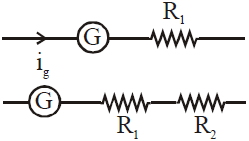

Download our appand get started for free
Experience the future of education. Simply download our apps or reach out to us for more information. Let's shape the future of learning together!No signup needed.*
Similar Questions
- 1$\alpha$ particle is revolving in radius $r$ with frequency $f$ then find value of magnetic dipole moment.View Solution
- 2View SolutionA positively charged particle moving due east enters a region of uniform magnetic field directed vertically upwards. The particle will
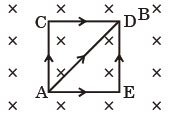
- 3A square of side $2.0\,m$ is placed in a uniform magnetic field $B = 2.0\, T$ in a direction perpendicular to the plane of the square inwards. Equal current, $i = 3.0\, A$ is flowing in the direction shown in figure. Find the magnitude of magnetic force on the loopView Solution
- 4$A$ galvanometer may be converted into ammeter or voltmeter. In which of the following cases the resistance of the device will be the largest ? (Asssume maximum range of galvanometer $= 1\, mA$)View Solution
- 5A singly ionized magnesium atom $(A=24)$ ion is accelerated to kinetic energy $5\,keV$ and is projected perpendicularly into a magnetic field $B$ of the magnitude $0.5\,T$. The radius of path formed will be___________ $cm$View Solution
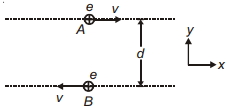
- 6Two protons $A$ and $B$ move parallel to the $x$-axis in opposite directions with equal speeds $v$. At the instant shown, the ratio of magnetic force and electric force acting on the proton $A$ is ( $c=$ speed of light in vacuum)View Solution
- 7A current $i$ is flowing in a conductor of length $l$. When it is bent in the form of a circular loop then its magnetic moment will be-View Solution
- 8View SolutionWhich of the following statement is wrong
- 9A solenoid is $1.0$ $ metre$ long and it has $4250$ $turns$. If a current of $5.0$ $ampere$ is flowing through it, what is the magnetic field at its centre $[{\mu _0} = 4\pi \times {10^{ - 7}}\,weber/amp - m]$View Solution
- 10View SolutionThe radius of curvature of the path of a charged particle moving in a static uniform magnetic field is