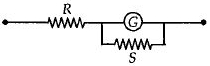
A galvanometer of resistance, $G,$ is shunted by a resistance $S$ $ohm$. To keep the main current in the circuit unchanged, the resistance to be put in series with the galvanometer is
AIPMT 2011, Medium


Download our appand get started for free
Experience the future of education. Simply download our apps or reach out to us for more information. Let's shape the future of learning together!No signup needed.*
Similar Questions
- 1Two long current carrying conductors are placed parallel to each other at a distance of $8 \,cm$ between them. The magnitude of magnetic field produced at mid-point between the two conductors due to current flowing in them is $300 \,\mu T$. The equal current flowing in the two conductors is ...............View Solution
- 2The acceleration of an electron at a moment in a magentic field $\vec B\, = \,2\hat i + 3\hat j + 4\hat k$ is $\vec a\, = \,x\hat i - 2\hat j + \hat k$. The value of $x$ isView Solution
- 3View SolutionA charged particle moves in a uniform magnetic field. The velocity of the particle at some instant makes an acute angle with the magnetic field. The path of the particle will be
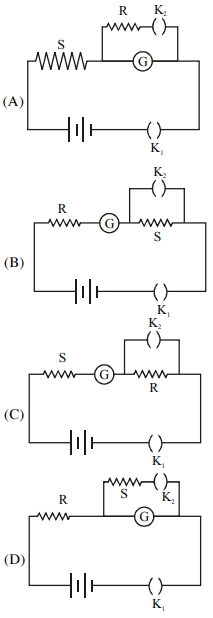
- 4In the circuit diagrams $(A, B, C$ and $D$) shown below, $R$ is a high resistance and $S$ is a resistance of the order of galvanometer resistance $G$. The correct circuit, corresponding to the half deflection method for finding the resistance and figure of merit of the galvanometer, is the circuit labelled asView Solution
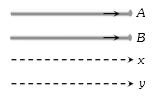
- 5$A$ and $B$ are two conductors carrying a current $i$ in the same direction. $x$ and $y$ are two electron beams moving in the same directionView Solution
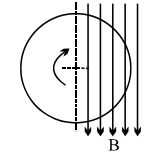
- 6A thin non conducting disc of radius $R$ is rotating clockwise (see figure) with an angular velocity $w$ about its central axis, which is perpendicular to its plane. Both its surfaces carry $+ve$ charges of uniform surface density. Half the disc is in a region of a uniform, unidirectional magnetic field $B$ parallel to the plane of the disc, as shown. Then,View Solution
- 7In the figure, find out the magnetic field at $B$ (Given $I =2.5 \;A,r =5\, cm )$View Solution
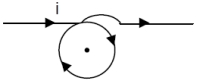
- 8A steel wire has a magnetic moment $M.$ What will be its magnetic moment if it is bent into a semi-circular arc ?View Solution
- 9A long solenoid with $20$ $turns$ per $cm$ is made. To produce a magnetic field of $20$ $millitesla$ inside the solenoid, the necessary current will nearly be......$ampere$View Solution
- 10Two infinitely long straight wires lie in the $\mathrm{xy}$-plane along the lines $\mathrm{x}=+R$. The wire located at $\mathrm{x}=+\mathrm{R}$ carries a constant current $\mathrm{I}_1$ and the wire located at $\mathrm{x}=-R$ carries a constant current $\mathrm{I}_2$. A circular loop of radius $R$ is suspended with its centre at $(0,0, \sqrt{3} R)$ and in a plane parallel to the xy-plane. This loop carries a constant current $/$ in the clockwise direction as seen from above the loop. The current in the wire is taken to be positive if it is in the $+\hat{\mathrm{j}}$ direction. Which of the following statements regarding the magnetic field $\dot{B}$ is (are) true?View Solution
$(A)$ If $I_1=I_2$, then B' cannot be equal to zero at the origin $(0,0,0)$
$(B)$ If $\mathrm{I}_1>0$ and $\mathrm{I}_2<0$, then $\mathrm{B}$ can be equal to zero at the origin $(0,0,0)$
$(C)$ If $\mathrm{I}_1<0$ and $\mathrm{I}_2>0$, then $\mathrm{B}$ can be equal to zero at the origin $(0,0,0)$
$(D)$ If $\mathrm{I}_1=\mathrm{I}_2$, then the $\mathrm{z}$-component of the magnetic field at the centre of the loop is $\left(-\frac{\mu_0 \mathrm{I}}{2 \mathrm{R}}\right)$