Two infinitely long straight wires lie in the $\mathrm{xy}$-plane along the lines $\mathrm{x}=+R$. The wire located at $\mathrm{x}=+\mathrm{R}$ carries a constant current $\mathrm{I}_1$ and the wire located at $\mathrm{x}=-R$ carries a constant current $\mathrm{I}_2$. A circular loop of radius $R$ is suspended with its centre at $(0,0, \sqrt{3} R)$ and in a plane parallel to the xy-plane. This loop carries a constant current $/$ in the clockwise direction as seen from above the loop. The current in the wire is taken to be positive if it is in the $+\hat{\mathrm{j}}$ direction. Which of the following statements regarding the magnetic field $\dot{B}$ is (are) true?
$(A)$ If $I_1=I_2$, then B' cannot be equal to zero at the origin $(0,0,0)$
$(B)$ If $\mathrm{I}_1>0$ and $\mathrm{I}_2<0$, then $\mathrm{B}$ can be equal to zero at the origin $(0,0,0)$
$(C)$ If $\mathrm{I}_1<0$ and $\mathrm{I}_2>0$, then $\mathrm{B}$ can be equal to zero at the origin $(0,0,0)$
$(D)$ If $\mathrm{I}_1=\mathrm{I}_2$, then the $\mathrm{z}$-component of the magnetic field at the centre of the loop is $\left(-\frac{\mu_0 \mathrm{I}}{2 \mathrm{R}}\right)$
IIT 2018, Advanced
Download our app for free and get started
(image)
$(A)$ At the origin, $\mathrm{B}=0$ due to two wires if $\mathrm{I}_1=\mathrm{I}_2$, hence $\overrightarrow{\mathrm{B}}_{\text {net }}$ at the origin is equal to $\mathrm{B}$, due to loop, which is non zero.
$(B)$ If $\mathrm{I}_1>0$ and $\mathrm{I}_2<0$, $\dot{\mathrm{B}}$ at the origin due to wires will be along $+\hat{\mathrm{k}}$ direction and $\dot{\mathrm{B}}$ due to loop is along $-\hat{\mathrm{k}}$ direction, hence $\dot{\mathrm{B}}$ can be zero at the origin.
$(C)$ If $\mathrm{I}_1<0$ and $\mathrm{I}_2>0, \overrightarrow{\mathrm{B}}$ at the origin due to wires is along $-\hat{\mathrm{k}}$ and also due to ring is along $-\hat{k}$ so, $\vec{B}$ can not be zero.
$(D)$ At the centre of the loop B due to wires is along $\mathrm{x}$-axis. Hence the z-component of the magnetic field at the center of the loop is $\left(\frac{\mu_0 I}{2 R}\right)(-\hat{k})$.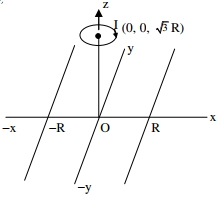

Download our appand get started for free
Experience the future of education. Simply download our apps or reach out to us for more information. Let's shape the future of learning together!No signup needed.*
Similar Questions
- 1A moving coil galvanometer has resistance $50\,\Omega $ and it indicates full deflection at $4\,mA$ current. A voltmeter is made using this galvanometer and a $5\,k\Omega $ resistance. The maximum voltage, that can be measured using this voltamenter, will be close to ......$V$View Solution
- 2The correct curve between the magnetic induction $(B)$ along the axis of a long solenoid due to current flow $i$ in it and distance $x$ from one end is :View Solution
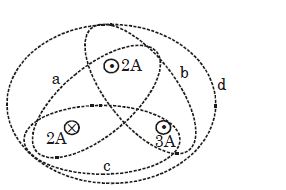
- 3Rank the value of $\oint {\vec B.\overrightarrow {dl} } $ for the closed paths shown in figure from the smallest to largestView Solution
- 4A particle of mass $M$ and charge $Q$ moving with velocity $\mathop v\limits^ \to $ describes a circular path of radius $R$ when subjected to a uniform transverse magnetic field of induction $B$. The work done by the field when the particle completes one full circle isView Solution
- 5A long straight wire along the $z-$ axis carries a current $I$ in the negative $z$ direction. The magnetic field vector $\vec B$ at a point having coordinates $(x, y)$ in the $z = 0$ plane isView Solution
- 6The cyclotron frequency of an electron grating in a magnetic field of $1\, T$ is approximatelyView Solution
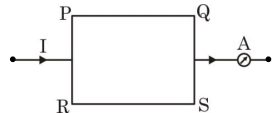
- 7A current carrying rectangular loop PQRS is made of uniform wire. The length $PR = QS =5\,cm$ and $PQ = RS =100\,cm$. If ammeter current reading changes from I to $2 I$, the ratio of magnetic forces per unit length on the wire $P Q$ due to wire RS in the two cases respectively $f_{ PQ }^{ I }: f_{ PQ }^{2 I }$ is :View Solution
- 8A particle is projected with a velocity ( $10\ m/s$ ) along $y-$ axis from point $(2, 3)$ . Magnetic field of $\left( {3\hat i + 4\hat j} \right)$ Tesla exist uniformly in the space. Its speed when particle passes through $y-$ axis for the third time is : (neglect gravity)View Solution
- 9The correct curve between the magnetic induction $(b)$ along the axis of a long solenoid due to current flow $ i$ in it and distance $x$ from one end isView Solution
- 10In toroid magnetic field on axis will be the radius $=0.5\, cm ,$ current $=1.5\, A ,$ turns $=250,$ permeability $=700$ (in Tesla)View Solution