A long solenoid with $20$ $turns$ per $cm$ is made. To produce a magnetic field of $20$ $millitesla$ inside the solenoid, the necessary current will nearly be......$ampere$
Medium


Download our appand get started for free
Experience the future of education. Simply download our apps or reach out to us for more information. Let's shape the future of learning together!No signup needed.*
Similar Questions
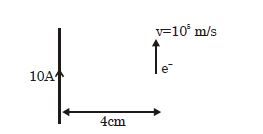
- 1An $e^-$ is moving parallel to a long current carrying wire as shown. Force on electron isView Solution
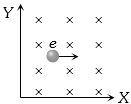
- 2View SolutionIn the given figure, the electron enters into the magnetic field. It deflects in ...... direction
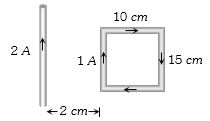
- 3View SolutionWhat is the net force on the square coil
- 4A particle of charge $q$ and mass $m$ moves in a circular orbit of radius $r$ with angular speed $\omega $. The ratio of the magnitude of its magnetic moment to that of its angular momentum depends onView Solution
- 5View SolutionFrom Ampere's circuital law for a long straight wire of circular cross-section carrying a steady current, the variation of magnetic field in the inside and outside region of the wire is :
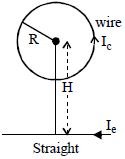
- 6Circular loop of a wire and a long straight wire carry currents $I_c$ and $I_e$, respectively as shown in figure. Assuming that these are placed in the same plane, the magnetic fields will be zero at the centre of the loop when the separation $H$ isView Solution
- 7A particle with charge $-Q$ and mass m enters a magnetic field of magnitude $B,$ existing only to the right of the boundary $YZ$. The direction of the motion of the $m$ particle is perpendicular to the direction of $B.$ Let $T = 2\pi\frac{m}{{QB}}$ . The time spent by the particle in the field will beView Solution
- 8An electric field of $1500\, V/m$ and a magnetic field of $0.40\, weber/metre^2$ act on a moving electron. The minimum uniform speed along a straight line the electron could have isView Solution
- 9View SolutionIn a region, steady and uniform electric and magnetic fields are present. These two fields are parallel to each other. A charged particle is released from rest in this region. The path of the particle will be a
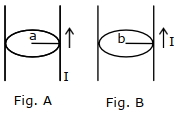
- 10Figure $A$ and $B$ shown two long straight wires of circular cross-section ($a$ and $b$ with $a$ $<$ $b$), carrying current $I$ which is uniformly distributed across the cross-section. The magnitude of magnetic field $B$ varies with radius $r$ and can be represented asView Solution