MCQ
A gas expands adiabatically at constant pressure such that its temperature $T \propto \frac{1}{{\sqrt V }}$, the value of ${C_P}/{C_V}$ of gas is
  • A
    $1.3$
  • $1.5$
  • C
    $1.67$
  • D
    $2$

Answer

Correct option: B.
$1.5$
b
(b) $T{V^{\gamma - 1}} = $ constant ==> $T \propto {V^{1 - \gamma }}$

According to question $T \propto {V^{ - \frac{1}{2}}}$

Hence $1 - \gamma = - \frac{1}{2} \Rightarrow \gamma \frac{3}{2} = 1.5$

Need a full question paper?

Generate a complete, print-ready paper with questions like this in minutes — across 16+ boards, with answer keys.

Start Generating Free

Similar questions

As an electron makes a transition from an excited state to the ground state of a hydrogen - like atom/ion:
The displacement time equation of a particle executing $SHM$ is : $x = A \,sin\,(\omega t + \phi )$. At time $t = 0$ position of the particle is $x = A/2$ and it is moving along negative $x-$ direction. Then the angle $\phi $ can be
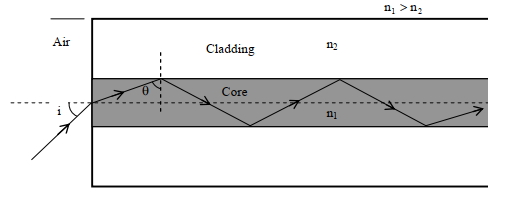
Light guidance in an optical fiber can be understood by considering a structure comprising of thin solid glass cylinder of refractive index $n_1$ surrounded by a medium of lower refractive index $n_2$. The light guidance in the structure takes place due to successive total internal reflections at the interface of the media $n_1$ and $n_2$ as shown in the figure. All rays with the angle of incidence $i$ less than a particular value $i_m$ are confined in the medium of refractive index $n_1$. The numerical aperture ($NA$) of the structure is defined as $\sin i_m$ - $Image$

$1.$ For two structures namely $S_1$ with $n_1=\sqrt{45} / 4$ and $n_2=3 / 2$, and $S_2$ with $n_1=8 / 5$ and $n_2=7 / 5$ and taking the refractive index of water to be $4 / 3$ and that of air to be 1 , the correct option$(s)$ is(are)

$(A)$ $NA$ of $S_1$ immersed in water is the same as that of $S_2$ immersed in a liquid of refractive index $\frac{16}{3 \sqrt{15}}$

$(B)$ $NA$ of $S _1$ immersed in liquid of refractive index $\frac{6}{\sqrt{15}}$ is the same as that of $S _2$ immersed in water

$(C)$ $NA$ of $S_1$ placed in air is the same as that of $S_2$ immersed in liquid of refractive index $\frac{4}{\sqrt{15}}$.

$(D)$ $NA$ of $S_1$ placed in air is the same as that of $S_2$ placed in water

$2.$ If two structures of same cross-sectional area, but different numerical apertures $N A_1$ and $NA _2\left( NA _2< NA _1\right)$ are joined longitudinally, the numerical aperture of the combined structure is

$(A)$ $\frac{ NA _1 NA _2}{ NA _1+ NA _2}$ $(B)$ $NA _1+ NA _2$ $(C)$ $NA _1$ $(D)$ $NA _2$

Give the answer question $1$ and $2.$
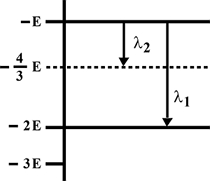
Some energy levels of a molecule are shown in the figure. The ratio of the wavelengths $r$ =$\frac{{{\lambda _1}}}{{{\lambda _2}}}$ is given by
If three moles of monoatomic gas $\left(\gamma=\frac{5}{3}\right)$ is mixed with two moles of a diatomic gas $\left(\gamma=\frac{7}{5}\right)$, the value of adiabatic exponent $\gamma$ for the mixture is:
In a zener diode, break down occurs in reverse bias due to
The energy required to remove the electron from a singly ionized Helium atom is $2.2\, times$ the energy required to remove an electron from Helium atom . The total energy required to ionize the Helium atom completely is......$eV$
In a moving coil galvanometer, the deflection of the coil $\theta $ is related to the electrical current $i$ by the relation
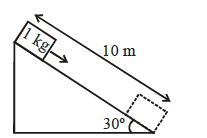
Find work done by friction if block reaches to the end with constant velocity
A reflecting telescope utilizes