MCQ
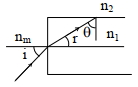
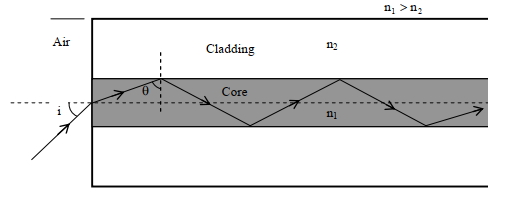
Light guidance in an optical fiber can be understood by considering a structure comprising of thin solid glass cylinder of refractive index $n_1$ surrounded by a medium of lower refractive index $n_2$. The light guidance in the structure takes place due to successive total internal reflections at the interface of the media $n_1$ and $n_2$ as shown in the figure. All rays with the angle of incidence $i$ less than a particular value $i_m$ are confined in the medium of refractive index $n_1$. The numerical aperture ($NA$) of the structure is defined as $\sin i_m$ - $Image$

$1.$ For two structures namely $S_1$ with $n_1=\sqrt{45} / 4$ and $n_2=3 / 2$, and $S_2$ with $n_1=8 / 5$ and $n_2=7 / 5$ and taking the refractive index of water to be $4 / 3$ and that of air to be 1 , the correct option$(s)$ is(are)

$(A)$ $NA$ of $S_1$ immersed in water is the same as that of $S_2$ immersed in a liquid of refractive index $\frac{16}{3 \sqrt{15}}$

$(B)$ $NA$ of $S _1$ immersed in liquid of refractive index $\frac{6}{\sqrt{15}}$ is the same as that of $S _2$ immersed in water

$(C)$ $NA$ of $S_1$ placed in air is the same as that of $S_2$ immersed in liquid of refractive index $\frac{4}{\sqrt{15}}$.

$(D)$ $NA$ of $S_1$ placed in air is the same as that of $S_2$ placed in water

$2.$ If two structures of same cross-sectional area, but different numerical apertures $N A_1$ and $NA _2\left( NA _2< NA _1\right)$ are joined longitudinally, the numerical aperture of the combined structure is

$(A)$ $\frac{ NA _1 NA _2}{ NA _1+ NA _2}$ $(B)$ $NA _1+ NA _2$ $(C)$ $NA _1$ $(D)$ $NA _2$

Give the answer question $1$ and $2.$
  • A
    $(BD,A)$
  • B
    $(BC,C)$
  • $(AC,D)$
  • D
    $(AD,B)$

Answer

Correct option: C.
$(AC,D)$
c
$1.$ $\theta \geq c$

$\Rightarrow 90^{\circ}-r \geq c$

$\Rightarrow \sin \left(90^{\circ}-r\right) \geq c$

$\Rightarrow \cos r \geq \sin c$

using $\frac{\sin i }{\sin r }=\frac{ n _1}{ n _{ m }}$ and $\sin c =\frac{ n _2}{ n _1}$

we get, $\sin ^2 i_m=\frac{n_1^2-n_2^2}{n_m^2}$

Putting values, we get, correct options as $A \& C$

$2.$ For total internal reflection to take place in both structures, the numerical aperture should be the least one for the combined structure \& hence, correct option is $D$.

Need a full question paper?

Generate a complete, print-ready paper with questions like this in minutes — across 16+ boards, with answer keys.

Start Generating Free

Similar questions

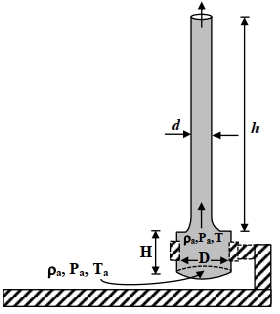
A cylindrical furnace has height $(H)$ and diameter $(D)$ both $1 \mathrm{~m}$. It is maintained at temperature $360 \mathrm{~K}$. The air gets heated inside the furnace at constant pressure $P_a$ and its temperature becomes $T=360 \mathrm{~K}$. The hot air with density $\rho$ rises up a vertical chimney of diameter $d=0.1 \mathrm{~m}$ and height $h=9 \mathrm{~m}$ above the furnace and exits the chimney (see the figure). As a result, atmospheric air of density $\rho_a=1.2 \mathrm{~kg} \mathrm{~m}^{-3}$, pressure $P_a$ and temperature $T_a=300 \mathrm{~K}$ enters the furnace. Assume air as an ideal gas, neglect the variations in $\rho$ and $T$ inside the chimney and the furnace. Also ignore the viscous effects.

[Given: The acceleration due to gravity $g=10 \mathrm{~ms}^{-2}$ and $\pi=3.14$ ]

(image)

($1$) Considering the air flow to be streamline, the steady mass flow rate of air exiting the chimney is

. . . . .$\mathrm{gm} \mathrm{s}^{-1}$.

($2$) When the chimney is closed using a cap at the top, a pressure difference $\Delta P$ develops between the top and the bottom surfaces of the cap. If the changes in the temperature and density of the hot air, due to the stoppage of air flow, are negligible then the value of $\Delta P$ is. . . . .$\mathrm{Nm}^{-2}$.

Find the approx. number of molecules contained in a vessel of volume $7$ litres at $0^oC$ at $1.3 \times 10^5$ pascal
A particle moves a distance $x$ in time $t$ according to equation $x = (t + 5)^{-1}$ The  acceleration of particle is proportional to 
According to law of equipartition of energy the molar specific heat of a diatomic gas at constant volume where the molecule has one additional vibrational mode is :-
Assume there are two identical simple pendulum Clocks$-1$ is placed on the earth and Clock$-2$ is placed on a space station located at a height $h$ above the earth surface. Clock$-1$ and Clock$-2$ operate at time periods $4\,s$ and $6\,s$ respectively. Then the value of $h$ is $....km$ (consider radius of earth $R _{ E }=6400\,km$ and $g$ on earth $10\,m / s ^{2}$ )
Equal potentials are applied on an iron and copper wire of same length. In order to have the same current flow in the two wires, the ratio $r$ (iron)/$r$ (copper) of their radii must be (Given that specific resistance of iron = $1.0 \times {10^{ - 7}}$ $ ohm-m$ and specific resistance of copper = $1.7 \times {10^{ - 8}}\,ohm-m$)
The correct relation between $\gamma=\frac{ C _p}{ c _v}$ and temperature $T$ is :
Which impurity is doped in $Si $ to form $N-$type semi-conductor?
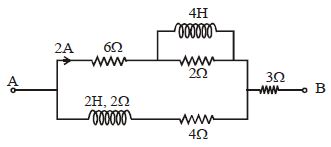
Find $V_A -V_B$ in steady state
In a double slit experiment the angular width of a fringe is found to be $0.2^o $on a screen placed $1\, m$ away. The wavelength of light used is $600\, nm$. What will be the angular width of the fringe if the entire experiment apparatus is immersed in water? Take refractive index of water to be $4/3$.......$^o$