MCQ
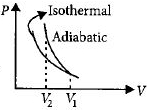
A gas is compressed isothermally to half its initial volume. The same gas is compressed separately through an adiabatic process until its volume is again reduced to half. Then
  • Compressing the gas through adiabatic process will require more work to be done.
  • B
    Compressing the gas isothermally or adiabatically will require the same amount of work.
  • C
    Which of the case (whether compression through isothermal or through adiabatic process) requires more work will depend upon the atomicity of the gas.
  • D
    Compressing the gas isothermally will require more work to be done.
Answer

Correct option: A.
Compressing the gas through adiabatic process will require more work to be done.
a
${V_1} = V,{V_2} = V/2$

$On\,P - V\,diagram,$

$Area\,under\,adiabatic\,curve>Area\,under\,isothermal\,curve,$

So compressing the gas through adiabatic process will require more work to be done.

Need a full question paper?

Generate a complete, print-ready paper with questions like this in minutes — across 16+ boards, with answer keys.

Start Generating Free

Similar questions

Three vectors $\overrightarrow a ,\,\overrightarrow b $and $\overrightarrow c $ satisfy the relation $\overrightarrow a \,.\,\overrightarrow b = 0$ and $\overrightarrow a \,.\,\overrightarrow c = 0.$ The vector $\overrightarrow a $ is parallel to
A geostationary satellite is orbiting around an arbitary planet $^{\prime} P ^{\prime}$ at a height of $11 R$ above the surface of $^{\prime} P ^{\prime} ,$ $R$ being the radius of $^{\prime} P .^{\prime}$ The time period of another satellite in hours at a height of $2R$ from the surface of $^{\prime} P ^{\prime}$ is $........$.$^{\prime} P ^{\prime}$ has the time period of $24\, hours.$
The displacement of a particle from a point having position vector $2 \hat{i}+4 \hat{j}$ to another point having position vector $5 \hat{i}+1 \hat{j}$ is ........ units
Two capillary tubes of same radius $r$ but of lengths $l_1$ and $l_2$ are fitted in parallel to the bottom of a vessel. The pressure head is $P$. What should be the length of a single tube that can replace the two tubes so that the rate of flow is same as before
A particle moves with simple harmonic motion in a straight line. In first $\tau  \,s$, after starting from rest, it travels a distance $a$, and in next $\tau \,s$, it travels $2a$ in same direction then
Identify the pair whose dimensions are equal
Three balls of same masses are projected with equal speeds at angle $15^{\circ}, 45^{\circ}, 75^{\circ}$, and their ranges are respectively $R_1, R_2$ and $R_3$, then
The vectors $5i + 8j$ and $2i + 7j$ are added. The magnitude of the sum of these vector is
If the running bus stop suddenly our feet stop due to friction which does not allow relative motion between the feet and floor of the bus. But the rest of the body continues to move forward due to:
A mass of $20\  kg$ is hanging with support of two strings of same linear mass density. Now pulses are generated in both strings at same time near the joint at mass. Ratio of time, taken by a pulse travel through string $1$ to that taken by pulse on string $2$ is