MCQ
A gas performs minimum work when it expands:
  • A
    Adiabatically.
  • B
    Isothermally.
  • C
    Isobarically.
  • Isochorically.

Answer

Correct option: D.
Isochorically.
In isochoric process, $V =$ constant, $dV = 0$
$\text{dW = P(dv)} = 0$ and hence minimum.

Need a full question paper?

Generate a complete, print-ready paper with questions like this in minutes — across 16+ boards, with answer keys.

Start Generating Free

Similar questions

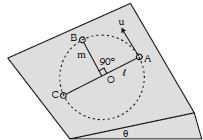
A small sphere of mass $m$ is suspended by a light and inextensible string of length $l$ from a point $O$ fixed on a smooth inclined plane of inclination $\theta $ with the horizontal. The sphere is moving in a circle on the incline as shown. If the sphere has a velocity $u$ at the top most position $A$ . Then,
A stone of mass $m$ is tied to a string of length $l$ and rotated in a circle with a constant speed $v$. If the string is released, the stone flies
A block of mass $M$ is pulled along a horizontal frictionless surface by a rope of mass $M / 2$. If a force $2 Mg$ is applied at one end of the rope, the force which the rope exerts on the block is -
$5$ litre of benzene weighs
Time period of revolution of a nearest satellite around a planet of radius $R$ is T. Period of revolution around another planet, whose radius is $3R$ but having same density is
The magnitude of torque on a particle of mass $1\,kg$ is $2.5\, Nm$ about the origin. If the force acting on it is $1\,N$, and the distance of the particle from the origin is $5\,m$, the angle between the force and the position vector is (in radians)
A beam of metal supported at the two ends is loaded at the centre. The depression at the centre is proportional to
A ring and a solid sphere roll down the same inclined plane without slipping. They start from rest. The radii of both bodies are identical and the ratio of their kinetic energies is $\frac{7}{\mathrm{x}}$ where $\mathrm{x}$ is___________.
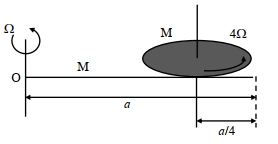
A thin rod of mass $M$ and length $a$ is free to rotate in horizontal plane about a fixed vertical axis passing through point $O$. A thin circular disc of mass $M$ and of radius $a / 4$ is pivoted on this rod with its center at a distance $a / 4$ from the free end so that it can rotate freely about its vertical axis, as shown in the figure. Assume that both the rod and the disc have uniform density and they remain horizontal during the motion. An outside stationary observer finds the rod rotating with an angular velocity $\Omega$ and the disc rotating about its vertical axis with angular velocity $4 \Omega$. The total angular momentum of the system about the point $O$ is $\left(\frac{ M a^2 \Omega}{48}\right) n$. The value of $n$ is. . . . .
A uniform bar of square cross$-$section is lying along a frictionless horizontal surface. A horizontal force is applied to pull it from one of its ends, then: