MCQ
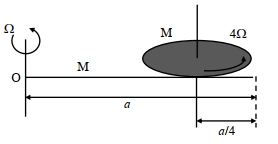
A thin rod of mass $M$ and length $a$ is free to rotate in horizontal plane about a fixed vertical axis passing through point $O$. A thin circular disc of mass $M$ and of radius $a / 4$ is pivoted on this rod with its center at a distance $a / 4$ from the free end so that it can rotate freely about its vertical axis, as shown in the figure. Assume that both the rod and the disc have uniform density and they remain horizontal during the motion. An outside stationary observer finds the rod rotating with an angular velocity $\Omega$ and the disc rotating about its vertical axis with angular velocity $4 \Omega$. The total angular momentum of the system about the point $O$ is $\left(\frac{ M a^2 \Omega}{48}\right) n$. The value of $n$ is. . . . .
  • A
    $30$
  • B
    $35$
  • $49$
  • D
    $50$

Answer

Correct option: C.
$49$
c
$\begin{array}{l} L =\frac{ Ma ^2}{3} \Omega+ M \left(\frac{3 a }{4}\right)^2 \Omega+\frac{ M \left(\frac{ a }{4}\right)^2 4 \Omega}{2} \\ L =\frac{49}{48} Ma ^2 \Omega \\ n =49\end{array}$

Need a full question paper?

Generate a complete, print-ready paper with questions like this in minutes — across 16+ boards, with answer keys.

Start Generating Free

Similar questions

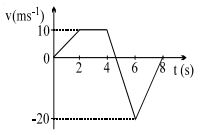
The figure shows a velocity-time graph of a particle moving along a straight line  The total distance travelled by the particle is  ........ $m$
A rod $(AB)$ is attached to a fixed point $(C)$ using a light rope $(AC)$. The other end of the rod $(B)$ is sitting on ice with negligible friction and the system is in stationary position. Which of the following can be the equilibrium configuration of this system?
The velocity of a freely falling body changes as ${g^p}{h^q}$ where g is acceleration due to gravity and $h$ is the height. The values of $p$ and $q$ are
A body falling on the ground from $a$ height of $10\, m$, rebounds to a height $2.5\, m,$ then the ratio of the velocities of the body just before and after the collision will be
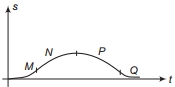
Let us cell a motion, $A$ when velocity is positive and increasing $A^{-1}$ when velocity is negative and increasing. $R$ when velocity is positive and decreasing and $R^{-1}$ when velocity is negative and decreasing. Now, match the following two columns for the given $s=t$ graph.
Colum $I$ Colum $II$
$(A)$ $M$ $(p)$ $A^{-1}$
$(B)$ $N$ $(q)$ $R^{-1}$
$(C)$ $P$ $(r)$ $A$
$(D)$ $Q$ $(s)$ $R$

A hollow pipe of length $0.8 \mathrm{~m}$ is closed at one end. At its open end a $0.5 \mathrm{~m}$ long uniform string is vibrating in its second harmonic and it resonates with the fundamental frequency of the pipe. If the tension in the wire is $50 \mathrm{~N}$ and the speed of sound is $320 \mathrm{~ms}^{-1}$, the mass of the string is
If three moles of monoatomic gas $\left(\gamma=\frac{5}{3}\right)$ is mixed with two moles of a diatomic gas $\left(\gamma=\frac{7}{5}\right)$, the value of adiabatic exponent $\gamma$ for the mixture is:
A sonometer wire supports a $4\ kg$ load and vibrates in fundamental mode with a tuning fork of frequency $416Hz$. The length of the wire between the bridges is now doubled. In order to maintain fundamental mode, the load should be changed to:​​​​​​
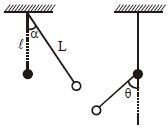
A simple pendulum consisting of a mass $M$ attached to a string of length $L$ is released from rest at an angle $\alpha$. $A$ pin is located at a distance $l$ below the pivot point. When the pendulum swings down, the string hits the pin as shown in the figure. The maximum angle $\theta$ which string makes with the vertical after hitting the pin is :-
At what temperature will the oxygen molecules have the same root mean square speed as hydrogen molecules at $200 \,K$ ....... $K$