MCQ
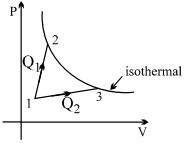
A gas takes part in two processes in which it is heated from the same initial state $1$ to the same final temperature. The processes are shown on the $P-V$ diagram by the straight line $1-2$ and $1-3$. $2$ and $3$ are the points on the same isothermal curve. $Q_1$ and $Q_2$ are the heat transfer along the two processes. Then
  • A
    $Q_1 = Q_2$
  • $Q_1 < Q_2$
  • C
    $Q_1 > Q_2$
  • D
    insufficient data

Answer

Correct option: B.
$Q_1 < Q_2$
b
Let the volumes and temperatures of gas at points 1,2 and 3 are $V_1, T_1, V_2, T_2$ and $V _3, T _3$ respectively.

Given: $T_2=T_3$

Thus $\Delta U _1= nC _{ v }\left( T _2- T _1\right)$

Also $\Delta U _2= nC _{ v }\left( T _3- T _1\right)$

But $T _2= T _3 \Rightarrow \Delta U _1=\Delta U _2$

Work done by the gas in process 1, $W _1= nRT \ln \frac{ V _2}{ V _1}$

Also work done by gas in process $2, \quad W_2=n R T \ln \frac{V_3}{V_1}$

$V _3 > V _2 \Rightarrow W _2 > W _1$

From ist law: $\quad Q=\Delta U+W$

$\therefore \quad Q _{ I }=\Delta U _1+ W _1$

Also $\quad Q _2=\Delta U _2+ W _2$

$\therefore Q _2- Q _1= W _2- W _1>0 \quad\left(\because \Delta U _1=\Delta U _2\right)$

$\Rightarrow Q _2 > Q _1$

Need a full question paper?

Generate a complete, print-ready paper with questions like this in minutes — across 16+ boards, with answer keys.

Start Generating Free

Similar questions

A person draws water from a $5\,m$ deep well in a bucket of mass $2\,kg$ of capacity $8\,litre$ by a rope of mass $1\,kg.$ What is the total work done by the person ? .............. $\mathrm{J}$ (Assume $g = 10\,m/sec^2$ )
A wagon of $200\, kg$ is moving on a smooth track with a velocity of $2\, m/s$. A man of $80\, kg$ also runs in the wagon with a velocity such that the speed of centre of mass of the system is zero. Find the relative velocity of man w.r.t. wagon ...... $m/s$
If in a stationary wave the amplitude corresponding to antinode is $4 \,cm$, then the amplitude corresponding to a particle of medium located exactly midway between a node and an antinode is ........... $cm$
Your friend driving his car overtakes your car on the highway. Which of the following statement must be true at the instant he is passing you? Assume the cars as point particles.
The rise of a liquid in a capillary tube depends on
As the temperature of a metallic resistor is increased, the product of its resistivity and conductivity:
A particle tied to one end of a string is being rotated in a vertical circle with constant frequency. The tension in the string at points $A, B, C$ and $D$ are $T_1, T_2, T_3$ and $T_4$ respectively Then
A ball of mass $0.5 \mathrm{~kg}$ is attached to a string of length $50 \mathrm{~cm}$. The ball is rotated on a horizontal circular path about its vertical axis. The maximum tension that the string can bear is $400 \mathrm{~N}$. The maximum possible value of angular velocity of the ball in rad/s is,:
The potential energy of a particle of mass $m$ at a distance $r$ from a fixed point $O$ is given by $\mathrm{V}(\mathrm{r})=\mathrm{kr}^2 / 2$, where $\mathrm{k}$ is a positive constant of appropriate dimensions. This particle is moving in a circular orbit of radius $\mathrm{R}$ about the point $\mathrm{O}$. If $\mathrm{v}$ is the speed of the particle and $\mathrm{L}$ is the magnitude of its angular momentum about $\mathrm{O}$, which of the following statements is (are) true?

$(A)$ $v=\sqrt{\frac{k}{2 m}} R$

$(B)$ $v=\sqrt{\frac{k}{m}} R$

$(C)$ $\mathrm{L}=\sqrt{\mathrm{mk}} \mathrm{R}^2$

$(D)$ $\mathrm{L}=\sqrt{\frac{\mathrm{mk}}{2}} \mathrm{R}^2$

A force of $10N$ is applied on an object of mass $2\ kg$ placed on a rough surface having coefficient of friction equal to $0.2.$ Work done by applied force in $4s$ is: