Question
A geyser heats water flowing at the rate of $3.0$ litres per minute from $27°C$ to $77°C$. If the geyser operates on a gas burner, what is the rate of consumption of the fuel if its heat of combustion is $4.0 × 10⁴J/g$?

Answer

Water is flowing at a rate of $3.0$ litre/min. The geyser heats the water, raising the temperature from $27^\circ C$ to $77^\circ C$. Initial temperature, $T_1 = 27^\circ C$ Final temperature, $T_2 = 77^\circ C$
$\therefore$ Rise in temperature, $\triangle T = T_2 - T_1 = 77 – 27= 50^\circ C$ Heat of combustion $= 4 \times 10^4J/g$ Specific heat of water, $c = 4.2J {g^{-1}{^\circ C}^{-1}}$ Mass of flowing water, m = 3.0 litre/min = 3000g/min Total heat used, $\Delta\text{Q} =\text{mc}\Delta\text{T}$ = $3000 \times 4.2 \times 50 = 6.3 \times 10^5J/min$
$\therefore$ Rate of consumption $=\frac{6.3\times0^5}{4\times10^4}=15.75\text{g/min}$

Need a full question paper?

Generate a complete, print-ready paper with questions like this in minutes — across 16+ boards, with answer keys.
Start Generating Free

Similar questions

A projectile is fired horizontally with a velocity of $98ms^{-1}$ from the hill 490m high. Find (i) time taken to reach the ground (ii) the distance of the target from the hill and (iii) the velocity with which the body strikes the ground.
A certain element emits $\text{K}_\alpha$ X-ray of energy 3.69keV. Use the data from the previous problem to identify the element.
Calculate the number of degrees of freedom of molecules of hydrogen in $1cc$ of hydrogen gas at NTP.
A heavy particle is suspended by a $1.5m$ long string. It is given a horizontal velocity of $\sqrt{57}\text{m/s}.$
  1. Find the angle made by the string with the upward vertical, when it becomes slack.
  2. Find the speed of the particle at this instant.
  3. Find the maximum height reached by the particle over the point of suspension. Take $g = 10m/s^2$.
A body covers $12m$ in $2^{nd}$ second and $20m$ in $4^{th}$ second. Find what distance the body will cover in $4$ second after $5^{th}$ second.
State the assumptions of the kinetic theory of gases. The density of carbon dioxide gas at $0^{\circ} \mathrm{C}$ and at a pressure of $1.0 \times 10^5$ newton/ metre ${ }^2$ is $1.98 \mathrm{~kg} / \mathrm{m}^3$. Find the root mean square velocity of its molecules at $0^{\circ} \mathrm{C}$ and $30^{\circ} \mathrm{C}$. Pressure is constant.
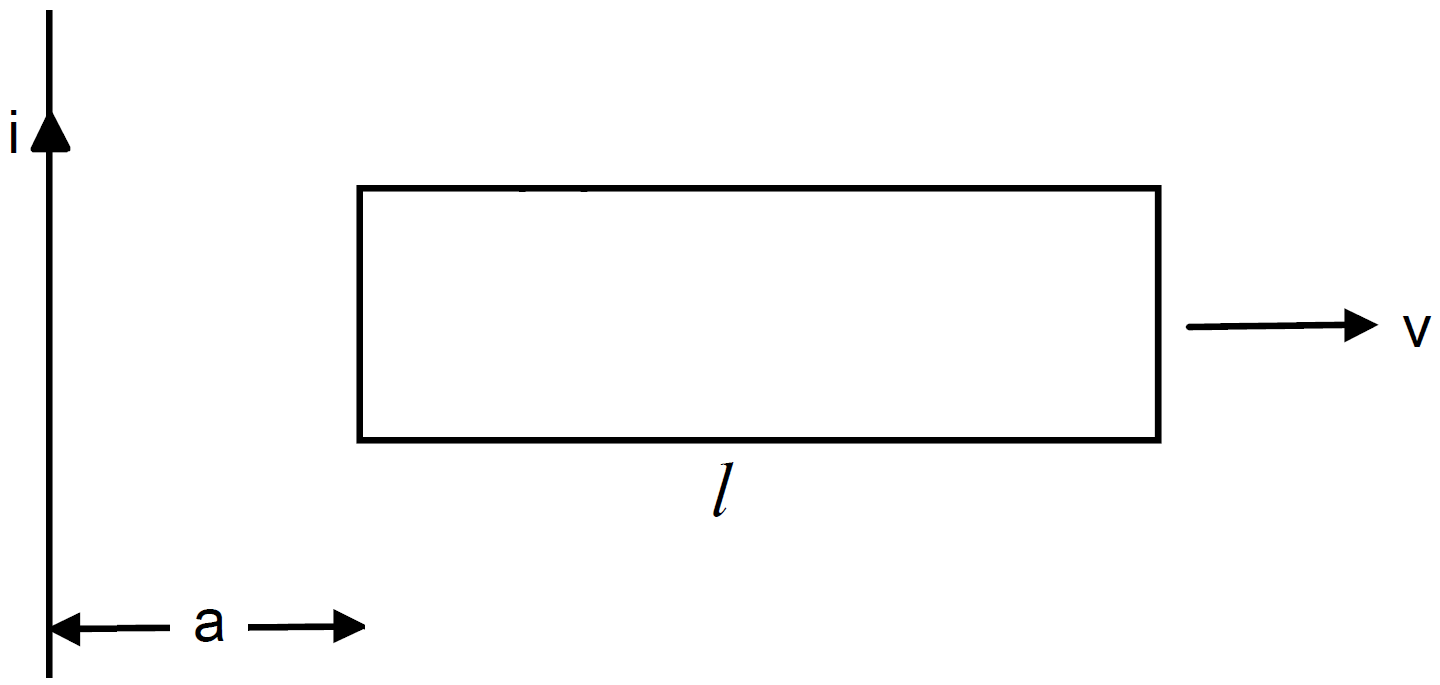
A rectangular metallic loop of length l and width b is placed coplanarly with a long wire carrying a current i. The loop is moved perpendicular to the wire with a speed v in the plane containing the wire and the loop. Calculate the emf induced in the loop when the rear end of the loop is at a distance a from the wire. Solve by using Faraday's law for the flux through the loop and also by replacing different segments with equivalent batteries.
A stone hangs in air from one end of a wire which is stretched over a sonometer. The wire is in unison with a certain tuning fork when the bridges of the sonometer are 45cm apart. Now the stone hangs immersed in water at 4°C and the distance between the bridges has to be altered by 9cm to re-establish unison of the wire with the same fork. Calculate the density of the stone.
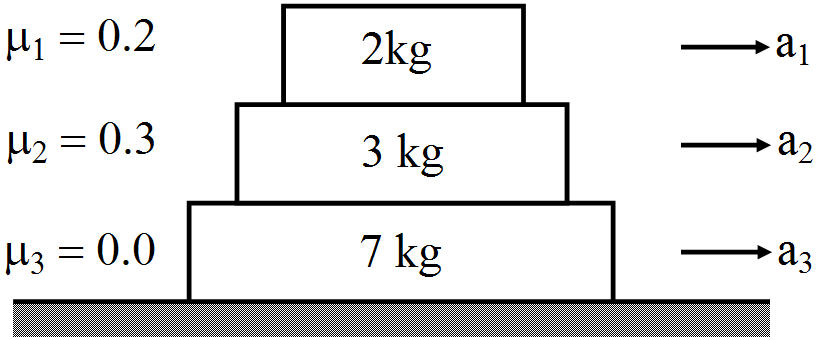
Find the accelerations $a_1, a_2, a_3$ of the three blocks shown in figure if a horizontal force of $10N$ is applied on:
  1. 2kg block.
  2. 3kg block.
  3. 7kg block. Take $g = 10m/s^2$.
Separation of Motion of a system of particles into motion of the centre of mass and motion about the centre of mass: Show $\text{K}=\text{K}'+\frac{1}{2}\text{M}\text{V}^2$ where K' is the total kinetic energy of the system of particles, K′ is the total kinetic energy of the system when the particle velocities are taken with respect to the centre of mass and $\frac{\text{MV}^2}{2}$ is the kinetic energy of the translation of the system as a whole (i.e. of the centre of mass motion of the system). The result has been used in $\sec7.14$