Separation of Motion of a system of particles into motion of the centre of mass and motion about the centre of mass: Show $\text{K}=\text{K}'+\frac{1}{2}\text{M}\text{V}^2$ where K' is the total kinetic energy of the system of particles, K′ is the total kinetic energy of the system when the particle velocities are taken with respect to the centre of mass and $\frac{\text{MV}^2}{2}$ is the kinetic energy of the translation of the system as a whole (i.e. of the centre of mass motion of the system). The result has been used in $\sec7.14$
Download our app for free and get started
We have the relation for velocity of the $I^{th}$ particle as, $\text{v}_\text{i}=\text{v}'_\text{i}+\text{V}$
$\sum\limits_\text{i}\text{m}_\text{i}\text{v}_\text{i}=\sum\limits_\text{i}\text{m}_\text{i}\text{v}_\text{i}'+\sum\limits_\text{i}\text{m}_\text{i}\text{V}\ ...(\text{ii})$ Taking the dot product of equation (ii) with itself, we get $\sum\limits_\text{i}\text{m}_\text{i}\text{v}_\text{i}\cdot\sum_\limits\text{i}\text{m}_\text{i}\text{v}_\text{i}=\sum\limits_\text{i}\text{m}_\text{i}\big(\text{v}'_\text{i}+\text{V}\big)\cdot\sum\limits_\text{i}\text{m}_\text{i}\big(\text{v}'_\text{i}+\text{V}\big)$
$\text{M}^2\sum\limits_\text{i}\text{v}_\text{i}^2=\text{M}^2\sum\limits_\text{i}\text{v}'{_\text{i}^2}+\text{M}^2\sum\limits_\text{i}\text{v}_\text{i}\cdot\text{v}_\text{i}'+\text{M}^2\sum\limits_\text{i} \text{v}'_\text{i}\cdot\text{v}_\text{i}+\text{M}^2\text{V}^2$ Here, for the centre of mass of the system of particles, $\sum\limits_\text{i}\text{v}_\text{i}\cdot\text{v}'_\text{i}=-\sum\limits_\text{i}\text{v}'_\text{i}\cdot\text{v}_\text{i}$
$\text{M}^2\sum\limits_\text{i}\text{v}_\text{i}^2=\text{M}^2\sum\limits_\text{i}\text{v}'{_\text{i}^2}+\text{M}^2\text{V}^2$
$\text{M}^2\sum\limits_\text{i}\text{v}_\text{i}^2=\text{M}^2\sum\limits_\text{i}\text{v}'{_\text{i}^2}+\text{M}^2\text{V}^2$
$\frac{1}{2}\text{M}\sum\limits_\text{i}\text{v}^2_\text{i}=\frac{1}{2}\text{M}\sum\limits_\text{i}\text{v}'^2_\text{i}+\frac{1}{2}\text{MV}^2$
$\text{K}=\text{K}'+\frac{1}{2}\text{MV}^2$ Where, $\text{K}=\frac{1}{2}\text{M}\sum\limits_\text{i}\text{v}^2_\text{i}$ = Total kinetic energy of the system of particles $\text{K}'=\frac{1}{2}\text{M}\sum\limits_\text{i}\text{v}'^2_\text{i}$ = Total kinetic energy of the system of particles with respect to the centre of mass $\frac{1}{2}\text{MV}^2$ = Kinetic energy of the translation of the system as a whole.
$\sum\limits_\text{i}\text{m}_\text{i}\text{v}_\text{i}=\sum\limits_\text{i}\text{m}_\text{i}\text{v}_\text{i}'+\sum\limits_\text{i}\text{m}_\text{i}\text{V}\ ...(\text{ii})$ Taking the dot product of equation (ii) with itself, we get $\sum\limits_\text{i}\text{m}_\text{i}\text{v}_\text{i}\cdot\sum_\limits\text{i}\text{m}_\text{i}\text{v}_\text{i}=\sum\limits_\text{i}\text{m}_\text{i}\big(\text{v}'_\text{i}+\text{V}\big)\cdot\sum\limits_\text{i}\text{m}_\text{i}\big(\text{v}'_\text{i}+\text{V}\big)$
$\text{M}^2\sum\limits_\text{i}\text{v}_\text{i}^2=\text{M}^2\sum\limits_\text{i}\text{v}'{_\text{i}^2}+\text{M}^2\sum\limits_\text{i}\text{v}_\text{i}\cdot\text{v}_\text{i}'+\text{M}^2\sum\limits_\text{i} \text{v}'_\text{i}\cdot\text{v}_\text{i}+\text{M}^2\text{V}^2$ Here, for the centre of mass of the system of particles, $\sum\limits_\text{i}\text{v}_\text{i}\cdot\text{v}'_\text{i}=-\sum\limits_\text{i}\text{v}'_\text{i}\cdot\text{v}_\text{i}$
$\text{M}^2\sum\limits_\text{i}\text{v}_\text{i}^2=\text{M}^2\sum\limits_\text{i}\text{v}'{_\text{i}^2}+\text{M}^2\text{V}^2$
$\text{M}^2\sum\limits_\text{i}\text{v}_\text{i}^2=\text{M}^2\sum\limits_\text{i}\text{v}'{_\text{i}^2}+\text{M}^2\text{V}^2$
$\frac{1}{2}\text{M}\sum\limits_\text{i}\text{v}^2_\text{i}=\frac{1}{2}\text{M}\sum\limits_\text{i}\text{v}'^2_\text{i}+\frac{1}{2}\text{MV}^2$
$\text{K}=\text{K}'+\frac{1}{2}\text{MV}^2$ Where, $\text{K}=\frac{1}{2}\text{M}\sum\limits_\text{i}\text{v}^2_\text{i}$ = Total kinetic energy of the system of particles $\text{K}'=\frac{1}{2}\text{M}\sum\limits_\text{i}\text{v}'^2_\text{i}$ = Total kinetic energy of the system of particles with respect to the centre of mass $\frac{1}{2}\text{MV}^2$ = Kinetic energy of the translation of the system as a whole.

Download our appand get started for free
Experience the future of education. Simply download our apps or reach out to us for more information. Let's shape the future of learning together!No signup needed.*
Similar Questions
- 1A disc of mass $5kg$ and radius $50cm$ rolls on the ground at the rate of $10ms^{-1}$. Calculate the K.E. of the disc. $\Big(\text{Given}:\text{I}=\frac{1}{2}\text{MR}^2\Big)$View Solution
- 2Two discs of moments of inertia $I_1$ and $I_2$ about their respective axes (normal to the disc and passing through the centre), and rotating with angular speed $\omega_1$ and $\omega_2$ are brought into contact face to face with their axes of rotation coincident.View Solution
- Does the law of conservation of angular momentum apply to the situation? why?
- Find the angular speed of the two-disc system.
- Calculate the loss in kinetic energy of the system in the process.
- Account for this loss.
- 3The oxygen molecule has a mass of $5.30 \times 10^{-26}kg$ and a moment of inertia of $1.94 \times 10^{-46}kgm^2$ about an axis through its centre perpendicular to the lines joining the two atoms. Suppose the mean speed of such a molecule in a gas is $500m/s$ and that its kinetic energy of rotation is two thirds of its kinetic energy of translation. Find the average angular velocity of the molecule.View Solution
- 4Point masses $m_1$ and $m_2$ are placed at the opposite ends of a rigid rod of length L, and negligible mass. The rod is to be set in rotation about an axis perpendicular to it. Find the position on this rod through which the axis should pass in order that the work required to set the rod in rotation with angular velocity $\omega_0$ should be minimum.View Solution
- 5Two particles of mass $2kg$ and $1kg$ are moving along the same line with speeds $2ms-1$ and $5ms^{-1}$ respectively. What is the speed of the centre of mass of the system if both the particles are moving (a) in same direction (b) in opposite direction?View Solution
- 6View SolutionShow that for an isolated system the centre of mass moves with a uniform velocity along a straight line path.
- 7In the HCl molecule, the separation between the nuclei of the two atoms is about $1.27\mathring{\text{A}}\big(1\mathring{\text{A}}= 10^{-10} \text{m}\big).$ Find the approximate location of the CM of the molecule, given that a chlorine atom is about 35.5 times as massive as a hydrogen atom and nearly all the mass of an atom is concentrated in its nucleus.View Solution
- 8View SolutionA uniform disc of radius R is put over another uniform disc of radius 2R of the same thickness and density. The peripheries of the two discs touch each other. Locate the centre of mass of the system.
- 9A star of mass twice the solar mass and radius $106km$ rotates about its axis with an angular speed of $10^{‑6}$ rad per sec. What is the angular speed of the star when it collapses (due to inward gravitational forces) to a radius of $10^4km$? Solar mass = $1.99 \times 10^{23}kg$.View Solution
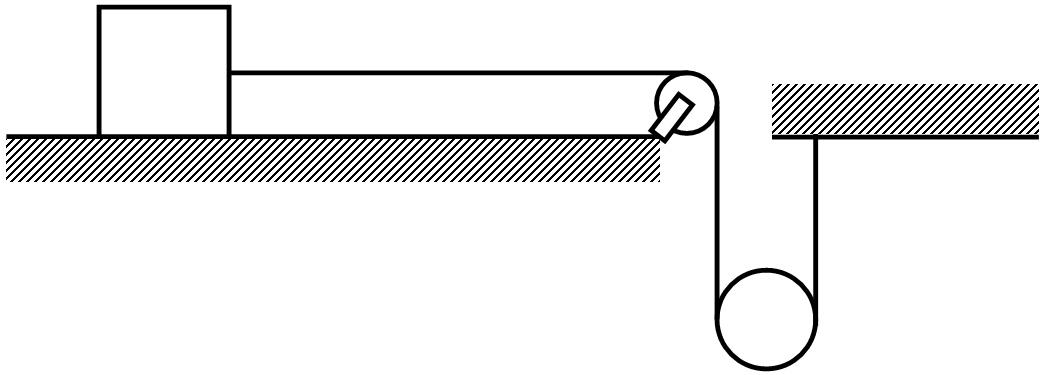
- 10The descending pulley shown in figure has a radius $20cm$ and moment of inertia $0.20kg-m^2$. The fixed pulley is light and the horizontal plane frictionless. Find the acceleration of the block if its mass is $1.0kg$.View Solution