MCQ
A given system undergoes a change in which the work done by the system equals the decrease in its internal energy. The system must have undergone an
  • A
    Isothermal change
  • Adiabatic change
  • C
    Isobaric change
  • D
    Isochoric change

Answer

Correct option: B.
Adiabatic change
b
(b)In adiabatic change $Q =$ constant ==> $\Delta Q = 0$
So $\Delta W = -  \Delta U \, ( \, \Delta Q = \Delta U + \Delta W)$

Need a full question paper?

Generate a complete, print-ready paper with questions like this in minutes — across 16+ boards, with answer keys.
Start Generating Free

Similar questions

The thermal radiation emitted by a body is proportional to $\text{T}^n$ where $T$ is its absolute temperature. The value of $n$ is exactly $4$ for:
A transverse wave travels along $x$-axis. The particles of medium move
If a ladder weighing $250\,N$ is placed against a smooth vertical wall having coefficient of friction between it and floor is $0.3$, then what is the maximum force of friction available at the point of contact between the ladder and the floor ........ $N$
When stopping potential is applied in an experiment on photoelectric effect, no photocurrent is observed. This means that:
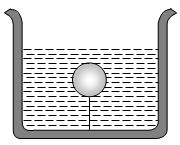
A solid sphere of density $\eta$ $( > 1)$  times lighter than water is suspended in a water tank by a string tied to its base as shown in fig. If the mass of the sphere is m then the tension in the string is given by
The phase difference between two waves, represented by ${y_1} = {10^{ - 6}}\sin \left\{ {100t + \left( {x/50} \right) + 0.5} \right\}\ m$ , ${y_2} = {10^{ - 6}}\cos \left\{ {100t + \left( {\frac{x}{{50}}} \right)} \right\}\ m$ where $x$ is expressed in metres and $t$ is expressed in seconds, is approximately .... $radians$
A gas ($\gamma = 1.3)$ is enclosed in an insulated vessel fitted with insulating piston at a pressure of ${10^5}\,N/{m^2}$. On suddenly pressing the piston the volume is reduced to half the initial volume. The final pressure of the gas is
$Assertion :$ In pressure-temperature $(P-T)$ phase diagram of water, the slope of the melting curve is found to be negative.
$Reason :$ Ice contracts on melting to water.
A $120\, g$ mass has a velocity $\vec v = 2\hat i + 5\hat j\,m{s^{ - 1}}$ at a certain instant. Its kinetic energy is .................. $\mathrm{J}$
A fluid is flowing through a horizontal pipe of varying cross-section, with speed $v\;ms^{-1}$ at a point where the pressure is $P$ Pascal. At another point where pressure is $\frac{ P }{2}$ Pascal its speed is $V\;ms^{-1}$. If the density of the fluid is $\rho\, kg\, m ^{-3}$ and the flow is streamline, then $V$ is equal to