Question
A glass flask of volume $250 \mathrm{~cm}^3$ is just filled with mercury at $20^{\circ} \mathrm{C}$. How much mercury overflows when the temperature of the system is raised to $100^{\circ} \mathrm{C}$ ? The coefficient of volume expansion of glass is $12 \times 10^{-6}\left({ }^{\circ} \mathrm{C}\right)^{-1}$ and that of mercury is $18 \times 10^{-5}\left({ }^{\circ} \mathrm{C}\right)^{-1}$.
Answer

The increase in the volume of the flask is, $(\Delta\text{V})_\text{f}=\text{V}\gamma\ \Delta\text{t}=250\times12\times10^{-6}\times80$ $=0.24\text{cm}^3$ The increase in the volume of mercury is, $(\Delta\text{V})_\text{m}=250\times18\times10^{-5}\times80$ $3.6\text{cm}^{3}$ Therefore, the volume of mercury overflowing is, $3.6 - 0.24 = 3.36cm^3$

Need a full question paper?

Generate a complete, print-ready paper with questions like this in minutes — across 16+ boards, with answer keys.

Start Generating Free

Similar questions

The distance of a galaxy is of the order of $10^{25}m$. Calculate the order of magnitude of time taken by light to reach us from the galaxy.
Show that for a particle performing linear simple harmonic motion, the average kinetic energy of any period of oscillation is equal to the average potential energy of the same period.
State few important uses of the phenomenon of beats.
What is the principle behind the launch of rockets?
Two cylinders A and B of equal capacity are connected to each other via a stopcock. A contains a gas at standard temperature and pressure. B is completely evacuated. The entire system is thermally insulated. The stopcock is suddenly opened. Answer the following: Do the intermediate states of the system (before settling to the final equilibrium state) lie on its P-V-T surface?
What is the temperature which has the same numerical value in kelvin scale and Fahrenheit scale?
If force F, length L and time T are taken as fundamental units then what be the dimensions of mass?
Two samples of gas initially at the same temperature and pressure are compressed from volume V to $\frac{\text{V}}{2}.$ One sample is compressed isothermally and the other adiabatically. In which case will the pressure be higher? Explain.
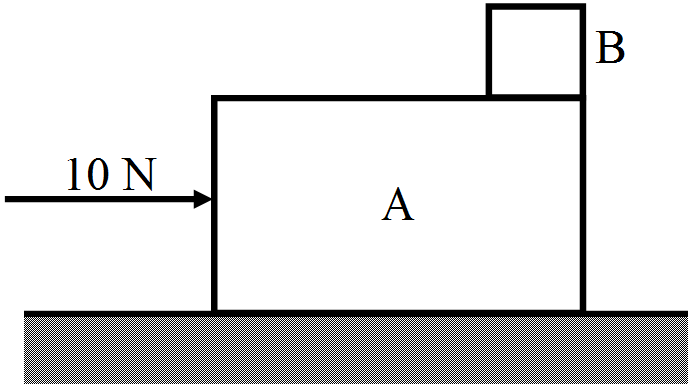
A small block B is placed on another block A of mass 5kg and length 20cm. Initially the block B is near the right end of block A. A constant horizontal force of 10N is applied to the block A. All the surfaces are assumed frictionless. Find the time elapsed before the block B separates from A.
Define gravitational potential energy. Give its SI unit.