A heater coil connected to a supply of a $220\, V$ is dissipating some power ${P_1}.$ The coil is cut into half and the two halves are connected in parallel. The heater now dissipates a power ${P_2}.$ The ratio of power ${P_1}\,\,:\,\,{P_2}$ is
Medium


Download our appand get started for free
Experience the future of education. Simply download our apps or reach out to us for more information. Let's shape the future of learning together!No signup needed.*
Similar Questions
- 1The electric current through a wire varies with time as $I=I_0+\beta t$. where $I_0=20 \mathrm{~A}$ and $\beta=3 \mathrm{~A} / \mathrm{s}$. The amount of electric charge crossed through a section of the wire in $20 \mathrm{~s}$ is :View Solution
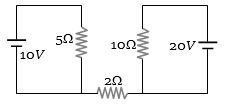
- 2Find out the value of current through $2\,\Omega$ resistance for the given circuit ............ $A$View Solution
- 3An electric kettle has two heating coils. When one coil is used, water in the kettle boils in $5$ minutes, while when second coil is used, same water boils in $10\,\min$. If the two coils, connected in parallel are used simultaneously, the same water will boil in timeView Solution
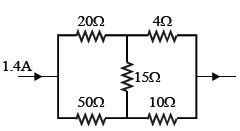
- 4In the given figure the current through $4\,\Omega$ resistor is .................. $\mathrm{A}$View Solution
- 5View SolutionThe specific resistance of all metals is most affected by
- 6A potentiometer is an accurate and versatile device to make electrical measurements of $EMF$ because the method involvesView Solution
- 7View SolutionThe example for non-ohmic resistance is
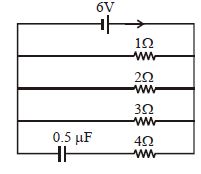
- 8View SolutionIn the given circuit diagram the current through the battery and the charge on the capacitor respectively in steady state are
- 9A galvanometer together with an unknown resistance in series is connected to two identical batteries each of $1.5\, V$. When the batteries are connected in series, the galvanometer records a current of $1\,A$, and when batteries are in parallel the current is $0.6\,A$. What is the internal resistance of the battery ?View Solution
- 10Two resistances equal at $0\,^oC$ with temperature coefficient of resistance $\alpha _1$ and $\alpha _2$ joined in series act as a single resistance in a circuit. The temperature coefficient of their single resistance will beView Solution