Question
A heating element using nichrome connected to a 230 V supply draws an initial current of 3.2 A which settles after a few seconds to a steady value of 2.8 A. What is the steady temperature of the heating element if the room temperature is 27.0°C? Temperature coefficient of resistance of nichrome averaged over the temperature range involved is $1.70\times10^{-4}{^\circ\text{C}}^{-1}.$
Answer

Here,
Potential applied across the heating element, V = 230 V
Initial current, l1 = 3.2 A
After few seconds, steady current attained is, l2 = 2.8 A
Using ohm's law,
$\text{R}_1=\frac{230}{3.2}=71.87\ \Omega$
and,
$\text{R}_2=\frac{230}{2.8}=82.14\ \Omega$
$\alpha=1.7\times10^{-4}{^\circ\text{C}^{-1}}$
$\text{t}_1=27^\circ\text{C}$
Using the relation,
$\text{R}_2=\text{R}_1[1+\alpha(\text{t}_2-\text{t}_1)]$
$\text{Therefore,}\ \ \text{t}_2=\frac{\text{R}_2-\text{R}_1}{\text{R}_1.\alpha}+\text{t}_1$
$\Rightarrow\ \ \text{t}_2=\frac{82.14-71.87}{71.87\times1.7\times10^{-4}}+27$
$=840.56+27$
$=867.56^\circ\text{C}$
$=867^\circ\text{C}$

Need a full question paper?

Generate a complete, print-ready paper with questions like this in minutes — across 16+ boards, with answer keys.

Start Generating Free

Similar questions

State Gauss's theorem in electrostatics. Apply this theorem to derive an expression for electric field intensity at a point near an infinitely long straight charged wire.
Consider a head-on collision between two particles of masses m1 and m2. The initial speeds of the particles are u1 and u2 in the same direction. The collision starts 2 at t = 0 and the particles interact for a time interval $\triangle\text{t}.$ During the collision, the speed of the first particle varies as.

$\text{v}(\text{t})=\text{u}_1+\frac{\text{t}}{\triangle\text{t}}(\text{v}_1-\text{u}_1).$

Find the speed of the second particle as a function of time during the collision.

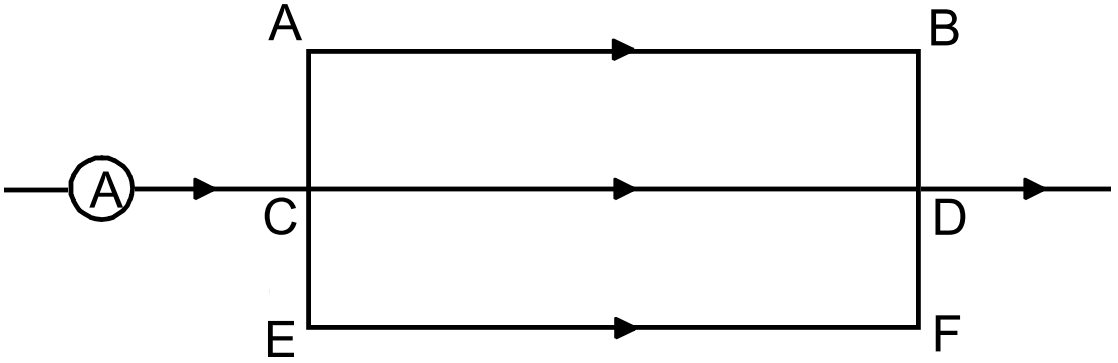
Figure shows a part of an electric circuit. The wires AB, CD and EF are long and have identical resistances. The separation between the neighbouring wires is 1.0cm. The wires AE and BF have negligible resistance and the ammeter reads 30A. Calculate the magnetic force per unit length of AB and CD.

The work function for the certain metal is 4.2 eV. Will this metal give photoelectric emission for incident radiation of wavelength 330 nm?
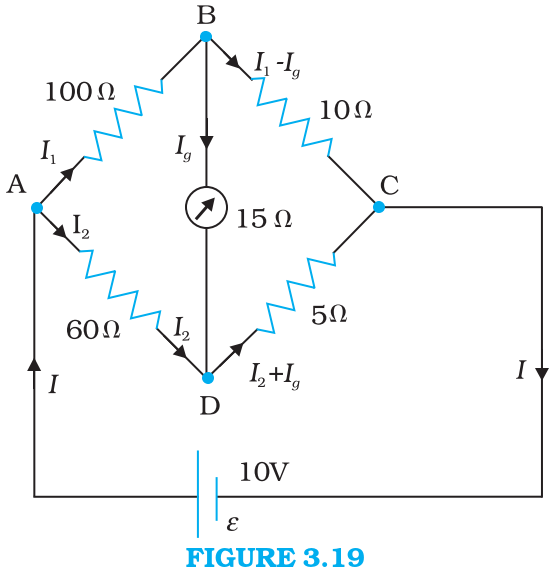
The four arms of a Wheatstone bridge (Fig. 3.19) have the following resistances:
$
AB =100 \Omega, BC =10 \Omega, CD =5 \Omega \text {, and } DA =60 \Omega \text {. }
$
Image
A galvanometer of $15 \Omega$ resistance is connected across BD. Calculate the current through the galvanometer when a potential difference of $10 V$ is maintained across AC.
Two parallel wires carry equal currents of 10A along the same direction and are separated by a distance of 2.0cm. Find the magnetic field at a point which is 2.0cm away from each of these wires
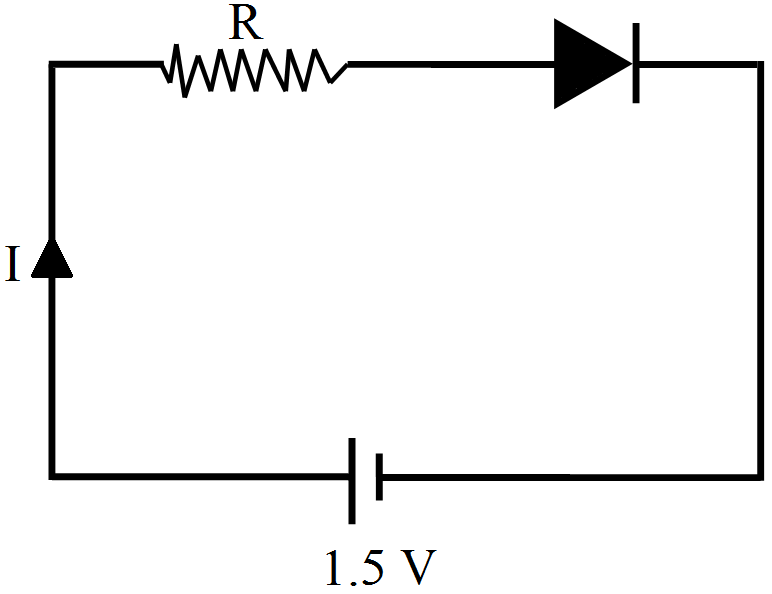
A p-n junction germanium diode when forward biased has a drop of 0.3V which is assumed to be independent of current. The current in excess of 10mA through the diode produces a large Joule-heating which damages (burns) the diode. If we want to use a 1.5V battery to forward-bias the diode, what should be the value of resistor used in series with the diode, so that the maximum current does not exceed 6mA?

Suppose we have 12 protons and 12 neutrons. We can assemble them to form either a :uMg nucleus or two 12C nuclei. In which of the two cases more energy will be liberated?
The potential difference across a resistor ‘r’ carrying current ‘I’ is Ir.
  1. Now if the potential difference across ‘r’ is measured using a voltmeter of resistance ‘RV’, show that the reading of voltmeter is less than the true value
  2. Find the percentage error in measuring the potential difference by a voltmeter.
  3. At what value of RV, does the voltmeter measures the true potential difference?
  1.  

  1.