MCQ
A heavy stone is thrown from a cliff of height $h$ with a speed $\nu.$ The stone will hit the ground with maximum speed if it is thrown:
  • A
    Vertically downward.
  • B
    Vertically upward.
  • C
    Horizontally.
  • The speed does not depend on the initial direction.
Answer

Correct option: D.
The speed does not depend on the initial direction.
As the stone falls under the gravitational force, which is a conservative force, the total energy of the stone remains the same at every point during its motion.
From the conservation of energy, we have:
Initial energy of the stone $=$ final energy of the stone
i.e., $(\text { K.E. })_i+(\text { P.E. })_{\mathrm{i}}=(\text { K.E. })_{\mathrm{f}}+(\text { P.E. })_{\mathrm{f}}$
$=\frac{1}{2}\text{mv}^2+\text{mgh}=\frac{1}{2}\text{m}(\text{v}_\text{max})^2$
$\Rightarrow\text{v}_\text{max}=\sqrt{\text{v}^2+2\text{gh}}$
From the above expression, we can say that the maximum speed With which stone hits the ground does not depend on the initial direction.

Need a full question paper?

Generate a complete, print-ready paper with questions like this in minutes — across 16+ boards, with answer keys.

Start Generating Free

Similar questions

A body weighs $72 N$ on surface of the earth. When it is taken to a height of $h=2 R$, where $R$ is radius of earth, it would weigh ........ $N$
A particle of mass $m$ starts moving from origin along $x$-axis and its velocity varies with position $(x)$ as $v=k \sqrt{x}$. The work done by force acting on it during first " $t$ " seconds is ...........
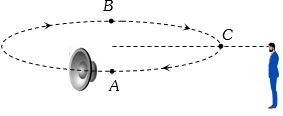
A small source of sound moves on a circle as shown in the figure and an observer is standing on $O$. Let ${n_1},\;{n_2}$ and ${n_3}$be the frequencies heard when the source is at $A,\,B$ and $C$ respectively. Then
A torque of $0.5Nm$ is required to drive a screw into a wooden frame with the help of a screw driver. If one of the two forces of couple produced by screw driver is $50N,$ the width of the screw driver is:
$'Torr'$ is the unit of
In an isobaric expansion of an ideal gas, which of the following is zero?
The internal energy of an ideal gas depends on:
Match List $I$ with List $II$

List $I$ List $II$
$A$ Torque  $I$ ${\left[\mathrm{M}^1 \mathrm{~L}^1 \mathrm{~T}^{-2} \mathrm{~A}^{-2}\right]}$
$B$ Magnetic fileld  $II$ $\left[\mathrm{L}^2 \mathrm{~A}^1\right]$
$C$ Magneti moment $III$ ${\left[\mathrm{M}^1 \mathrm{~T}^{-2} \mathrm{~A}^{-1}\right]}$
$D$ permeability of free  space $IV$ $\left[\mathrm{M}^1 \mathrm{~L}^2 \mathrm{~T}^{-2}\right]$

Choose the correct answer from the options given below :

$y = 2\, (cm)\, sin\,\left[ {\frac{{\pi t}}{2} + \phi } \right]$ what is the maximum acceleration of the particle doing the $S.H.M.$
A body travels $200\ cm$ in the first two seconds and $220\ cm$ in the next $4$ seconds with same acceleration. The velocity of the body at the end of the $7^{th}$ second is: