MCQ
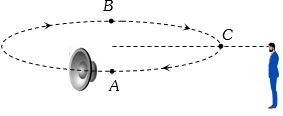
A small source of sound moves on a circle as shown in the figure and an observer is standing on $O$. Let ${n_1},\;{n_2}$ and ${n_3}$be the frequencies heard when the source is at $A,\,B$ and $C$ respectively. Then
  • A
    ${n_1} > {n_2} > {n_3}$
  • ${n_2} > {n_3} > {n_1}$
  • C
    ${n_1} = {n_2} > {n_3}$
  • D
    ${n_2} > {n_1} > {n_3}$

Answer

Correct option: B.
${n_2} > {n_3} > {n_1}$
b
(b) At point $A$, source is moving away from observer so apparent frequency ${n_1} < n$ (actual frequency) 

At point $B$ source is coming towards observer so apparent frequency ${n_2} > n$

and point $C$ source is moving perpendicular to observer so ${n_3} = n$ 

Hence ${n_2} > {n_3} > {n_1}$

Need a full question paper?

Generate a complete, print-ready paper with questions like this in minutes — across 16+ boards, with answer keys.

Start Generating Free

Similar questions

A rocket with a lift- off mass $3.5 \times {10^4}$$kg$ is blasted upwards with an initial acceleration of $10m/{s^2}.$ Then the initial thrust of the blast is
At time $t=0$, a disk of radius $1 m$ starts to roll without slipping on a horizontal plane with an angular acceleration of $\alpha=\frac{2}{3} rad s ^{-2}$. A small stone is stuck to the disk. At $t=0$, it is at the contact point of the disk and the plane. Later, at time $t=\sqrt{\pi} s$, the stone detaches itself and flies off tangentially from the disk. The maximum height (in $m$ ) reached by the stone measured from the plane is $\frac{1}{2}+\frac{x}{10}$. The value of $x$ is. . . . . . .[Take $g=10 m s ^{-2}$.]
The horizontal range is four times the maximum height attained by a projectile. The angle of projection is ......... $^o$
For a ball falling in a liquid with constant velocity, ratio of resistance force due to the liquid to that due to gravity is:
A body is released from a height equal to the radius ( $R$ ) of the earth. The velocity of the body when it strikes the surface of the earth will be :

(Given $g$ = acceleration due to gravity on the earth.)

A mass of $10 \,kg$ is suspended vertically by a rope of length $5 \,m$ from the roof. A force of $30 \,N$ is applied at the middle point of rope in horizontal direction. The angle made by upper half of the rope with vertical is $\theta=\tan ^{-1}\left(x \times 10^{-1}\right)$. The value of $x$ is ................

$\text { (Given } g =10 \,m / s ^{2} \text { ) }$

A particle executing simple harmonic motion of amplitude $5\, cm$ has maximum speed of $31.4\, cm/s$. The frequency of its oscillation is ..... $Hz$
A ball of mass $0.2\ kg$ is thrown vertically upwards by applying a force by hand. If the hand moves $0.2\ m$ while applying the force and the ball goes upto $2\ m$ height further, find the  magnitude of the force .......... $N$ .(consider $g = 10\; m/s^2$)
The masses and radii of the earth and the moon are $M_1$, $R_1$ and $M_2$,$R_2$ respectively. Their centres are distance $d$ apart. The minimum speed with which particle of mass m should be projected from a point midway between the two centres so as to escape to infinity is :
Water flows through a frictionless duct with a cross-section varying as shown in figure. Pressure $p$ at points along the axis is represented by