Question
A hole is:

Answer

  1. An unfilled covalent bond.
Explanation:
When the covalent bond breaks, electrons are freed from atom. The departure of electron from valence band creates vacancy in bond, this vacancy is known as hole. Hence, a hole is an unfilled covalent bond.

Need a full question paper?

Generate a complete, print-ready paper with questions like this in minutes — across 16+ boards, with answer keys.
Start Generating Free

Similar questions

A charged particle moves along a circle under the action of possible constant electric and magnetic fields. Which of the following are possible?
  1. $\text{E}=0,\ \text{B}=0$
  2. $\text{E}=0,\ \text{B}\not=0$
  3. $\text{E}\not=0,\ \text{B}=0$
  4. $\text{E}\not=0,\ \text{B}\not=0$
Angle of dip is $90^\circ$ at
The current is flowing in south direction along a power line. The direction of magnetic field above the power line (neglecting earth's field) is(a) South(b) East(c) North(d) West
       
When potential difference is applied across an electrolyte, then Ohm's law is obeyed at:
If the decay or disintegration constant of a radioactive substance is $\lambda ,$ then its half life and mean life are respectively
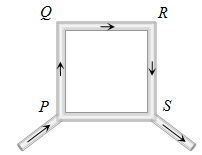
$\text{PQRS}$ is a square loop made of uniform conducting wire the current enters the loop at $P$ and leaves at $S.$  Then the magnetic field will be
In the following reaction  $12^{\mathrm{Mg}^{24}}+2^{\mathrm{He}^4} \rightarrow 14^{\mathrm{Si}^{\mathrm{X}}}+0^{\mathrm{n}^1}, \mathrm{X}$ is
At neutral temperature, the thermoelectric power $\left(\frac{\mathrm{dE}}{\mathrm{dT}}\right)$ rias the value
Assertion  : Radio waves can be polarised.
Reason     : Sound waves in air are longitudinal in nature. (a) If both assertion and reason are true and the reason is the correct explanation of the assertion.(b) If both assertion and reason are true but reason is not the correct explanation of the assertion.(c) If assertion is true but reason is false.(d) If the assertion and reason both are false.


Glass has refractive index $m$ with respect to air and the critical angle for a ray of light going from glass to air is $q.$ If a ray of light is incident from air on the glass with angle of incidence $q,$ the corresponding angle of refraction is